Area Rug Guide: Sizes, Materials and Washable Options
What size area rug fits a living room, dining table, queen or king bed and hallway, where it sits, and which fibers, washable rugs and pads suit pets and kids.
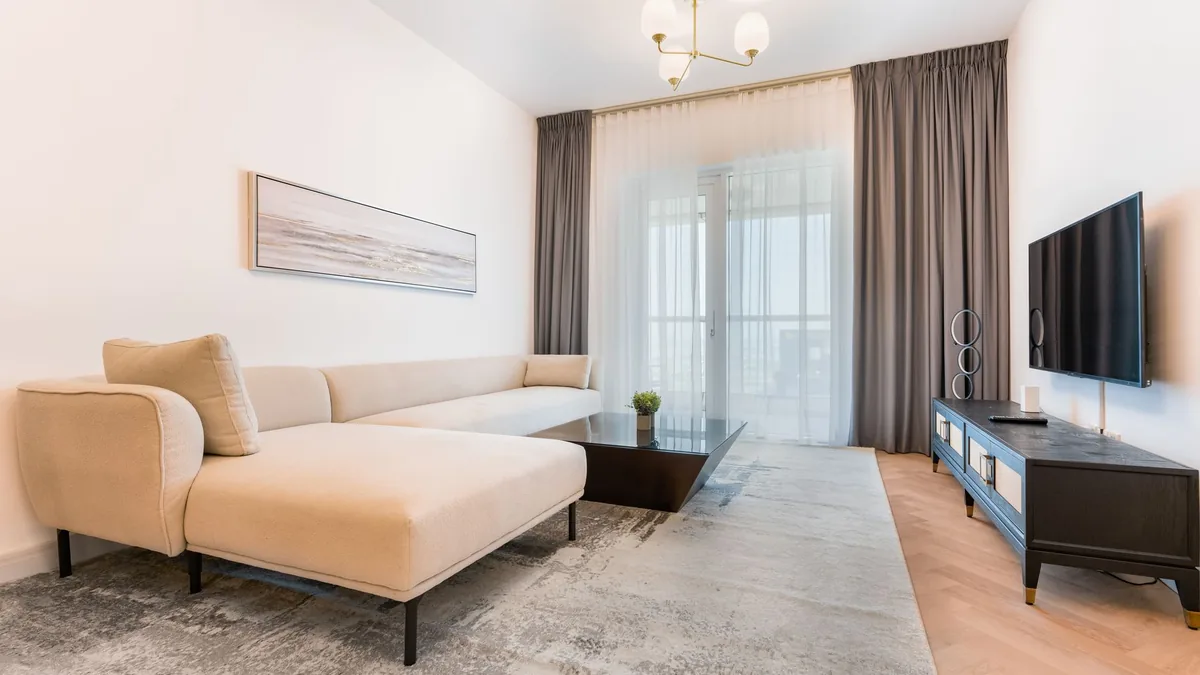
The rug arrives and the sofa sits in front of it instead of on it, or the dining chairs catch its edge whenever someone stands up. One easy slip is buying the size that sounds big enough: a 5’ x 8’ sounds generous, yet one rug maker’s dining guide calls it “often too small” for most dining tables. Below is how to size and place area rugs room by room, which fibers cope with kids, pets and spills, when a washable rug is worth it, and what goes underneath.
The short answer
- Living room: 8’ x 10’ with the front legs of the sofa and chairs on it; 9’ x 12’ (retailer) or 10’ x 14’ (maker) to put everything on; 5’ x 8’ to 6’ x 9’ in a small room.
- Bed: 8’ x 10’ for a queen, 9’ x 12’ for a king, laid crosswise.
- Dining table: the table plus at least 24 inches on every side, so pulled-out chairs stay on the rug.
- Hallway: at least 3 inches of floor each side, and a runner at least a foot shorter than the hall.
- Kids, pets, spills: low pile or flatweave, synthetic or washable; keep jute and sisal dry.
How do you measure for a rug?
Place the furniture first, then measure the area you want covered, or the whole room for a room-size rug; on a wood floor, leave at least 18 to 24 inches bare around it, per one maker’s room-by-room post. A rug retailer’s size guide asks for at least 8 inches between a king-bed rug and the walls. Before ordering, mark the outline on the floor with tape or string and check where the legs land.
How big should a living room rug be?
Size it by where the sofa and chair legs land. The retailer’s guide gives three layouts; the maker’s sizes fit them like this:
- All legs on: 9’ x 12’ or larger. A 9’ x 12’ lets all the furniture sit on the rug in a larger room, per the retailer’s guide. The maker’s living room guide puts only the sofa fully on a 9’ x 12’, with armchair back legs off; it puts everything on at 10’ x 14’.
- Front legs on: 8’ x 10’. In a mid-size room the front legs go on and the back legs stay off, with about 6 inches of rug under the sofa and about 75% of the space under each chair, in the retailer’s guide.
- Furniture around the rug: 5’ x 8’ or 6’ x 9’. In a small room the furniture can surround a 5’ x 8’ (retailer) or keep its back legs off a 6’ x 9’ (maker), though the maker notes a 6’ x 9’ can feel small with a sofa and two chairs.
The half-on look is a matter of taste: the maker’s 2011 room-by-room post says all legs on or none, while its current living room guide allows legs partly off. Putting furniture on the rug also stops people tripping on its edges.
Still choosing the sofa? Settle it first with the furniture buying guide, since the rug size follows the seating.
How far should a dining rug extend past the table?
Far enough that a pulled-out chair stays on the rug, with all its legs on the rug and not on the edge binding. The maker’s dining guide adds about 24 to 36 inches to each side of the table, the retailer’s guide and the maker’s 2011 post ask for at least 24, and a 2016 maker post allows 18 to 24. So 24 inches is the minimum in three of the four guides read here.
A worked example (our arithmetic): a 72 x 36 inch table plus 24 inches each side needs 120 x 84 inches, so an 8’ x 10’ is the smallest standard size that works. Measure rather than going by seat count: the retailer lists a 5’ x 7’ for two to four seats, but a 5’ x 7’ leaves 24 inches all round only a table 12 inches wide (our arithmetic).
What size rug goes under a queen or king bed?
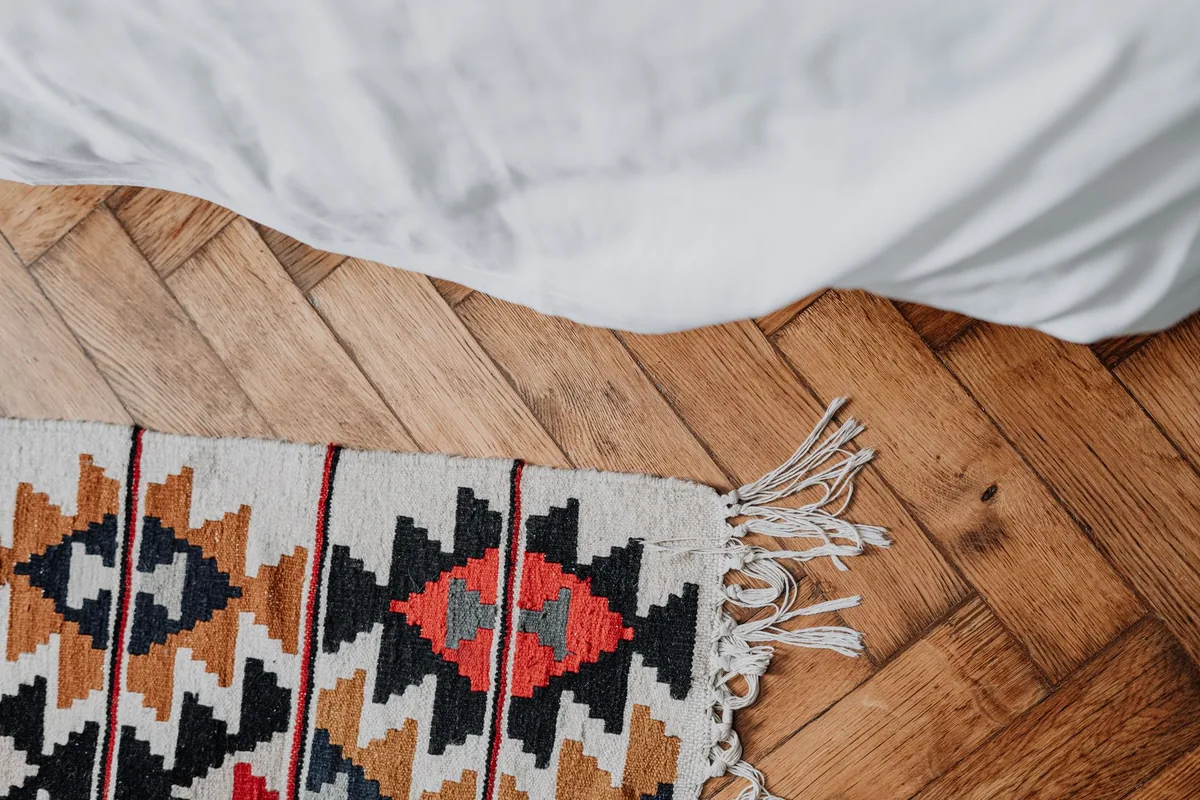
An 8’ x 10’ for a queen and a 9’ x 12’ for a king: the maker’s bedroom guide and the retailer’s guide agree on both. What you are paying for is the strip of rug you step onto beside the bed. Laid crosswise under the bed, each size leaves this much each side (our arithmetic):
| Rug, laid crosswise | Queen, 60 in wide | King, 76 in wide |
|---|---|---|
| 6’ x 9’ | 24 in | 16 in |
| 8’ x 10’ | 30 in | 22 in |
| 9’ x 12’ | 42 in | 34 in |
The maker’s own figures line up: a 6’ x 9’ is “the minimum size to have 2’ showing on either side of the bed,” and a 9’ x 12’ leaves 42 inches each side of a queen. Its exception for a king, an 8’ x 10’ with nightstands of 18 inches or less, fits the 22 inches in the table (our reading). (Its diagram labels the queen 80 inches wide by 60 long; the table takes 60 as the width.)
How much should show? At least 18 inches beyond the side or foot of a queen or king and 12 for a twin or full, in the maker’s room-by-room post. The retailer puts a twin on a 5’ x 7’; the maker puts a 5’ x 8’ beside it.
Dressing the bed as well? See the bedding guide.
What size runner fits a hallway or entry?
Leave bare floor on each side: 4 to 5 inches is a good start and 3 inches the minimum, per the maker’s runner guide, so a 42-inch hall takes a 32- or 34-inch runner. Make it at least a foot shorter than the hall so it sits centered; a long hall can take two or three shorter runners with their edges between doorways. The retailer’s guide gives 2’ x 8’ (or 2’ x 3’) for a typical hall and a 2’ x 10’ for an extra-long one. At the front door, the runner guide suggests a 4- to 10-foot runner, with a gap to the door of 4 to 8 inches in one section and about 3 inches in another, so anywhere from about 3 to 8 inches works.
Rug sizes chart
| Room and layout | Size | Placement |
|---|---|---|
| Living room, furniture around the rug | 5’ x 8’ or 6’ x 9’ | Back legs (or all legs) off |
| Living room, front legs on | 8’ x 10’ | About 6 in under the sofa |
| Living room, everything on | 9’ x 12’ (retailer) or 10’ x 14’ (maker) | All on; the maker’s 9’ x 12’ keeps armchair back legs off |
| Twin bed | 5’ x 7’ under or 5’ x 8’ beside | At least 12 in showing (under the bed) |
| Queen bed | 8’ x 10’ (6’ x 9’ minimum) | 18 in or more each side |
| King bed | 9’ x 12’ or wider | 8 in or more from the walls |
| Dining, 6 to 8 seats | 8’ x 10’ or 9’ x 12’ | Table plus 24 in each side |
| Round table, 4 or 6 seats | 6 ft or 8 ft round | Match the table’s shape |
| Hallway | 2 to 3 ft wide, 6 to 14 ft long | 3 in or more from each wall |
Which rug material survives kids, pets and spills?
The pile decides how a rug copes with claws, crumbs and small feet; the fiber decides how it copes with liquid.
Pile. High pile is soft but traps fur and holds odors; low pile is easier to vacuum. With cats, loop pile is the worst choice because claws snag the loops, and a flatweave resists snagging, per one maker’s guide to rugs for cats. Skip fringe, shaggy fibers and, per one maker’s pet guide, cotton rugs if a cat claws or a dog digs.
| Fiber | Underfoot | Spills, pets and kids | How it cleans |
|---|---|---|---|
| Wool | Soft, long lasting | Liquid beads up at first, but repeated accidents can shrink and discolor it; can shed for the first 6 to 9 months (one maker’s wool care guide says this is typical of most rugs) | Blot, spot clean, vacuum without a beater bar; no steam |
| Jute | Thick, textured, soft | Absorbent; can stain or weaken if it stays wet | Vacuum without a beater bar, spot clean; no soaking or steam |
| Sisal | Extremely durable; one maker’s Q&A for its 100% sisal Boucle rug says it “is not considered soft” | Absorbent; mildews if left wet, fades in sun; cats like to scratch it | Vacuum and blot; never steam or wet shampoo |
| Cotton flatweave | One maker’s washable cotton lines are light and soften with washing | Washable versions go in the machine; light matting over time; can be picked apart by claws | Cold gentle cycle, tumble low or dry flat |
| Polypropylene, polyester | Varies by weave | Non-absorbent, easy to clean; polypropylene can hold oily residue | Hose down (polypropylene) or machine wash |
What that means for a household:
- Daily spills, pets or toddlers: a synthetic or washable rug. One maker’s fiber guide calls polypropylene “great indoors for kitchens, sunrooms, family rooms, and for kids and pets”, and many can be hosed down.
- Bare feet in a bedroom: wool, if you can live with spot cleaning only on non-washable wool (it may shed for the first months, as most rugs do).
- Natural texture in a dry room: jute for a softer feel, sisal for heavy foot traffic. Both are more absorbent than wool, per the same pet guide, so keep them away from a sink or a wet entry (our reading).
- Entryway: seagrass or polypropylene, both named in the high-traffic guide for dirt and moisture from outside.
Are washable rugs worth it?
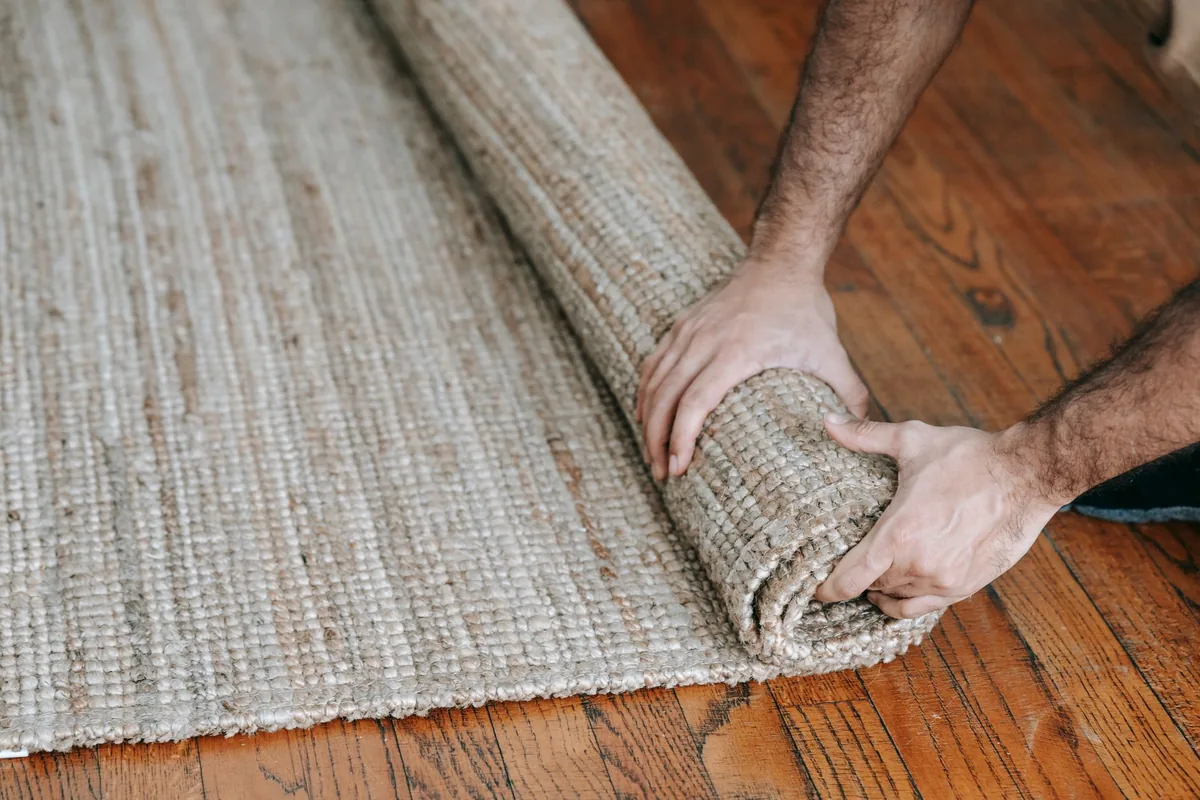
A washable rug goes in the washing machine: one maker says it developed its first washable line, cotton dhurries, to be light enough to drop in the laundry, and describes the Cardigan as pliable for washing. One example is the Revival Cardigan Washable Flatweave Rug: recycled polyester, a flatweave about 1/3 inch thick, washed with a tablespoon of clear, unscented detergent on a cold gentle cycle, then hung or tumbled dry on low. It is $629 for the 8’ x 10’ at 10 October 2026 prices (price for reference only).
The trade-offs, from its product page and care notes:
- Your washer has to take it. The page has a size-by-size Washer Guide, and the care guide says not to exceed the washer’s load capacity. The same maker’s 2022 notes on its earlier washable lines recommended a 60 lb laundromat machine for 5’ x 8’ and larger, saying most domestic machines were sized for 20 to 25 lb loads. Check the current Washer Guide for your size before you order.
- It shrinks a little: up to 5% after washing, or 6 inches on a 10-foot length (our arithmetic).
- It wears in busy spots: light shedding, fiber breakage and matting in high-traffic areas.
- It needs a pad: the rug is pliable, so the page recommends one, sold separately.
Our reading: a washable rug is worth it when spills, pets or small children are part of the room and the size fits a washer you can use.
Do you need a rug pad?
Yes: both makers whose pad advice is used here recommend one for all rugs. A pad keeps the rug from sliding, protects the floor and adds cushion, and flatweaves need one most because a low pile is more likely to slip, per one maker’s pad guide.
- Size: a little smaller than the rug, so the rug’s edges meet the floor. Advice ranges from a quarter to half an inch of space around the pad in another maker’s guide to trimming it 1 to 2 inches smaller than the rug in the first.
- Material: felt is softest, rubber grips better and sits lower, and PVC is cheapest but can discolor hardwood. A felt-and-rubber pad goes rubber side down on hard floors.
- Thickness: plush pads run about 1/5 inch, low-profile about 1/8 inch (the first maker’s two pads); the thinner suits tight door clearance and thin flatweave or low-pile rugs.
How do you keep a rug looking good?
- Vacuum weekly with suction only, since a rotating beater bar can pull fibers and increase shedding, per a wool care guide.
- Blot spills, don’t rub, working from the outside of the spill inward, as the sisal cleaning guide describes. On natural fibers, never steam clean or wet shampoo.
- Rotate the rug now and then for even wear; a two-sided rug can also be flipped between deeper cleans.
For curtains, lamps and wall art to go with the rug, browse rugs and decor.
Where these numbers come from
Sizes and placement rules come from Sisal Rugs Direct’s room guides and blog posts and Decorsify’s rug size guide; fiber, pad and care notes come from Sisal Rugs Direct, Revival, CICIL and Super Area Rugs pages. All were read on 10 October 2026. The clearances beside the bed, the dining-table example and the shrinkage figure are our arithmetic from those numbers.
Frequently asked questions
What size rug goes under a queen bed?
An 8' x 10', laid crosswise. Both size guides used here give 8' x 10' for a queen; under a 60-inch-wide queen it leaves about 30 inches each side (our arithmetic). A 6' x 9' is the maker's minimum for 2 feet each side, and a 9' x 12' leaves 42 inches.
What size rug goes under a king bed?
A 9' x 12' or larger. An 8' x 10' leaves about 22 inches each side of a 76-inch-wide king (our arithmetic), and the maker's bedroom guide accepts it only with nightstands of 18 inches or less.
What are the standard area rug sizes?
The maker's list runs 3' x 5', 4' x 6', 5' x 7', 6' x 9', 7' x 9', 8' x 10', 9' x 12', 10' x 13' and 12' x 15'; the retailer's guide also uses 5' x 8'. Runners are about 2 to 3 feet wide and 6 to 14 feet long.
Are washable rugs worth it?
Our reading: yes, if spills, pets or small children are part of the room and you have a washer, or a laundromat, that can take the size. The example rug's care notes expect shrinkage of up to 5% and some matting in busy spots, and it needs a rug pad.
- #area rugs
- #rug sizes
- #washable rugs