Bedding Guide: Sheets, Duvets and Comforters Explained
What goes on a bed from the mattress up, duvet vs comforter vs quilt, bed sizes and sheet depth, percale vs sateen vs linen, warmth and how to wash it all.

The fitted sheet pops off one corner of the mattress by morning, or the duvet slides into a heap at the foot of its cover. Buying everything labelled queen does not stop either: a queen fitted sheet is 60 by 80 inches across the top on the charts read here, but one maker lists its pocket as 16 inches deep and another prints “+ 18”, and one maker advises keeping the insert within about 2 inches of the cover. Below: the layers in the order they go on, the measurements that decide each one, what percale, sateen and thread count mean, how warm a top layer to pick, and how to wash each layer.
The short answer
- Layers, bottom to top: mattress pad or topper, fitted sheet, flat sheet (optional), then a duvet in its cover, a comforter or a quilt, then pillows.
- Size: match the fitted sheet to the mattress’s width, length and depth, topper included. A queen is 60 by 80 inches, a full 54 by 75.
- Cover and insert: keep them within 2 inches of each other each way; an insert 2 inches bigger gives a snugger fit.
- Fabric: percale is crisp and matte, sateen silkier with a slight sheen. Thread count does not tell you which.
- Warmth: pick the comforter weight for your bedroom’s temperature after heating or air conditioning, and go lighter if you sleep hot (our reading).
- Care: follow the label. The sheet care pages read here agree on low heat in the dryer.
What goes on a bed, from the mattress up?
One bedding maker’s guide to making a bed lays it out in six steps, and they double as a shopping list:
- Mattress.
- Mattress pad (optional). It adds a layer of comfort and protects the mattress from dust, spills and stains; the same guide suggests cotton over polyester for breathability. A topper goes here too, under the sheets, and it adds height (our reading): latex toppers on one mattress maker’s page come 2 or 3 inches thick.
- Fitted sheet, its elastic corners pulled over each corner of the mattress and pad.
- Flat sheet (optional), finished side facing down, with hospital corners if you like it tucked in, and the top folded over.
- The top layer: a duvet insert inside a duvet cover, a comforter, or a quilt.
- Pillows: your sleeping pillows in the cases from your sheet set, then shams, the decorative pillow covers, in standard, king or euro size.
Layers 2 to 5 are sized to the mattress; pillows have their own sizes. On one maker’s size chart, a standard pillow is 20 by 26 inches, a king 20 by 36 and a euro 26 by 26, with standard cases at 20 by 32 and king cases at 20 by 40. Sheet sets pick the case for you: Wamsutta’s full and queen sets come with two standard cases and its king sets with king cases, so king pillows on a queen bed need king cases bought on their own (our reading).
Duvet, comforter or quilt: which top layer suits you?
- Comforter: a thick, quilted blanket, typically filled with synthetic fibre that is stitched in place to keep it evenly spread. It is one piece that sits on top of your sheets and is usually sold in sets with coordinating pieces.
- Duvet: a soft flat bag filled with down, feathers, wool or a synthetic alternative, inside a removable duvet cover that closes. Duvet is to duvet cover as pillow is to pillowcase. In the US a duvet insert is sometimes called a comforter, so read the description before you order.
- Quilt: no maker’s page read for this guide defines one. The four quilts read here, all from one maker, are sold as quilt-and-sham sets with no cover, and each of the four lists “Lightweight all-season bedding” in its details (our reading of how they are sold).
Choose a duvet and cover if you want an easier bed to make, an outer layer you can strip off and wash, or a new look by swapping only the cover; the cover also protects the insert, which is harder to clean. Choose a comforter for one piece, a layered look and a coordinated set. Choose a quilt if you want one lightweight piece, sold with shams and no cover to fit, going by the four read here. For example, Great Bay Home’s Floral Boho Printed Cotton Quilt Set is cotton with a lightweight down-alternative fill, reversible, and sold as lightweight all-season bedding for layering. The Full/Queen set is a 90 by 90 inch quilt with two 20 by 30 inch shams, $89.99 at 10 October 2026 prices (price for reference only).

What size bedding fits your bed?
Bed and mattress sizes
Mattress sizes vary slightly by maker. On one mattress maker’s list, a second maker’s and a bedding maker’s mattress pad chart, the full, queen, king and California king match; the twin and twin XL are 38 inches wide on the first list and 39 on the other two.
| Mattress | Width x length (in) | Top layer size to buy (one maker’s matching guide) |
|---|---|---|
| Twin | 38 x 75 or 39 x 75 | Twin/Twin XL |
| Twin XL | 38 x 80 or 39 x 80 | Twin/Twin XL |
| Full | 54 x 75 | Full/Queen |
| Queen | 60 x 80 | Full/Queen |
| King | 76 x 80 | King/Cal King |
| California king | 72 x 84 | King/Cal King |
Queen vs full: a queen is 6 inches wider and 5 inches longer (our arithmetic). A California king trades 4 inches of width for 4 more of length against a king, 72 by 84 against 76 by 80. If the bed frame is still on your list, our furniture buying guide is the place to start.
Fitted sheets: match the depth, not only the size
Of the sheets and top layers, the fitted sheet has almost no room for error: a slightly large one can work if you tuck it in tightly, but one that is too small will not go on at all.
So measure the mattress from bottom seam to top, add the topper, and compare the total with the sheet’s “fits up to” figure where it prints one, not the pocket figure. On the Wamsutta sheets below the two differ: the queen fitted sheet is listed as 60 x 80 + 18 inches, which we read as the pocket, and fits mattresses up to 20 inches (our reading). The fitted sheets on one bedding maker’s size chart are cut 16 inches deep. A 12 inch mattress under a 3 inch topper comes to 15 inches (our arithmetic), inside both.
Comforters and duvets: how much overhang
Top layers have more slack, and the limit is the floor. Measure from the top of the bed to the floor, double it and add the mattress width: that is the widest top layer before it drapes on the floor. A queen whose top sits 25 inches off the floor can take up to 110 inches (our arithmetic: 25 x 2 + 60).
| Size sold | Duvet cover and comforter fill, one maker (in) | Cotton quilt, another maker (in) | Overhang per side of the comforter (our arithmetic) |
|---|---|---|---|
| Twin/Twin XL | 70 x 88 | 66 x 90 | 15.5 in on a 39 in twin |
| Full/Queen | 90 x 94 | 90 x 90 | 15 in on a queen, 18 on a full |
| King/Cal King | 108 x 94 | 108 x 90 | 16 in on a king, 18 on a California king |
The cover maker’s own sizing guide lists each cover 2 inches smaller each way than its size chart (88 by 92 for Full/Queen), so check the measurement on the product page itself.
When you buy a cover and an insert separately, keep the insert within 2 inches of the cover each way, or 2 inches bigger in both directions for a snugger fit. Allow for shrinkage too: a duvet cover can shrink 3 to 5% in the wash, which is up to 4.5 inches off a 90 inch cover (our arithmetic). Corner ties inside the cover stop the insert sliding to the bottom.
Percale, sateen or linen: which fabric suits how you sleep?
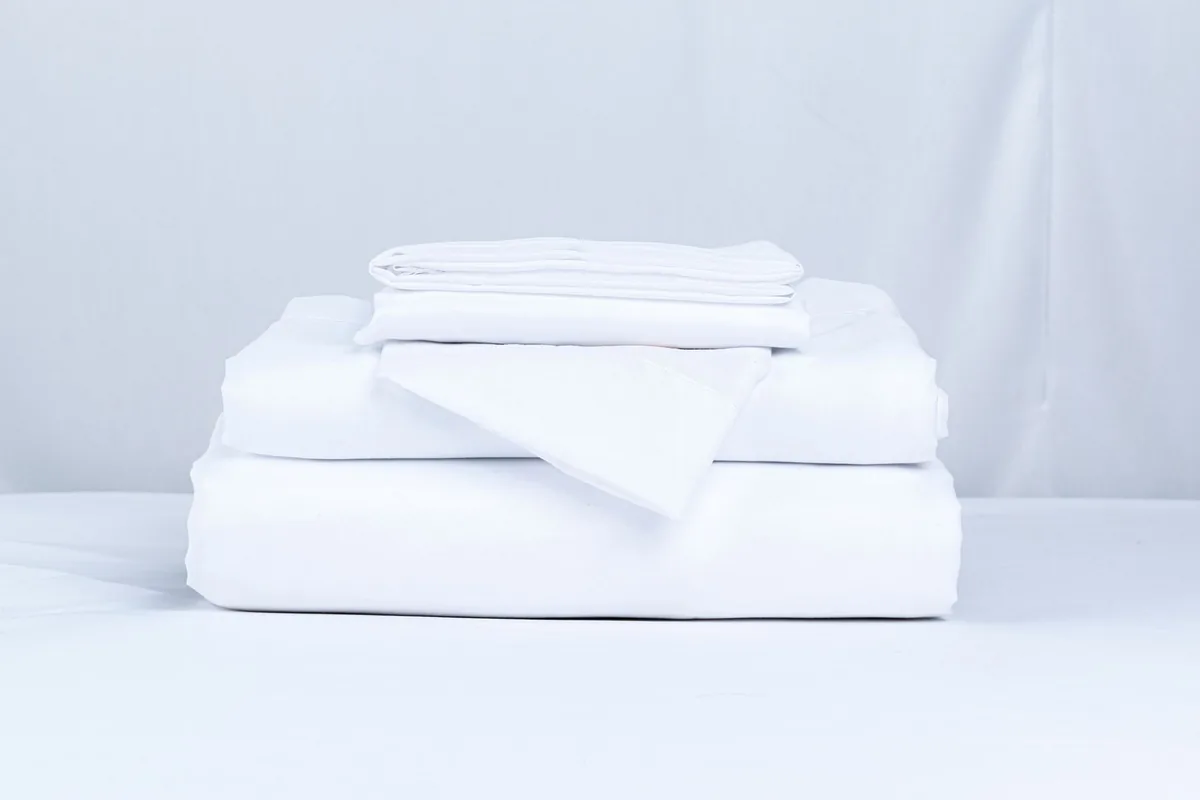
Percale vs sateen is a weave, not a fibre. Percale is woven one thread over one thread, which makes it tightly woven, crisp like a dress shirt and matte, and it softens with washing. Sateen is woven four threads over one, which gives it a silky feel, a light sheen and a lovely drape, and it resists wrinkles better.
The cleanest way to see the difference is one maker selling the same sheet both ways. Wamsutta’s Original Percale Sheet Set and Essentials Cotton Sheet Set are both 100% cotton, 400 thread count, with fitted pockets for mattresses up to 20 inches, and each is $200 for a queen at 10 October 2026 prices (price for reference only). The percale is the crisp, matte one; the Essentials is the sateen, which the brand describes as slightly silkier than percale with a subtle sheen. With price, fibre and thread count equal, the choice comes down to feel and how warm you sleep.
For hot sleepers. Wamsutta’s FAQ points hot sleepers to percale, calling it “the perfect solution for warm weather and hot sleepers”; the weave guide linked above ties its breathability to the warmer months. On sateen they split: Wamsutta pitches its sateen for cool sleepers and cold climates, the other maker for comfort year-round. Treat these makers’ descriptions as a starting point, not a measurement.
Cotton vs linen. Linen comes from flax. On one maker’s linen guide, it is heavier than cotton and about 30% stronger, starts crisp and softens with use, and absorbs up to 20% of its weight in moisture against cotton’s 25%. Linen also wicks moisture away, which cotton does not, and cotton can take longer to dry; that is why the same guide steers people who sleep warm toward linen. Cotton’s finer fibres can be woven to higher thread counts, and cotton layers well through the seasons.
What thread count does and doesn’t tell you. Thread count is the number of threads in a square inch, the vertical and horizontal threads added together. It does not name the weave: the percale and sateen sets above are both 400. It is also easy to inflate. One maker’s thread count guide puts 400 as the most that can realistically be woven into a square inch and says counts above that are usually multi-ply yarns multiplied out; its bed-making guide draws that line at 430 instead and puts sheets that last at 300 to 430. The two pages don’t agree, but on both a count in the high hundreds is no guarantee of a finer sheet. Linen is woven at lower counts because its fibres are thicker. Read the fibre and the weave first, and the count last (our reading).
How warm should the top layer be?
Start from the room, not the season. One maker’s comforter buying guide matches its comforter weights to the bedroom temperature after heating and air conditioning:
| Bedroom (°F) | Down alternative | Cotton filled | Goose down |
|---|---|---|---|
| 55–59 | – | – | Extra |
| 60–64 | All Year | – | All Year or Extra |
| 65–69 | All Year or Light Weight | All Year | All Year |
| 70–74 | Light Weight or Super Lightweight | All Year or Light Weight | All Year or Light Weight |
| 75+ | Super Lightweight | Light Weight | Light Weight |
The weight names are that maker’s own, so use the table for direction, not to compare brands. On the same guide, down alternative and goose down both cover a wide warmth range, and cotton fill is pitched at warm sleepers. On down, fill power measures loft: the higher it is, the better the down insulates, and that maker suggests 600 or more for winter. Down alternative suits people allergic to down or on a tighter budget and is easier to wash, though on that maker’s page synthetic fills do not regulate temperatures as well as 100% down. A box-stitched grid is that maker’s tip against clumping.
If you sleep hot, put the pieces together: percale or linen sheets, a lighter fill or a quilt, and a blanket you can add or take off rather than one heavy layer (our reading).
How do you wash sheets and a comforter?
The label wins; below is where the makers’ care pages read here agree and differ.
Sheets and duvet covers. Wash one complete bedding set per load so it cleans evenly, zips closed. The pages agree on low heat in the dryer and differ on water:
| Care source | Water | Bleach | Drying |
|---|---|---|---|
| Crane & Canopy care guide (cotton and linen) | Cold, gentle cycle, mild detergent; warm if heavily soiled | No chlorine bleach; a colour-safe alternative if any | Air dry where possible, otherwise low heat |
| Egyptian Linens care chart, percale | Cold, separately, gentle cycle, mild detergent | Not on that row | Tumble dry low, out at 90% dry |
| Great Bay Home, sheet sets | Gentle cycle, never hot | No bleach | Tumble dry low, out right away |
| Wamsutta percale and sateen sets | Machine wash normal, and before first use | No bleach | Tumble dry low, out promptly |
Comforters, inserts and quilts.
- One at a time: wash one duvet insert per load, so it cleans evenly.
- Down alternative: machine wash cold, tumble dry low on one store’s care chart.
- Goose and duck down: dry clean or spot clean only on the same chart. Check your own label first.
- Quilts: on one quilt maker’s care page, its quilt sets go in a warm wash and tumble dry low, with the washer no higher than the gentle cycle and no fabric softener; a dryer ball or tennis ball in the dryer is fine.
That is the practical case for a duvet (our reading): the cover comes off and goes in with the sheets.
More on each layer is in our bedding section.
Where these numbers come from
Sizes, weaves, fill guidance, care instructions and prices come from the mattress and bedding makers’ own size charts, fabric and care guides and product pages, linked above and read on 10 October 2026. Prices are without discount codes. Overhangs, size differences and shrinkage figures are our arithmetic.
Frequently asked questions
What are the dimensions of a queen bed, and how does it compare with a full?
A queen mattress is 60 by 80 inches and a full is 54 by 75 on every mattress size list read for this guide, so a queen is 6 inches wider and 5 inches longer (our arithmetic). Fitted sheets come in separate full and queen sizes, while the duvet covers, comforters and quilts read here are sold as one Full/Queen size.
What is the difference between a duvet and a comforter?
A comforter is one quilted piece that sits on top of the sheets. A duvet is a soft flat bag of down, feathers, wool or synthetic fill that lives inside a removable duvet cover, the way a pillow lives in a pillowcase. In the US a duvet insert is sometimes called a comforter.
Is percale or sateen better?
Neither; they feel different. Percale is woven one thread over, one under, for a crisp, matte sheet; sateen is woven four over, one under, for a silkier feel and a slight sheen. One sheet maker pitches percale for hot sleepers and another for warm months; on sateen they differ, one pitching it for cool sleepers and another for year-round use.
How do you wash a comforter?
Follow its care label. Down-alternative comforters on one bedding store's care chart are machine wash cold and tumble dry low, while its goose and duck down comforters are dry clean or spot clean only. One bedding maker advises washing one duvet insert per load so it cleans evenly, and on one quilt maker's care page its quilt sets go in a warm wash on no more than the gentle cycle, without fabric softener.
Does a higher thread count mean better sheets?
Not on its own. Thread count is the threads per square inch, warp and weft added together, and it does not tell you the weave. One sheet maker's thread count guide puts 400 as the most that can realistically be woven into a square inch and says counts above that are usually multi-ply yarns multiplied out; its bed-making guide draws that line at 430 instead and puts sheets that last at 300 to 430.
- #bed sizes
- #sheets
- #duvets
- #comforters