Patio Furniture Guide: Materials, Sizes and Upkeep
How to choose patio furniture for your weather (HDPE, aluminum, wicker or teak), measure a patio or balcony for it, and clean and store it through the year.
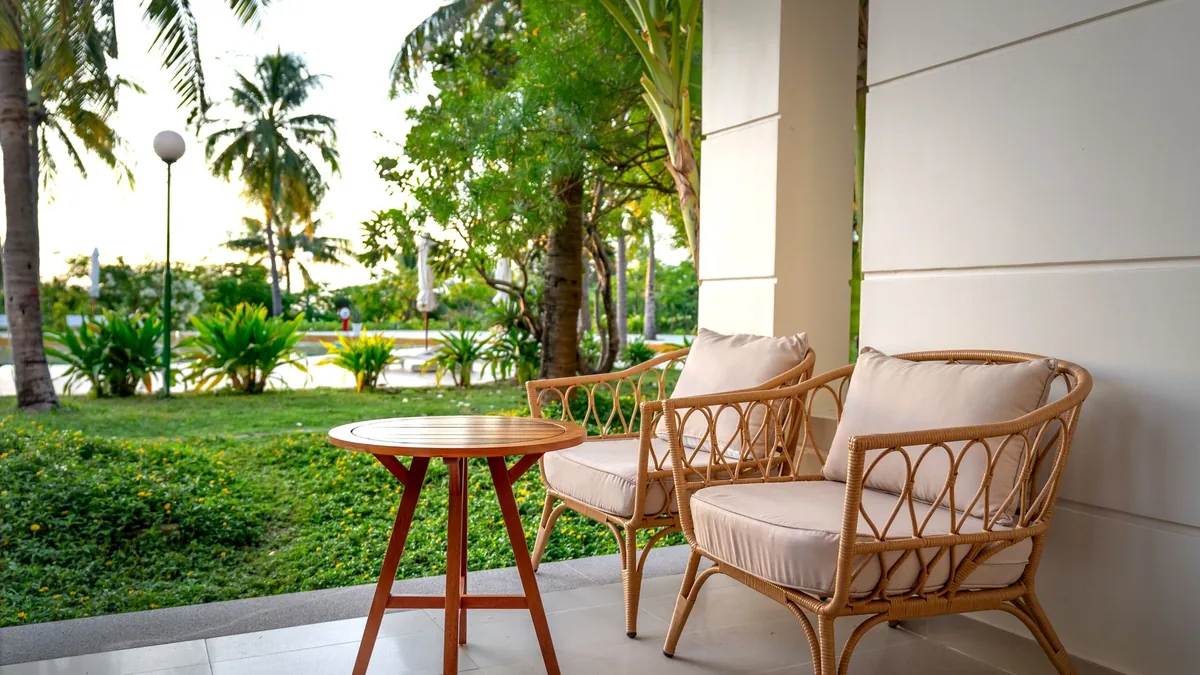
The chairs that looked right in the photo cannot pull back from the table, the cushions are still damp two days after a storm, and the light chair has ended up against the railing. Choosing by the picture skips the things that decide whether outdoor furniture works: a soaked cushion can need 1 to 3 days in the sun to dry, and a dining table wants 36 inches between it and the nearest wall. This guide goes in the order you do the job: match the material to your weather, measure the space, choose the type of furniture for how you will use it, then plan the cleaning and winter storage.
The short answer
| Step | What to do |
|---|---|
| 1. Weather | Winters outdoors: POLYWOOD’s HDPE frames can stay out uncovered. Windy spot: be wary of lightweight aluminum and wicker. No appetite for refinishing: skip teak, or accept it turning silver-gray |
| 2. Space | Multiply length by width in feet: 100 sq ft or less counts as small. Leave 36 in between a dining table and walls |
| 3. Type | Small space: one or two uses, such as a bistro set for two to four. Bigger dining sets: check them against the 36 in clearance. Large patio: split it into zones |
| 4. Upkeep | Soap and water for HDPE and aluminum, a brush into the weave for wicker, a sealer rather than oil for teak. Dry cushions fully and store them dry in winter |
Which material will survive your weather?
Start here: the material decides what sun, rain, wind and winter do to the furniture, and how much work it asks of you. Here are four common frame materials and what their makers’ pages say about each kind of weather.
| Material | Sun and heat | Rain | Wind | Winter |
|---|---|---|---|---|
| HDPE lumber | UV inhibitors for fade resistance | Not prone to rot, splinter or crack | Heavy; hard to move is its listed drawback | POLYWOOD frames: can stay out uncovered; one maker’s guide lists HDPE as not needing a cover |
| Powder-coated aluminum | Listed as uncomfortable in hot and cold weather | Yardbird sells its aluminum frames as rust-proof | Light; may be moved by strong winds | Yardbird: store, or cover with frames upright |
| Synthetic (HDPE) wicker | Not covered by the pages used here | Yardbird: HDPE wicker inhibits fungus and mildew | Lightweight styles are vulnerable to gusts | Yardbird: store, or cover with frames upright |
| Teak | Weathers to silver-gray in roughly 8 to 12 months | New, untreated teak surfaces natural oils in its first rains | Hardwood is listed as wind-resistant | The two makers’ guides differ; see the winter section |
HDPE lumber is solid plastic board. On POLYWOOD’s pages the lumber is not prone to splinter, crack, chip, peel or rot, and carries UV inhibitors for fade resistance. For winter, POLYWOOD’s HDPE frames, like the balcony set here, can stay outside uncovered year-round, per POLYWOOD. The trade-off is weight. POLYWOOD’s own outdoor materials chart gives HDPE one con: “Heavier weight; moving the furniture may be challenging”. That is a nuisance on moving day and a help on a windy balcony (our reading).
Powder-coated aluminum is the opposite: light and easy to move and store, which also means the same chart lists it as liable to “be moved by strong winds” and as uncomfortable in hot and cold weather. Rust is not the worry on the Yardbird aluminum frames: they are sold as rust-proof.
Synthetic wicker is plastic strand woven over a frame. Yardbird’s wicker is woven from 100% HDPE, sold as inhibiting fungus and mildew growth, a point in its favor for damp climates (our reading). Wind is one of its two cons on POLYWOOD’s chart: “Lightweight styles are vulnerable to wind gusts”; the other is “Some styles are thin and prone to breakage”.
Teak handles wet weather but changes color in the sun. Left alone, it ages to a silver-gray patina in roughly 8 to 12 months, depending on climate and exposure, a purely aesthetic change that does not affect how long it lasts. As a hardwood it is heavy: POLYWOOD’s chart lists hardwood as wind-resistant but hard to move, and the chairs of the teak set in step 3 weigh 46 lb each.
Cushions get wet whatever the frame. Sunbrella fabric is highly water-resistant, but heavy or steady rain still gets it wet. If you would rather not wait on wet cushions, one maker sells a Sunbrella sling seat as removing the need to manage cushions or wait for them to dry after rain.
How much room do you have, and what fits in it?
Measure the length and width of the space in feet and multiply them for square feet. A patio counts as small at 100 square feet or less, medium from 121 to 256, and large from roughly 324.
On a small patio, furniture that is too large can overwhelm the space quickly. Look for simple lines, low backs and no arms, which can help a small patio look more spacious, and for pieces that fold or stack so they can be put away. Keep the door and any steps clear, and bring extra chairs out only when guests do.
For dining, leave at least 36 inches of clearance between the table and walls or other structures so people can move around it. Choose armless chairs where it is tight. Standard outdoor tables stand roughly 28 to 32 inches tall and high-top tables 40 to 42, so match the chair height to the table you pick.
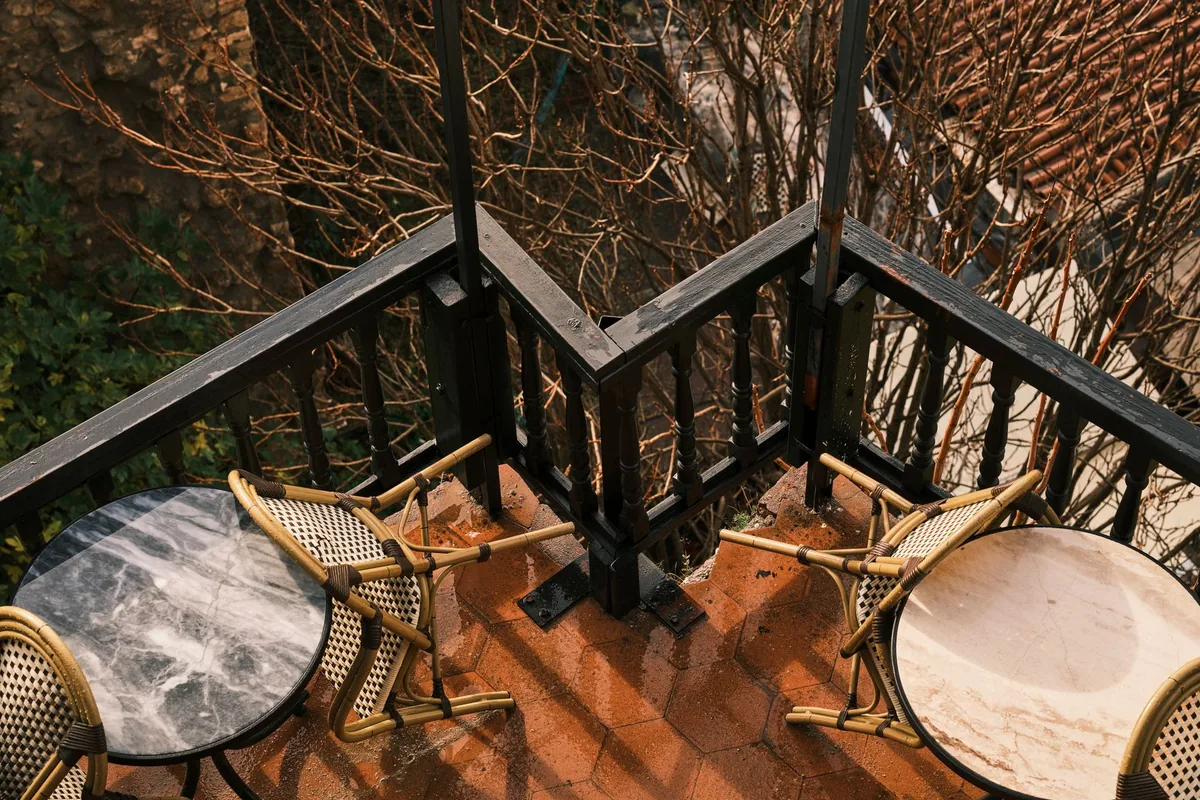
On a balcony, check the set’s listed minimum footprint first. The POLYWOOD Modern Studio Plaza Chair 3-Piece Balcony Set seats two and lists a recommended minimum space of 55 inches wide by 39 deep, about 15 square feet (our arithmetic). The chairs tuck under the table when not in use, the slatted top has thin gaps for drainage, and the set weighs 95 lb, worth knowing if it has to go up stairs (our suggestion). It costs $749 to $1,149 depending on color, at 10 October 2026 prices (price for reference only). That minimum is far tighter than the 36-inch dining rule: treat it as the least the set needs, not as room to walk around it (our reading).
Bistro, dining or conversation: what will you use it for?
Decide what the space is for before choosing pieces. A small patio can handle one or maybe two activities, such as a casual dining spot, a quiet nook for reading or sunbathing, or a conversation area; a large one can be split into zones, such as dining, lounging and sunbathing, with a dining set itself marking one zone off from the next.
Bistro: coffee or a meal for two. Bistro-style tables and compact sets for two to four people are the size suggested for balconies, narrow porches and cozy patios. For example, the Yardbird Madden 3-Piece Bistro Dining Set pairs a 30 by 23.75 inch table, 29.25 inches high and so in the standard range (our reading), with two chairs that stack for storage. Its spec sheet draws the set laid out at 23.75 by 74 inches. The frames are powder-coated aluminum with an HDPE slat tabletop. It costs $975 at 10 October 2026 prices (price for reference only).
Dining: regular meals for four or more. For medium spaces, one maker’s dining guide suggests a standard set for four to six; for large ones, six to eight or an expandable table. Check the set against the 36-inch clearance rather than the square-foot band alone (our suggestion). Shape matters too: a rectangle is the shape suggested for larger gatherings or narrow patios, a round table for small spaces and intimate meals, and a square for small groups. A bench on one or both sides seats more people.
Conversation: chairs around a low table. Measure the longest run you have and compare it with the set’s longest side. The Yardbird Winnie Conversation Set, two fixed teak chairs and a side table, lists 95.25 inches on its longest side, about 8 feet (our arithmetic). The frames are Grade A teak, and each chair weighs 46 lb. It costs $2,033 at 10 October 2026 prices (price for reference only).
How do you look after it through the year?
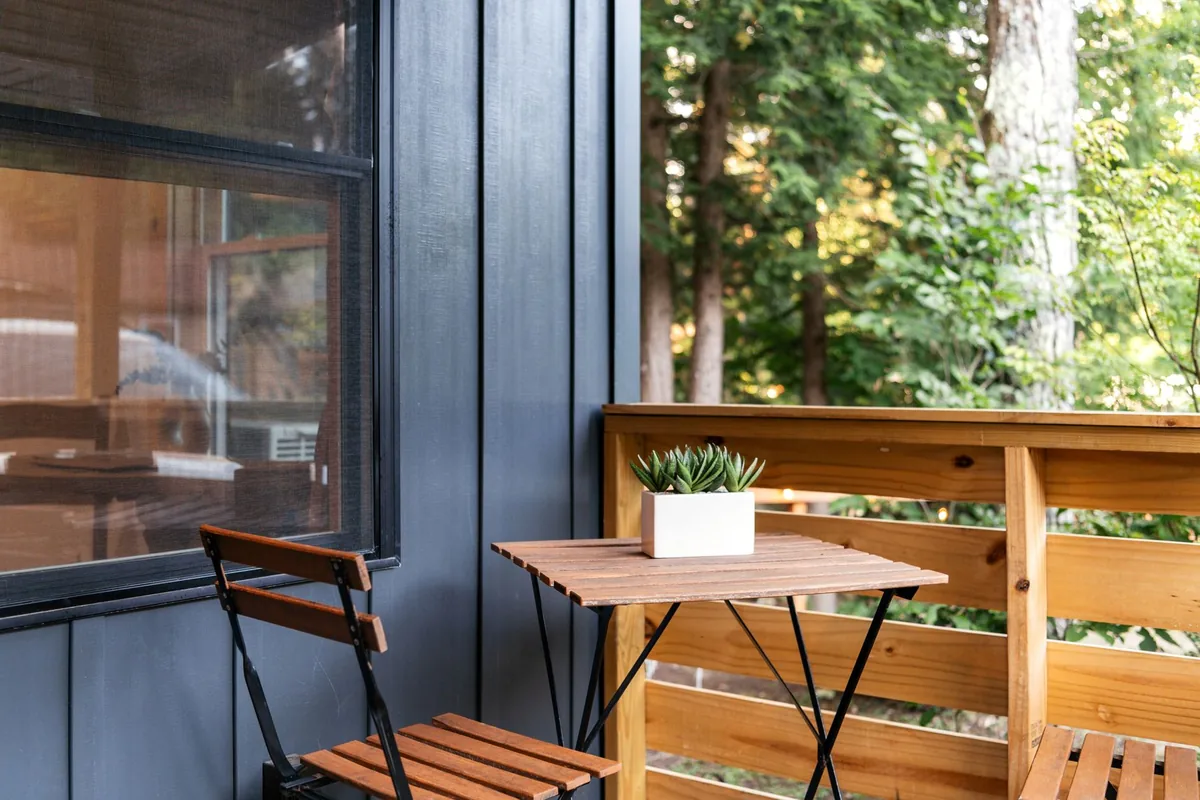
Routine cleaning needs water, a mild cleaner and a soft brush or cloth. What changes by material is the extra step, and what to keep off the surface.
- HDPE lumber (POLYWOOD’s steps): vacuum off loose dirt, wipe with mild dish soap in warm water, scrub with a soft-bristle brush, rinse and air-dry. Skip abrasive scrubbers such as eraser pads. For a deep clean, use a pressure washer rated no higher than 1,500 psi with a 40-degree fan tip, about 8 inches from the surface, and keep the wand moving. If the hardware touches salt water, rinse it with fresh water right away and towel it dry.
- Aluminum: hose off loose dirt, wash with soapy water and a soft cloth, rinse and towel-dry. For stubborn spots, use white vinegar and water. Avoid abrasive brushes and pads, bleach and ammonia-based cleaners, which can damage the powder coating.
- Synthetic wicker: take the cushions off, hose the furniture down, then work mild soap and lukewarm water into the cracks between the weaves with a soft brush, using a toothbrush for tight spots. Rinse until no soap is left and let it dry.
- Teak: on the teak set here, new wood is typically delivered untreated and sweats natural oils in its first rains, and those oils can stain cushions. Keep cushions off the frame while it breaks in (the maker says to plan on around 2 to 3 months, though it varies), especially in rain, and wait at least a few weeks before treating the wood. After that, choose: let it go silver-gray, or seal it. For the teak set here, the care guide gives a protector twice a year, at the start of spring and autumn, to keep the golden color. A sealer is the recommended finish rather than teak oil, which can cause mildew. Teak that has already grayed can be brought back by sanding with the grain using 320-grit paper and sealing again. Hairline cracks, called checking, can appear as the wood moves; they are cosmetic and do not affect the structure.
Cushions last longer when they dry properly: the foam depends on it. After heavy rain, unzip them and prop them on their sides to dry. To clean them, mix about a quarter cup of dish soap per gallon of warm water, apply it with a cloth and rinse. Flip them now and then to even out wear, and store them somewhere dry when they are not in use.
Winter. POLYWOOD’s HDPE frames, like the balcony set here, can be left out uncovered, per POLYWOOD; cover or store them if you want to skip the spring scrub. For the Yardbird sets, move the furniture into a garage, shed or basement if you have room. Otherwise, remove the cushions, spot-clean any stains, keep frames right side up so water does not collect, and cover them; store the cushions somewhere that stays above 40 degrees F. The two makers’ guides differ on teak: POLYWOOD’s winter guide lists teak, with HDPE, among materials that do not need the coating or cover step, while Yardbird’s winter steps cover its sets, teak included (our reading: the section makes no exception for teak). Follow the instructions that came with your set (our suggestion).
Before the furniture goes away for winter, work through a few general steps:
- Clean it first: removing dirt and moisture now lowers the chance of mold and rust.
- Check for repairs: take the foot caps off aluminum pieces to let trapped water out, and fix broken wicker fibers before they snag.
- Cover only once everything is fully dry, with a cover that fits snugly, because loose covers can trap snow and ice in the folds.
- Outdoors, raise the furniture on pallets or blocks, anchor lightweight pieces to heavier ones, keep everything upright, and brush off snow.
- Indoors, stack only pieces their maker labels as stackable.
For the rooms on the other side of the door, our furniture buying guide and guide to area rugs cover indoor pieces. More outdoor guides are in patio and garden.
Where these numbers come from
Materials, sizes, care steps and winter advice are from the POLYWOOD and Yardbird product pages, care pages, guides and spec sheet linked above, read on 10 October 2026. Prices are the ones the brands’ pages showed without a code that day. Square-foot and foot conversions are our arithmetic.
Frequently asked questions
What is the best material for outdoor furniture?
There is no single best one; match it to your weather. Of the four covered here, POLYWOOD's HDPE lumber frames can stay outside uncovered all year, per POLYWOOD, and are heavy enough that moving them is their listed drawback. Powder-coated aluminum and synthetic wicker are light, and strong winds are among the cons one maker's materials chart lists for both. Teak asks the most upkeep if you want to keep its golden color (our reading of the care pages).
What patio furniture works on a small patio or balcony?
Pick one or two uses for the space, then look for simple lines, low backs, no arms, and pieces that fold or stack. The two-seat POLYWOOD balcony set here lists a recommended minimum space of 55 by 39 inches, about 15 square feet (our arithmetic), with chairs that tuck under the table.
What furniture fits a narrow front porch?
A bistro-style table or a compact dining set for two to four people, the size one maker's dining guide suggests for balconies, narrow porches and cozy patios. Keep the door and steps clear, and if you want a dining table, a rectangle is the shape suggested for narrow patios.
Can patio furniture stay outside in winter?
It depends on the frame. POLYWOOD's HDPE lumber frames can stay outside uncovered all year, per POLYWOOD. For the Yardbird sets, move the furniture into a garage, shed or basement if you have room; otherwise remove the cushions, keep frames right side up, cover them, and store cushions somewhere that stays above 40 degrees F.
Should you oil teak patio furniture?
No. Use a sealer instead: teak oil can cause mildew and has to be reapplied more often. For the teak set here, a protector applied twice a year, at the start of spring and autumn, keeps the golden color; skip it and the wood weathers to silver-gray in roughly 8 to 12 months, depending on climate, a change that is purely aesthetic.
- #patio furniture
- #outdoor furniture
- #small patio ideas