Small Closet Ideas: How to Fit More Into a Reach-In Closet
Small closet ideas for a reach-in: measure four things, clear what doesn't belong, double the hanging space, then use the shelf height, door and floor.
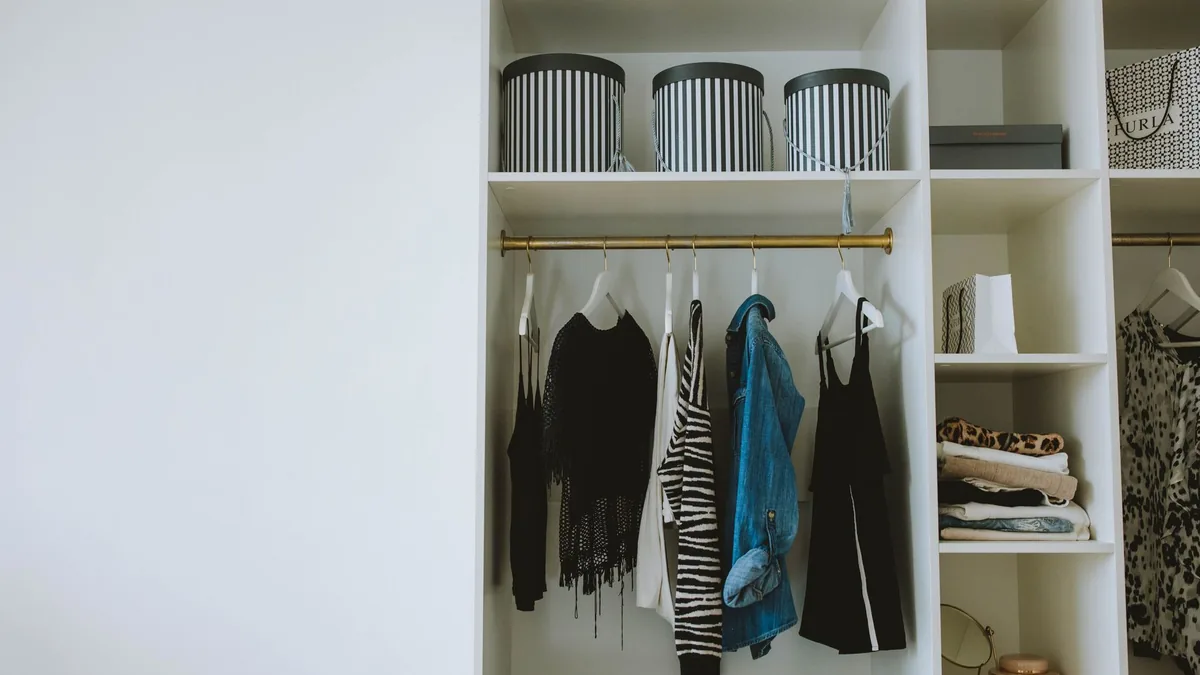
The rod is jammed, the shelf above it is stacked and the floor is a heap of shoes and bags. Buying a rack or a rod before measuring is how it gets worse: with a 16-inch-deep top shelf set at 84 inches behind a 72-inch door header, there is only a tiny gap to get bins through by one closet maker’s account. Below is the order that works for a small reach-in, from measuring to the floor, with the two things worth buying marked where they come up.
The short answer
| Step | What you do | Numbers to check |
|---|---|---|
| 1. Measure | Width (smallest reading), depth from back wall to door frame, height to the top shelf and the door header, door type | One closet maker puts reach-ins at 24 to 26 in deep; an adult hanger is 17.5 in long |
| 2. Make room | Move off-season clothes and bedding out; fold knits and jeans instead of hanging them | One retailer’s guide keeps only in-season clothes in the closet |
| 3. Double the hanging | Second rod for shirts, skirts and folded trousers; matching slim hangers | John Louis Home: upper rod 80 to 82 in (84 for taller adults), lower 40 to 42 in, at least 36 in apart; ClosetMaid: shelves at 85.5 and 42 in |
| 4. Go up | Bins on the top shelf, sized to come out under the door header | ClosetMaid runs one shelf at 85.5 in; one maker puts the usual top shelf at 84 in over a 72 in header |
| 5. Door and side walls | Hooks and slim pocket organizers on the back of a hinged door; hooks on free wall; one maker puts long-hang or bulky bedding in the blind corners | Clothes hang about 21 in from the back wall, leaving roughly 3 to 5 in behind the door of a 24 to 26 in closet (our arithmetic) |
| 6. Floor | Shoe shelf, or drawers, but not drawers under a lower rod (our reading) | ClosetMaid drawer frames are 30 or 42 in tall |
What do I measure before I buy or move anything?
Four numbers decide which of the moves below your closet can take. Write each one down.
- Width. Measure wall to wall at more than one point and keep the smallest reading, as one closet maker advises. Many reach-ins also run past the door frame on each side, by one maker’s account, leaving blind corners that are hard to reach.
- Depth, from the back wall to the inside of the door frame. Reach-ins are typically 24 to 26 inches deep by one maker’s count, and the same maker wants a rod at least 12 inches from the back wall. An adult hanger of the NEAT Method kind below is 17.5 inches long, so half of it (8.75 inches) reaches in front of the rod: about 21 inches of depth in total (our arithmetic). A closet 18 to 21 inches deep may still take a rod set closer to the wall than that 12 inches (our reading); under about 18 inches a hanger cannot face forward (our arithmetic), and that closet is for shelves, drawers and bins.
- Height, floor to ceiling, floor to the top shelf and floor to the underside of the door header. A low ceiling affects whether a shelf can go at 84 inches in ClosetMaid’s measuring guide, and the header limits what fits back out through the opening (step 4, our reading).
- Door type and swing. A hinged door has a back you can use (step 5) and needs room to swing. With bypass sliders, one maker says you can reach only half the closet at a time. For bifold doors, measure how much of the opening the folded panels clear (our suggestion).
Then hang your longest shirt and your longest folded trousers and measure from the hook down; those two numbers set the rod gap in step 3 (our suggestion).
What can leave the closet before I add anything?
Space made by removing things costs nothing (our reading). One home-improvement retailer’s guide says to keep only in-season clothes in the closet, folding the rest into under-bed containers or unused luggage, with vacuum storage bags to compact them. Another closet maker’s tip is to move out-of-season clothes to upper shelves or secondary storage at each season change. Bedding, luggage and under-bed options are in our small space storage ideas, and the full keep-or-donate sort is in how to organize a closet.
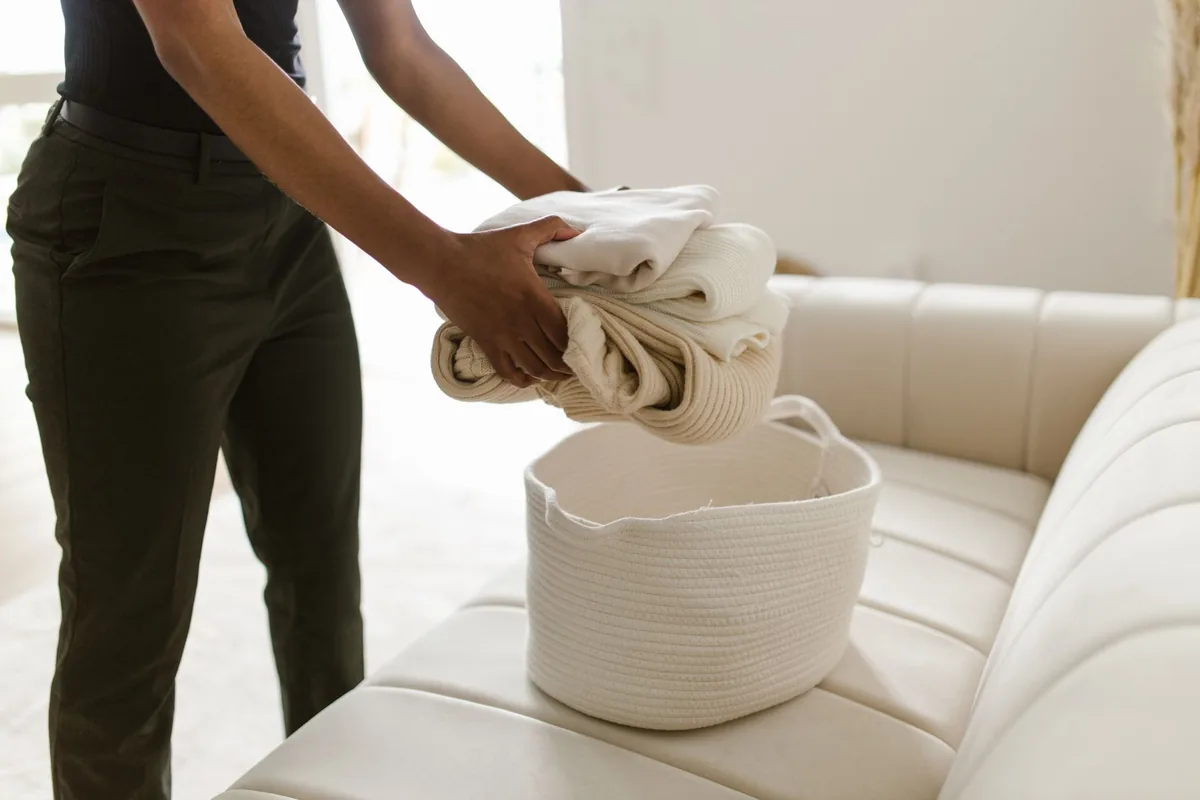
The second lever is moving clothes from the rod to the shelf. A good rule is to fold stretchy items such as sweaters and knitted tops, which can lose their shape if hung; IKEA’s guide lists t-shirts, vests, loungewear, jeans and heavier fabrics as good candidates for folding too; blouses, tops, skirts and jackets are what it hangs. Folded clothes take less room when you file fold them: fold to the height of the bin or drawer and stand them in upright rows with the fold facing out.
How do I double the hanging space?
Only for short clothes. One home-improvement retailer’s guide sizes hanging by length: dresses need 60 inches, suits 42, and shirts, skirts and pants folded over once 36. So two stacked rows work for the 36-inch group, and dresses and coats keep a long section of their own. Suits at 42 inches do not fit the 36-inch tier either: give them the long section, or use a wider gap such as ClosetMaid’s 85.5 and 42 inches, which is 43.5 inches apart (our arithmetic). Measure that long run in inches with the hangers pushed together; one closet maker finds that people tend to over-allocate long hang. A double-hang section holds two rows, so it needs about half your short-hang run in width (our arithmetic). The sizing of the sections is covered in our closet organizer guide.
The makers differ on the rod heights, so here is who says what.
| Source | Upper rod or shelf | Lower rod or shelf | Also stated |
|---|---|---|---|
| John Louis Home, two-rod guide | 80 to 82 in; 84 in for taller adults | 40 to 42 in | At least 36 in between the rods |
| John Louis Home, small reach-in guide | 80 to 84 in | 40 to 42 in | |
| John Louis Home, trousers guide | 80 to 82 in | 40 in | |
| ClosetMaid, wire shelving guide | 85.5 in (typical 84 in) | 42 in | Heights are for its SuperSlide shelves; long hang at 70 to 71.5 in |
At the bottom the sources land on 40 to 42 inches. At the top, ClosetMaid’s 85.5 inches is above John Louis Home’s 80 to 84, and ClosetMaid’s heights are for shelves that clothes hang from, not for a separate rod. Let your longest folded trousers settle the lower rod, keeping at least the 36-inch gap (our suggestion).
A second rod without drilling. One closet maker describes a hook-on double-hang rod that hangs from the existing rod and drops a second tier as a budget-friendly way to test the layout, and says a permanent lower rod screwed into the studs suits heavy denim. The Honey-Can-Do Hanging Closet Rod is one of that kind: $24.99 (price for reference only), 23 inches long and 35 inches tall, no tools, an adjustable bar, and its listing says the steel holds up to 50 lbs. Drawbacks: it drops at most 35 inches, under the at-least-36-inch gap John Louis Home asks for between rods, and the listing gives no range for the adjustment. The lower bar lands at most 35 inches below your current rod, so on a rod at 70 to 71.5 inches (ClosetMaid’s long-hang height) it sits at about 35 to 36.5 inches, below the 40 to 42 the makers give (our arithmetic). Treat it as a way to test the idea with short items, not as a match for the heights above (our reading). Each one also adds only 23 inches of lower row, so it fixes one section rather than a whole wall (our reading), and your existing rod now carries both rows. John Louis Home says a double-rod section often holds twice the weight of a standard one, and to replace a rod that shows bending, corrosion or loose mounting hardware.
Matching slim hangers. Bulky wooden and tubular hangers take up more room on the rod than they need to, and matching slimline hangers let you fit more on the same rod. NEAT Method’s Everyday Hangers are 0.25 inches thick and 17.5 inches long in the adult size, sold in sets of 25 for $40.00 (price for reference only), which is $1.60 a hanger (our arithmetic). Drawbacks: they are sold only in sets of 25, so a full rod may need two (our reading), and the 17.5-inch length counts against the depth you measured. Don’t pack the rod to the wall either: an overloaded rail can crush clothes and make them hard to see, in IKEA’s wardrobe guide. For trousers, tiered hangers can hold 4 to 5 pairs in the footprint of one, by one maker’s account, and jeans can move to a shelf.
How do I use the space above the top shelf?
ClosetMaid runs one shelf at 85.5 inches around the whole perimeter and adds shelf stacks for sweaters and linens; the second maker calls the space above 84 inches deep storage for seasonal bins, luggage and keepsakes; a third keeps extra blankets and seasonal items on it. If your ceiling is 9 or 10 feet, the second maker, which sells wall-mounted shelving, says its top shelves can go as high as the ceiling allows.
Check the door header first: for the 84-inch shelf and 72-inch header in the opening, that maker advises 12-inch shelves in reach-ins rather than 16. Test one bin, with its lid on, through the opening before you buy a set (our suggestion). For the look, use matching bins, the same bin repeated across the shelf, so a shelf works like a drawer. Put what you reach for twice a year up here, keep a step stool in the closet and label the end of each bin that faces out (our suggestion).
What can go on the door and on the walls beside it?
On a hinged door, one retailer’s guide lists over-the-door shoe organizer bags, which also hold rolled socks, t-shirts, gloves and hats, over-the-door hooks for jackets or tomorrow’s outfit, and hooks on any free wall space for ties, scarves and jewelry. Depth decides what fits: clothes hang about 21 inches out from the back wall using the depth figures above, so a 24 to 26 inch reach-in leaves roughly 3 to 5 inches behind a hinged door (our arithmetic). That rules out a 6-inch-deep rack such as Honey-Can-Do’s 18-pair steel shoe rack, which would need a closet about 27 inches deep (our arithmetic), so we do not recommend one for a typical reach-in. Hooks and slim pocket organizers can fit; measure the depth of whatever you pick against that gap and check the door still closes (our suggestion). Where the space behind the door holds shelves rather than a rod, the gap is larger (our reading). Whether over-the-door products suit sliding or folding doors is something to settle with the product’s maker before ordering (our suggestion).
The blind corners beside the opening are the other spot. One maker puts long-hang clothes or shelves of bulky bedding there and keeps shirts and shoes directly in front of the door opening, with no drawers in the corners. With sliders, the same maker recommends 12-inch shelves for the elbow room they leave to reach behind the door overlaps.
What goes on the floor, and how do I find things afterwards?
Shoes first: a retailer’s guide suggests single shelves or two- and three-tier racks, and when shelves run out, sandals can share a single bin. There is more in our shoe storage ideas.
Drawers or a second rod, not both, in the same section. ClosetMaid’s drawer frames are 30 or 42 inches tall and it asks for clearance, especially with sliding doors; the lower rod in step 3 sits at 40 to 42 inches with short clothes hanging beneath it, so there is no room for a 30-inch frame under it (our reading). If you do want drawers, one maker centers them on the door opening so they can pull out without hitting the frame.
To find things afterwards, four habits from the sources read here: one hanger type so everything hangs at the same level, the same bins, dividers to keep stacks apart, and a light: lighting inside or on top of a wardrobe gives a better overview of your clothes.
Where these numbers come from
Rod, shelf and depth figures are from John Louis Home, ClosetMaid, Home Depot, IKEA, NEAT Method and EasyClosets pages, linked above and read on 6 November 2026. Product sizes and prices are from the NEAT Method and Honey-Can-Do product pages on the same date, with no code applied. The hanger-depth figures and the width ratio are our arithmetic, and the steps marked (our suggestion) are our own additions.
Frequently asked questions
How do I double the hanging space in a small closet?
Add a second rod for short clothes only: shirts, skirts and folded trousers. John Louis Home puts the upper rod at 80 to 82 inches (84 for taller adults) and the lower at 40 to 42, at least 36 inches apart; ClosetMaid's wire shelving uses 85.5 and 42 inches. Dresses and coats stay in their own long section. A hook-on rod such as Honey-Can-Do's lets you test the layout without drilling.
What can I do if my closet is shallower than 24 inches?
John Louis Home puts typical reach-ins at 24 to 26 inches deep and asks for a rod at least 12 inches from the back wall. With a 17.5-inch hanger, that adds up to about 21 inches (our arithmetic), a closet 18 to 21 inches deep may still take a rod set closer to the wall than 12 inches (our reading), and under about 18 inches a hanger cannot face forward (our arithmetic). In that case use shelves, drawers, bins and the door for storage and hang clothes elsewhere.
What can go on the back of a closet door?
Home Depot's small-closet guide lists over-the-door shoe organizer bags for rolled socks, t-shirts, gloves and hats, over-the-door hooks for jackets or tomorrow's outfit, and a pantry organizer for small accessories. In a 24 to 26 inch reach-in, clothes hanging about 21 inches out leave roughly 3 to 5 inches behind the door (our arithmetic), so check the depth of anything you hang there; a 6-inch rack would need a closet about 27 inches deep (our arithmetic).
Where do the out-of-season clothes go in a small closet?
Home Depot's small-closet guide moves them out: folded into under-bed containers, or into unused luggage, with vacuum storage bags to compact them. John Louis Home suggests the upper shelves or secondary storage at each season change. If they stay in the closet, the shelf above the rod is the place, in bins that fit out under the door header (our suggestion).
- #small closet ideas
- #small closet design
- #small closet storage