Shoe Storage Ideas for Entryways, Closets and Stairs
Where to keep a family's shoes: how much shelf each pair needs, then benches, cabinets, closet racks, walls and under-bed bags, with each maker's capacity.
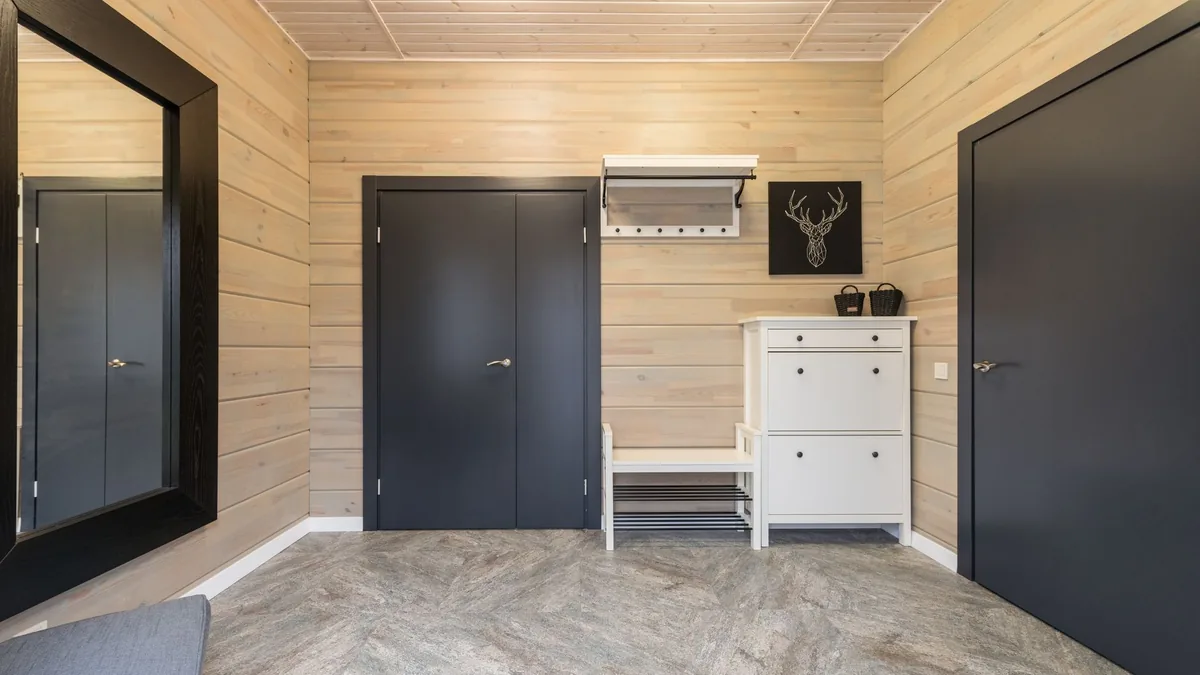
Shoes pile up on the mat by the door, single sneakers vanish under the closet rod, and the boots slump over every time someone digs for a pair. Buying one more rack before counting is the fix that keeps failing: on the four racks below, one tier 25 to 30 inches wide holds only three or four pairs, so 20 pairs need five to seven tiers (our arithmetic). Below: count and measure, choose by place, then boots and kids’ shoes, with each maker’s published capacity.
The short answer
| Where | What to use | Capacity on the makers’ pages |
|---|---|---|
| By the door, daily pairs | Shoe storage bench, seat 18–20 in high | 6–12 pairs |
| By the door, out of sight | Shoe cabinet, anchored to the wall | 15–20 pairs in one 43-in cabinet |
| Narrow hallway | Tilt-out cabinet 9.6 in deep, or a revolving shoe tree | Up to 20 pairs, or up to 24 |
| Closet floor | Low rack under short hanging clothes | Up to 9 pairs per rack |
| Back of a door | Over-the-door rack or pocket organizer | 12–18 pairs |
| Any wall | Angled shelves on brackets | Shelves 4, 6 or 8 ft long |
| Under the bed | Zip bags 5.9 in tall | 12 pairs per bag |
| Boots | 16 in between shelves, or an upside-down boot rack | 3–6 pairs per boot rack |
How many pairs do you have, and how much shelf does each pair need?
Line up every pair in the house and sort them into three piles (our suggestion): the pairs each person wears this week, which go by the door; the rest of this season’s pairs, for the closet; and off-season pairs, which can go under the bed or up high. Count boots and men’s sneakers on their own. One cabinet holds 24 pairs of women’s or kids’ shoes or 18 pairs of men’s sneakers, so a pair of men’s sneakers takes about a third more space there (our arithmetic).
Then turn the count into shelf length. Four racks from two makers give these figures:
| Rack | Overall width | Pairs per tier | Width per pair (our arithmetic) |
|---|---|---|---|
| Two-tier wood rack | 29 in | 4 (up to 8 pairs on 2 tiers) | About 7.25 in |
| Three-tier steel rack | 25 in | 3 (up to 9 pairs on 3 tiers) | About 8.3 in |
| Two-tier metal rack | 30 in | 3 (up to 6 pairs on 2 tiers) | 10 in |
| Two-shelf solid wood rack | 27.75 in | 3–4 (the page gives “up to 6 pairs” in one place and “6 to 8” in another) | About 6.9–9.25 in |
So plan on about 7 to 10 inches of rack width per pair. At three or four pairs a tier, 20 pairs need five to seven tiers (our arithmetic). To squeeze a shelf, set one shoe toe-forward and the other heel-forward so the heel nests into the toe space; one maker’s guide puts the gain at 20%.
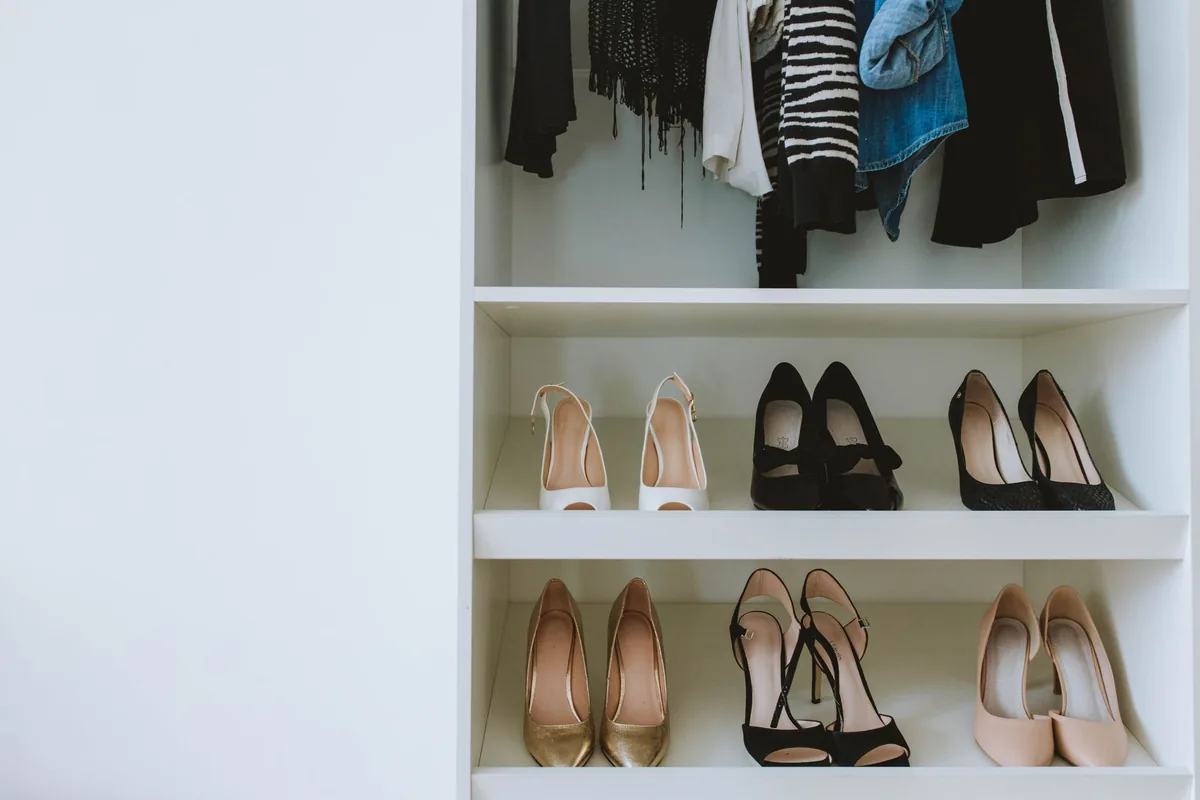
Measure two things on your shoes as well (our suggestion). The longest pair, heel to toe, goes against rack depth: the floor racks in this article run 10.5 to 13.5 inches deep, and one 11.75-inch rack is tested up to a men’s size 12. The tallest pair goes against the space between tiers: one closet maker suggests 8 inches for flats and sneakers and 16 inches for boots, so the boot shafts don’t crease.
What works by the front door?
Keep only the daily pile here.
A shoe storage bench: 6 to 12 pairs and a seat
A bench gives everyone a place to sit while they put shoes on. One maker gives 18 to 20 inches as the standard seat height, low enough for most adults to sit with their feet flat. Underneath, a 34-inch two-tier bench holds 6 to 8 pairs, and a 55-inch bench holds up to 12 pairs on its lower two shelves; they are 13 and 13.77 inches deep.
If you buy one piece for the door, a bench with cubbies keeps each pair apart (our reading). The John Louis Home Solid Wood Shoe Bench is 44 inches wide, 17 deep and 20 tall, holds up to ten pairs in cubbies, and seats two adults, up to 300 lb. Its middle shelves come out to make 12-inch-tall cubbies for boots, which brings it down to about 6 to 8 pairs of larger boots. The maker suggests the top cubbies for the shoes worn every day and the bottom row for seasonal pairs. $434 at 11 October 2026 prices (price for reference only). At 17 inches deep it takes 3 to 4 inches more of the hallway than the two benches above (our arithmetic).
A shoe cabinet: 15 to 20 pairs out of sight
Doors hide the pile. The Tribesigns 20 Pairs Shoe Cabinet, 6-Tier Shoe Storage Organizer with Adjustable Shelves is 31.5 inches wide, 13.78 deep and 43.31 tall and holds 15 to 20 pairs; its four shelves can be moved or taken out to fit anything from flats to boots, and its louvered doors let air through. $176 at 11 October 2026 prices for the walnut finish (price for reference only); the other finish was out of stock that day. Taking a shelf out for boots lowers the pair count (our reading), and at 72.75 lb it comes with an anti-tip kit to fit the day it arrives (steps below).
A tilt-out cabinet or a shoe tree for a narrow hallway
Where depth is short, a tilt-out cabinet keeps shoes behind fronts that flip down. One fluted two-drawer cabinet is 40 inches tall, 31.6 long and only 9.6 deep; each of its two flip-down compartments has two layers holding 8 to 10 pairs, up to 20 in all, and it comes with an anti-tip kit. A revolving shoe tree holds up to 24 pairs on about one square foot of floor (12.1 by 12.1 inches, 48.82 tall), and its tiers adjust in height.
For a wall less than 2 feet wide, one maker suggests a tall four-cube unit rather than a standard rack; its stackable racks are 27.75 inches wide, so they need a wall at least that wide (our arithmetic); for those it suggests stacking as high as the space allows. The same maker’s two-shelf rack, though, is not designed to be attached to a wall, so keep a stack you can’t anchor low (our suggestion). More ideas for tight halls are in small space storage ideas.
For wet boots, two makers point to open shelves: slatted shelves on one metal rack are there so rain boots and soggy sneakers can gently air dry, and one bench maker recommends open-back benches and ventilated shelving for a mudroom.
Anchor cabinets and tall racks
The U.S. Consumer Product Safety Commission’s Anchor It! campaign puts it plainly: “Anchoring all furniture with drawers, doors, and shelves to the wall prevents tip-over injuries and deaths.” Both cabinets above come with anti-tip hardware; on the 20-pair cabinet, the straps can reduce the risk of tipping over but cannot eliminate it. The steps, from the CPSC’s Anchor It! guides on what you need and how to install a kit:
- Check whether the cabinet came with a kit. The kit’s instructions should say how many straps to use; two is usual.
- Find the nearest stud with a stud finder. Move the cabinet a few inches if that lines it up with one.
- Hold the wall bracket on the stud at the height you want, trace its screw holes, and drill with the bit size the anchor packaging names, feeling resistance the whole way; then screw the bracket on. On brick, drill the face of the brick with a masonry bit and use masonry screws.
- Attach the second bracket to the cabinet, following the kit’s own instructions. If the cabinet’s manual shows where the kit attaches, use that spot (the 20-pair cabinet’s manual shows the top back); otherwise pick a thick, solid part, not the thin back panel that is stapled on. Drill a pilot hole first.
- Push the cabinet close to the wall, connect and tighten the straps, then tug on them to check.
How do I fit more shoes in the closet?
Shelf heights and depths for the rest of the closet are in our closet organizer guide.
- The floor under short hanging clothes. One 16-inch-tall rack that holds up to 9 pairs is sold to fit below hanging clothes.
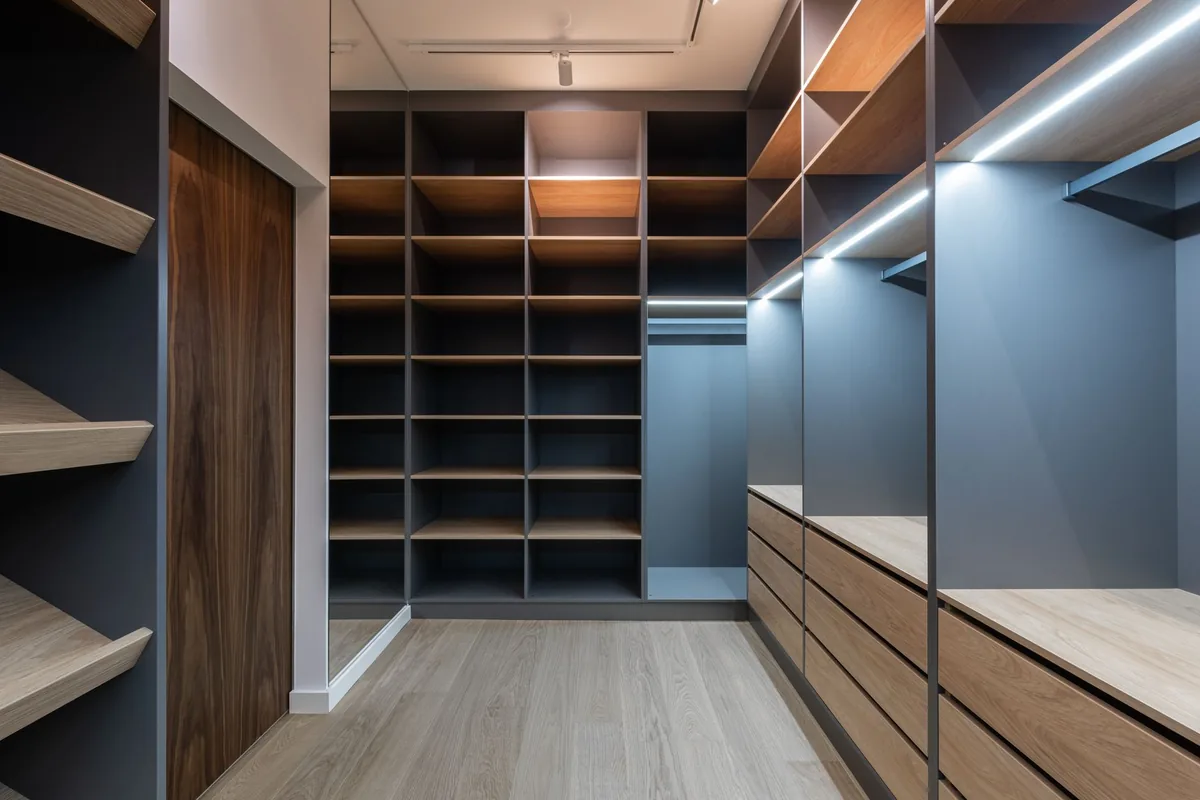
- Angled shelves. They tilt each pair toward you and take less depth than a flat shelf. One bracket takes 12- or 16-inch-deep shelves in 4, 6 or 8 ft lengths; its product page suggests brackets 18 to 24 inches apart, lined up with a stud where you can, rows about 10 to 12 inches apart, and setting your tallest pair on the shelf before the final screws. Its installation guide instead places the first bracket between the second and third slat from the end, adds a third bracket in the middle on shelves 6 ft or longer, and uses the supplied wall anchors where a bracket misses a stud. The guide recommends the lowest row at least 18 inches off the floor, to leave room for a hamper.
- The back of the door. Measure how thick your door is first (our suggestion). The Whitmor Over the Door Shoe Rack in white holds up to 18 pairs, measures 22.5 inches wide, 62.75 tall and 5 deep, and its brackets fit standard interior doors “no more than 1.25 inches wide”, which we read as the door’s thickness: on a thicker door these brackets won’t fit (our reading). We found no page for it on the maker’s own site, so the link goes to the retailer Organize-It, where it was $25.99 on 11 October 2026 (price for reference only). At 5 inches deep, check that the door still closes with the rack full and that shelves or rods behind the door don’t catch it (our suggestion). A 24-pocket over-the-door organizer is only 2.64 inches deep and holds 12 pairs. If you have no floor or wall space left, one closet maker suggests a fabric over-the-door organizer for flat sandals, keeping the shelves for structured, heavier shoes, and clear drop-front boxes for seasonal heels.
- The rod, when there is no floor. A hanging organizer with 10 shelves hooks over the closet rod and measures 12 by 6 by 52 inches.
For the order to sort and set up the whole closet, see how to organize a closet.
What about under the stairs, under the bed and on the walls?
Under the stairs. We found no maker’s guide to shoe storage under a staircase; one bench maker lists a 23.6-inch-tall, 13.8-inch-deep bench as fitting under staircases. Measure the clear height every foot or so along the slope before you buy (our suggestion). The four floor racks in the first section stand 12 to 24 inches tall, so the lowest ones can go toward the short end, with a bench or cabinet where the ceiling is higher (our reading).
Under the bed. A set of two zip bags holds up to 24 pairs, 12 per bag, in compartments 11.5 by 4.75 inches. Each bag is 29.9 by 25 inches and 5.9 inches tall, so the bed frame needs more than 5.9 inches of clearance (our reading). Check your longest pair against the 11.5-inch compartments, and keep the off-season pile here (our suggestion).
On the walls. The same angled bracket can carry a single row in a hallway or laundry room to keep indoor shoes off the floor.
Where do boots and kids’ shoes go?
Boots. Give tall boots 16 inches between shelves (see the first section) or take them off shelves altogether:
- An upside-down boot rack keeps tall boots upright: one holds 3 pairs in 24 by 11 inches of floor, 18 tall, and a 27.5-inch version holds 6 pairs and helps wet boots dry.
- In cubbies, take out the removable shelves, as on the bench above; in one 30-cubby cabinet, some shelves come out for tall boots, and the maker recommends one cubby per shoe for larger sizes.
Kids’ shoes. They take less room than men’s sneakers in one cabinet’s count (see the first section). Keep them low and reachable (our suggestion); one closet maker puts daily kids’ things such as socks, pajamas and uniforms on the lower shelf, calls a 12-inch-deep system usually ideal for kids’ rooms, and suggests shelves that adjust as shoe sizes go from small sneakers to tall boots. Giving each child one low tier or cubby by the door is our suggestion. A 10-pocket canvas rack holds 10 pairs of men’s, women’s or children’s shoes, and one hall tree has a shoe shelf where kids can stash up to six pairs.
More ideas for shelves, bins and closets are collected in home storage.
Where these numbers come from
Capacities and sizes come from each maker’s product page, installation guide or planning article, or for the over-door rack the retailer Organize-It’s listing, linked above and read on 11 October 2026; the anchoring steps are from the U.S. Consumer Product Safety Commission’s Anchor It! site. Prices are from each brand’s product page, or Organize-It for the over-door rack, on the same date, with no code applied. The width-per-pair figures and tier counts are our arithmetic.
Frequently asked questions
What are good shoe storage ideas for a small entryway?
Go narrow or go up. One tilt-out cabinet is only 9.6 inches deep and holds up to 20 pairs; a revolving shoe tree holds up to 24 pairs on about one square foot of floor; and for a wall less than 2 feet wide, one maker suggests a tall four-cube unit instead of a standard rack. Anchor any cabinet to the wall with the anti-tip kit it comes with, or a kit bought separately if none came with it.
How many pairs of shoes fit on a shoe rack?
On the four racks we read, one tier 25 to 30 inches wide holds three or four pairs, which works out to about 7 to 10 inches of rack width per pair (our arithmetic). In one cabinet, men's sneakers take more room: it holds 24 pairs of women's or kids' shoes but 18 pairs of men's sneakers.
How tall should a shoe storage bench be?
One maker gives 18 to 20 inches as the standard seat height for an entryway bench, so most adults can sit with their feet flat while putting shoes on. The benches we read hold 6 to 12 pairs underneath.
Do shoe cabinets need to be anchored to the wall?
Yes, in the words of the U.S. Consumer Product Safety Commission's Anchor It! campaign: “Anchoring all furniture with drawers, doors, and shelves to the wall prevents tip-over injuries and deaths.” Use the kit that came with the cabinet (its instructions should say how many straps; two is usual), screw the wall bracket into a stud, and tug the straps to check. One maker's manual adds that its straps can reduce the risk of tipping but cannot eliminate it.
How do I store tall boots?
Give them 16 inches between shelves, which one closet maker suggests so the shafts don't crease, or hang them upside down on a boot rack (3 or 6 pairs on the two we read). In a bench or cabinet with cubbies, take out the removable middle shelves; one bench drops from 10 pairs to about 6 to 8 pairs of larger boots that way.
- #shoe rack
- #shoe storage bench
- #entryway storage