Garage Storage Ideas: Shelving, Cabinets and Ceilings
How to organize a garage: plan the zones around the car, then pick wall track, shelving, cabinets and ceiling racks by load rating and how each one mounts.
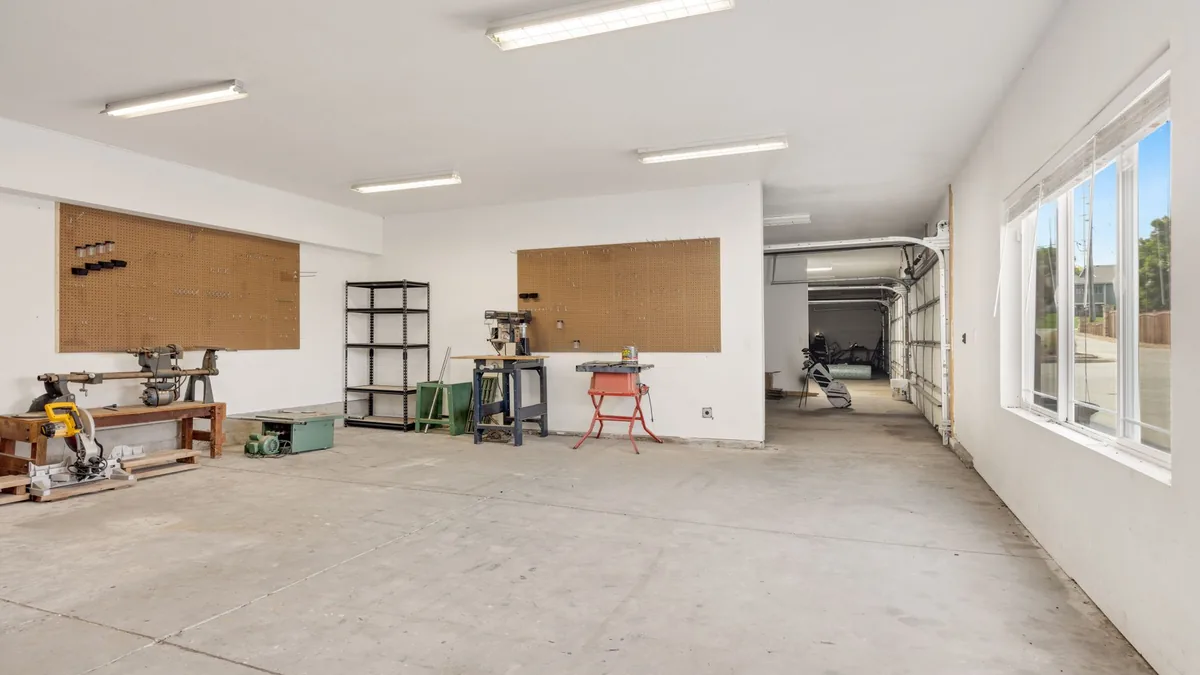
The car sits on the driveway because the bay is full of boxes, the bikes lean against the side wall, and the rake falls over every time someone squeezes past. Buying a stack of shelving first is the step that goes wrong: a unit 24 inches deep on the side wall takes the room the car doors need, and one garage company’s planning guide adds two to three feet around every side of the car for the doors. Below is the order to plan in: mark out the car’s space, give everything else a zone, then choose the wall system, shelving, cabinets and ceiling racks by what each is rated to hold and how it has to be fixed.
The short answer
| Zone | What goes there | Storage that suits it | Check before you buy |
|---|---|---|---|
| Parking | The car | Nothing; keep it clear | 2–3 ft on every side for door swings (one garage company’s guide) |
| Daily access, on the wall nearest the house door | Hand tools, cleaning supplies, this season’s sports gear | Slatwall, track or pegboard | The rating’s unit (per sq ft, per linear ft, per panel) and screws into studs |
| Lawn and garden | Rakes, shovels, leaf blower | Hooks on a wall system | Each hook’s own rating |
| Workshop, on the back wall | Workbench, power tools | Wall system above the bench | Studs behind the panel |
| Bulky things and overflow | Bins, boxes, heavy items | Freestanding shelving | Load per shelf; fix tall units to the wall (our suggestion) |
| Hazardous | Paint, solvents, car fluids, lawn chemicals | A shed away from the house for oil, paint, propane and varnish (US Fire Administration); without one, a locked cabinet away from heat for paint, solvents and car fluids (one garage company’s plan; our reading) | The product labels; gasoline and propane in a shed or detached structure, not the house or an attached garage |
| Seasonal | Decorations, camping gear, luggage | A ceiling rack | Wood joists, rack capacity, clearance over the open door |
Where should everything go in the garage?
Measure first and decide what the garage is for. Get the floor dimensions (and the ceiling height, for a rack later; our suggestion), and settle whether the garage has to park a car, hold a workspace or just store things. Clear out what you no longer use and hold off buying storage until you have, so you buy for what stays.
Mark the parking footprint before anything else. One garage company’s zone guide measures each vehicle and adds two to three feet of clearance on every side for comfortable door swings, then plans everything else around that. Chalk or tape the outline on the floor (our suggestion). If a shelving unit or base cabinet 24 inches deep goes on the side wall, the side of the car then has to sit 4 to 5 feet from that wall (our arithmetic); an 18-inch-deep unit gives 6 inches of that back.
Then give every kind of thing its own zone. The same guide puts the everyday wall closest to where you walk in from the house, so things get put back, and the workbench against the back wall, where it won’t interfere with parking. The rest:
- Lawn and garden. Hang rakes, shovels and leaf blowers on the wall, keep in-season tools at the front, and keep garden chemicals on high shelves out of children’s reach.
- Kids and sports. Keep storage low enough for young children to reach; bikes go on wall hooks or racks, balls in baskets.
- Car care. Near where the car parks, on shelves or in a locked cabinet.
- Bulky things and overflow. Freestanding shelving, for large items that may not fit in a cabinet.
- Hazardous products. A shed, or a locked cabinet if you have none; the safety section below has the sources and the rules.
- Seasonal. Holiday boxes, camping gear and luggage go overhead or in upper cabinets, in bins labeled on two sides so you can read them from below.
- The door into the house. A few hooks and a shoe tray; two to three linear feet of wall is usually enough, in that company’s experience. If the real overflow is coming from an indoor closet, sort that closet with our closet organizer guide first.
Slatwall, pegboard or track: which wall system, and how much will it hold?
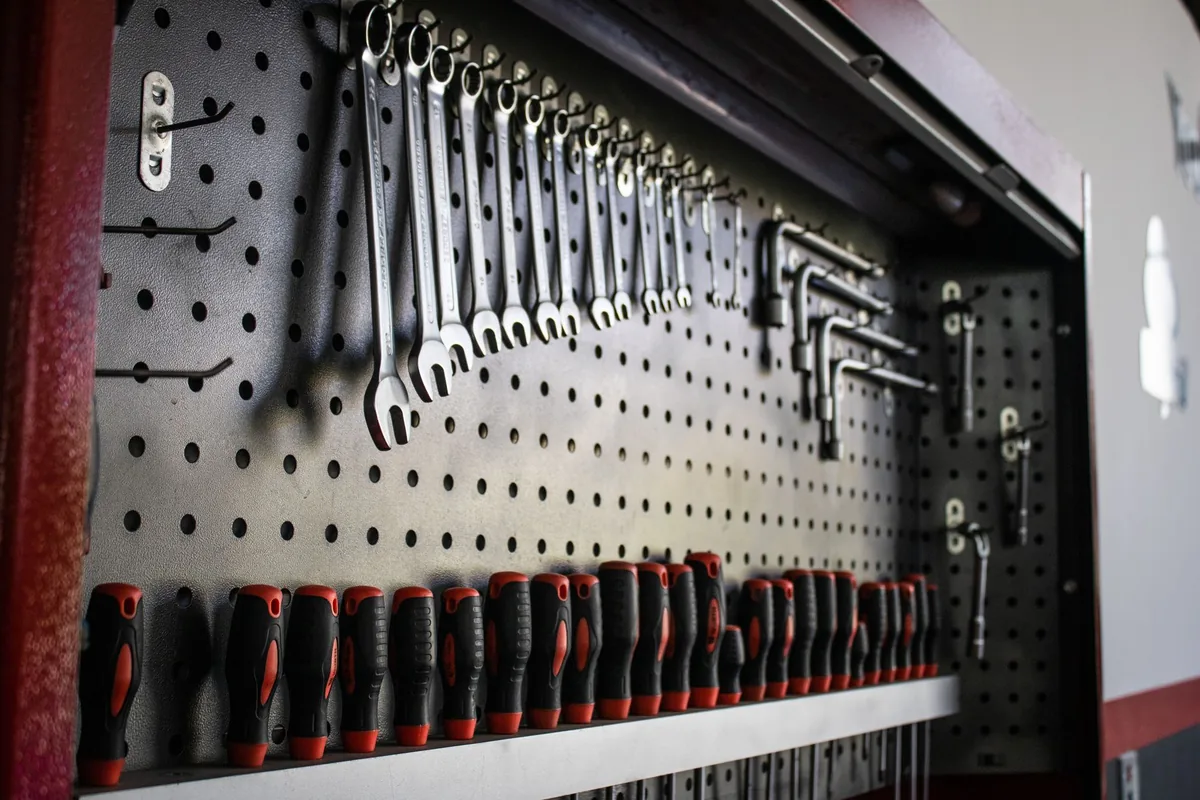
Wall systems take the hanging tools, sports gear and other things you reach for often. Each type is rated in its own unit (per square foot for slatwall, per linear foot or in total for track, per panel for pegboard), so compare products within a type rather than across the table (our reading).
| System | Rating as the maker prints it | Mounting the maker gives |
|---|---|---|
| Gladiator GearWall slatwall panels, 12 × 96 in | Up to 50 lb per sq ft | Concrete walls, wood studs or drywall |
| Proslat PVC slatwall | Up to 75 lb per sq ft | Designed for 16-in stud spacing; on concrete or block, 2×3 furring strips at 16 in, fixed with cement screws |
| Proslat ProCore or aluminum slatwall | Up to 200 lb per sq ft | 16–24-in stud spacing; on concrete or block, 2×3 strips at 24 in |
| Gladiator GearTrack channel, 6 × 48 in | Up to 75 lb per linear ft | Bare wood studs, or drywall over wood studs |
| SafeRacks rail system | 500 lb in total, 65 lb per hook | Full capacity when it reaches 4 studs across its 48 in; drywall anchors between studs |
| Wall Control metal pegboard, 16 × 32 in panels | Its recommendation: no more than 100 lb per panel into drywall with the included anchors, 200 lb into studs | Holes line up with 16-in stud spacing; masonry screws or 2×4 rails on concrete |
Slatwall or pegboard? Slatwall has grooves across its whole face, so hooks, baskets and shelves can go anywhere on it. Most pegboard is wood, by one wall-system maker’s account; it can often sag if overloaded, and metal panels can help prevent the warping wood may suffer. The metal-pegboard maker in the table gives a rule of thumb rather than a laboratory load rating, which it calls potentially misleading: the per-panel figure above, plus no more than 10–20 lb per shelf, 10–15 lb per hook that engages two slots and 5–10 lb per hook that engages one.
Track covers one strip of wall rather than the whole face, say above the garden-tool zone. A rail from one maker reaches its full 500 lb when it can be screwed into four studs across its 48 inches, so find and mark the studs before you choose where it goes, then level it.
The hook still has its own limit. On one maker’s system the scoop hook is rated 25 lb and the utility hook 50 lb; a panel rated per square foot doesn’t make a single hook stronger (our reading).
If track is what you need, the Gladiator 4’ Wide GearTrack Channels (2-Pack) are two 6 by 48 inch channels rated up to 75 lb per linear foot, for bare wood studs or drywall over wood studs, at $25.49 at 11 October 2026 prices (price for reference only). The matching screws are sold separately.
How much can freestanding shelving hold, and does it need fixing to the wall?
Freestanding shelving takes the bins, boxes and bulky things that won’t go in a cabinet or on the wall. Wall-mounted shelves keep the floor clear, while freestanding units can often support heavier loads. Ratings are printed per shelf, and they vary a lot within and between makers:
- SafeRacks garage shelving, 24 inches deep and 84 inches tall: 500 lb per shelf.
- Gladiator EZ Connect racks: up to 1,000 lb per shelf.
- Gladiator Heavy Duty racks: up to 2,000 lb per shelf.
Weigh a few full bins on a bathroom scale and multiply by the number per shelf to see which class you need (our suggestion). Then choose the depth: 24-inch shelves hold bigger bins, 18-inch shelves leave more room for the car doors.
Fix tall units to the wall. Proslat’s bin racks must be secured to the wall, and floor cabinets that aren’t wall-mounted can be anchored to the wall to prevent tipping, in one cabinet maker’s advice. Do the same with a tall shelving unit: use the maker’s anti-tip hardware if it comes with one, screw into a stud, and load the heaviest things on the lowest shelves (our suggestion).
For a bulk-storage zone, the Gladiator 48” Wide EZ Connect Rack with Five 24” Deep Shelves is 48 inches wide, 72 tall and 24 deep, with five laminate shelves rated 1,000 lb each and 5,000 lb for the unit, and it clicks together without tools. It is $187 at 11 October 2026 prices (price for reference only). At 24 inches deep it puts the car 4 to 5 feet off the side wall if it stands there (our arithmetic); the same width is also listed with 18-inch shelves.
More ideas for shelves, bins and small spaces are collected in home storage.
When are cabinets better than open shelving?
Open shelving is often more affordable and lets you see everything at a glance. Cabinets earn their price in three cases, drawn from one maker’s cabinet guide and its shelving guide: when things need protecting, since an enclosed cabinet helps protect what’s inside from dust and moisture; when they need locking, such as chemicals, car-care products and dangerous tools in a house with children; and when you want small items sorted into drawers and bins out of sight.
What to check:
- Depth. Base cabinets are 24 inches deep as an industry standard and wall cabinets usually about 12, in Gladiator’s guide; sizes vary, so check each product. A wall cabinet keeps the floor in front of the car clear.
- Load. Proslat rates its cabinet shelves up to 200 lb each and its drawers up to 400 lb; Gladiator lists individual cabinets that hold up to 1,400 lb.
- Material. MDF holds a lot but is more susceptible to moisture; plywood holds more but may cost more; and wood is worth reconsidering if the garage swings between hot and cold, in Gladiator’s cabinet guide.
- The floor. Proslat’s cabinets have adjustable feet for sloped garage floors and optional front feet for a concrete curb or stem wall that stops them sitting against the wall.
- Fixing. Find the studs for wall cabinets, and consider anchoring floor cabinets to the wall so they can’t tip.
How do I put up a ceiling rack without hitting the garage door?
Decide what goes up. Seasonal and bulky things you use once or twice a year. Heavy tools, chemicals, fragile items and anything you use often stay off it, and a ceiling of at least 8 feet is recommended, in one garage company’s guidance; SUVs and trucks need careful measuring first.
Measure the clearance with the door open and the car parked. Open the garage door fully and measure from the ceiling down to the highest point of the open door, its track and the opener rail where the rack will hang. Then park the car and measure down to its roof, or to its liftgate or trunk lid when open, and use the smaller of the two numbers (our suggestion). SafeRacks sells its racks in drop ranges and tells buyers to measure the space above an open garage door, cabinets or appliances and order the matching range. Its FAQ asks for at least 1 inch between the bottom of the rack and an opener or cabinets, and the frame hangs 3 inches below the top of the wire deck. So take the smaller of your two measurements and subtract 1 inch: that is the deepest the bottom of the frame can hang. If the drop is measured to the deck rather than the frame, subtract a further 3 inches. With 30 inches measured, that is a drop of no more than 29 inches to the frame, or 26 inches to the deck (our arithmetic). The drop-range page doesn’t say which point it measures to, so ask the maker before ordering. Whatever the brand, some overhead storage can interfere with the door and opener.
Pick the size by capacity. Two makers’ racks cover 300 to 1,000 lb depending on size:
| Rack size | SafeRacks | Gladiator GearLoft |
|---|---|---|
| 4 × 8 ft | 600 lb | 1,000 lb, evenly distributed |
| 4 × 6 ft | 500 lb | Not listed |
| 3 × 8 ft | 500 lb | Not listed |
| 3 × 6 ft | 400 lb | Not listed |
| 2 × 8 ft | 400 lb | 500 lb |
| 2 × 6 ft | 300 lb | Not listed |
| 4 × 4 ft | Not in the manual’s table | 500 lb |
| 2 × 4 ft | Not listed | 350 lb |
Check the ceiling framing against the manual. The capacities in the SafeRacks assembly instructions assume a statically loaded rack lagged into a wood-framed ceiling: joists at least 2×6, no more than 24 inches apart, with at least 2 inches of each lag screw in the wood; for a truss ceiling, a 2×4 bottom chord is acceptable. As the manual puts it, “The weakest point in this system is the frame of your house.” The manual says not to install the rack into anything but a traditional wood-framed garage with joists like these; installing into engineered I-beams, steel joists or concrete ceilings “requires professional installation by a certified contractor” and voids the warranty. The rack’s product page simply says not to install into them. If the joists are more than 24 inches apart or change direction, the manual says to contact the maker, which has longer ceiling brackets in the US.
Find the joists properly. With a drywall ceiling, use a stud finder (the maker’s tool list asks for a deep-scan electronic one), mark both edges and the middle of each joist, and confirm with a small nail. Joists are typically spaced 16 inches on center, in the manual. The manual’s preferred layout runs each ceiling bracket across two joists; along a single joist is the fallback when they are too far apart. Drill 3/16 inch pilot holes 3 inches deep in the center of the joist and drive each bracket’s 5/16 by 3 inch lag bolts, with washers, fully home. Place the other brackets from the first: on an 8 ft rack, 96½ inches from the outside end of one bracket to the inside end of the next along the long side (72½ inches on a 6 ft rack), and 48½ inches from outer edge to outer edge across the short side (36½ inches on a 3 ft rack, 24½ on a 2 ft rack).
Hang the posts, then the frame. Set the drop by overlapping each post’s two sections to the length you worked out and bolting them together top and bottom, and make all the posts the same length. Bolt each post to its bracket between the bracket’s two lag bolts, never outside them, where the manual warns the brackets will bend, and leave those post bolts slightly loose so the posts can move while you fit the frame; the outside faces of the posts end up 96½ inches apart on an 8 ft rack (72½ on a 6 ft). On an 8 ft rack, bolt the 52-inch C-channels together in pairs first. Then hammer the rivets of the beams and side rails into the posts’ teardrop holes with a rubber mallet, bolt in the center support, and tighten the posts to the brackets. Lower the decks into place and fit the machine screws and nuts through the teardrop holes at each corner. The posts must hang straight down, or the rivets won’t seat. Before loading, check that no rivet has backed out, that no lag bolt has pulled out (one that has isn’t centered on the joist or isn’t fully tightened), and that every bolt and nut on the posts and brackets is tight.
Load it the way the manual says. Spread the weight evenly, heavy things near the posts and light ones in the middle. Don’t climb on the rack or hang from it, and check now and then that the rivets and decks are seated; it may sag a little as it nears full load.
The SafeRacks 4’ x 8’ Overhead Garage Storage Rack is the rack the manual above covers: 48 by 96 inches, rated 600 lb in total, with ceiling brackets that span two joists and five accessory hooks, ordered in the 12–24 or 24–45 inch drop range. It is $200 at 11 October 2026 prices (price for reference only). It must go into wood joists. The maker recommends one of its installers or a qualified handyman but allows a DIY fit; the manual’s warning is that if you aren’t confident locating and anchoring into the ceiling joists, you shouldn’t attempt it without someone who is.
Where do paint, fuel and chemicals go?
Every product: follow its label. Follow the storage instructions on each label, never put hazardous products in food containers, keep them in their original containers with the labels on, and never mix leftovers, as the EPA’s household hazardous waste guidance sets out. A corroding container needs special handling: call your local hazardous materials official or fire department.
Oil, paint, propane and varnish: a shed, if you have one. The US Fire Administration’s garage advice is to store oil, gasoline, paints, propane and varnishes in a shed away from your home, and to keep items that can burn on shelves away from appliances.
Gasoline: not in the attached garage. Gas containers don’t belong in the home or an attached garage, in one gas-can maker’s safety advice: keep them in an outdoor structure such as a tool shed or a separate, unattached garage, out of reach of children and pets, closed, and away from flames, pilot lights, heaters and electric motors; vapors can be ignited by a source many feet away.
Without a shed: lock the rest away from children and heat. One garage company’s plan groups paint, solvents, automotive fluids and lawn chemicals in a locked metal cabinet, away from heat sources and living space, and one garage-storage maker suggests a locking cabinet, or one mounted high, for cleaning products. If you have no shed, that locked cabinet is the fallback for everything except gasoline and propane: away from the water heater and other appliances, holding only what you will use, with the rest taken to a collection site (our reading). None of the sources we read gives an in-garage option for propane; the US Fire Administration’s is a shed.
Paint: fire safety and paint care pull different ways. The fire agency’s advice above puts paint in a shed away from the home. Paint itself should be stored in a dry place out of direct sunlight, at 60 to 80 °F in one paint maker’s guidance, and if it lives in the garage, make sure it doesn’t freeze; one garage-storage maker even lists paint among things for a climate-controlled space. Neither covers both concerns, so keep only the paint you will really reuse, out of frost and away from heat and flames, and get rid of the rest (our reading). Expired latex paint can be mixed with cat litter, left to set and thrown away; oil-based paint is hazardous waste and goes to a drop-off center. Check with your local solid waste agency for collection sites or days.
Where these numbers come from
Load ratings, sizes and mounting rules come from the SafeRacks, Gladiator, Proslat and Wall Control product pages, FAQs and manuals, and the storage rules from the EPA, the US Fire Administration and the gas-can and paint makers linked above, all read on 11 October 2026. The car-door clearance figures are one garage company’s planning advice. Prices are from each brand’s product page on the same date, with no code applied.
Frequently asked questions
How do I organize my garage?
Mark the parking space first; one garage company's planning guide adds two to three feet around every side of the car for the doors. Then give everything else a zone: everyday tools on the wall nearest the house door, the workbench on the back wall, bulky bins on freestanding shelving fixed to the wall (our suggestion), chemicals in a shed, or in a locked cabinet away from heat without one (one garage company's plan; our reading), with gasoline and propane in a shed or detached structure, not the house or an attached garage, and seasonal boxes on a ceiling rack.
How much weight can a garage ceiling rack hold?
The six sizes in SafeRacks' assembly manual are rated from 300 lb (2 x 6 ft) to 600 lb (4 x 8 ft); Gladiator rates its 4 x 8 ft GearLoft at 1,000 lb, evenly distributed. The SafeRacks figures assume wood joists at least 2x6, no more than 24 inches apart, with at least 2 inches of each lag screw in the wood.
Is slatwall or pegboard better for garage organization?
Slatwall is rated per square foot: 50 lb for Gladiator GearWall, 75 lb for Proslat PVC and 200 lb for Proslat ProCore. Wall Control recommends no more than 100 lb per metal pegboard panel into drywall with its anchors, or 200 lb into studs. One maker's buying guide notes that most pegboard is wood and that pegboard can often sag if overloaded; on either system, each hook keeps its own rating (our reading).
Can I store gasoline and paint in the garage?
Not gasoline in an attached garage: on one gas-can maker's advice it belongs in a shed or a separate, unattached garage, and the US Fire Administration's garage advice puts oil, paint, propane and varnish in a shed away from the home too. Paint should be stored at 60 to 80 °F in Benjamin Moore's guidance, and if it is kept in a garage, make sure it doesn't freeze.
- #garage organization ideas
- #garage shelving
- #overhead garage storage