Standard Couch Sizes: Seat Depth, Length and Height
Standard couch sizes by type, loveseat to sectional, the seat height, seat depth and arm height that suit you, how to measure a couch and what fits your room.
You sit back on the new couch and your feet hover above the floor, or your knees end up higher than your hips, or it reaches so far into the room that the coffee table has nowhere to go. Picking by the type name is an easy slip: on one retailer’s size guide, seat depth generally runs from 20 to 24 inches, with shallower seats for upright sitting and deeper ones for lounging or taller people, and “3-seater” tells you none of that. Below are the size ranges for each type of couch with where each comes from, the seat numbers that suit shorter, taller and lounging sitters, how to measure a couch you already like, and how to check what fits your room.
The short answer
| Type | Length | Depth | Seats |
|---|---|---|---|
| Loveseat | 52–72 in | 30–38 in | 2 |
| Apartment sofa | 68–80 in | 30–38 in | Scaled for compact rooms |
| Standard sofa | 72–96 in | 30–38 / 30–40 in | 3 |
| Extra-long sofa | 90–110 in | 30–38 in | 4 |
| L-shaped sectional | 90–120+ in long (one guide); 95–130 in a side (the other) | 90–110 in at the chaise (one guide) | 3–4 |
| Sleeper sofa | 72–96 in | 36–40 in closed; 75–90 in front to back open | |
| Seat (typical) | 17–19 in high | 20–24 in deep |
Raymour & Flanigan figures, except the sleeper row and the second figure where two are given (Coleman); where the two guides differ, both are in the table below.
What size is a standard couch, by type?
Three numbers set a couch’s footprint: length, depth and height. Two retailers’ size guides give ranges for each type. They agree on height, 30 to 36 inches for every type both list (the second guide gives reclining sofas 36 to 40), and differ on depth and on a few lengths, so both are below with the guide each number comes from.
| Type | Length | Depth | Height | Where the numbers come from |
|---|---|---|---|---|
| Loveseat (2 seats) | 52–72 in | 30–38 in | 30–36 in | Raymour & Flanigan. Coleman’s table says 48–72 in long and 30–36 deep; its text says 52–72 |
| Apartment sofa | 68–80 in | 30–38 in | 30–36 in | Raymour & Flanigan |
| Standard sofa (3 seats) | 72–96 in | 30–38 in / 30–40 in | 30–36 in | Both guides give 72–96 long; 30–38 deep (Raymour & Flanigan), 30–40 (Coleman). Coleman puts the classic three-seater at 84–90 x 35–38 in |
| Extra-long sofa (4 seats) | 90–110 in | 30–38 in | 30–36 in | Raymour & Flanigan |
| L-shaped sectional | 90–120+ in long; 95–130 in a side | 90–110 in at the chaise | 30–36 in | Raymour & Flanigan (length, chaise depth); Coleman (each side) |
| U-shaped sectional | 120–160+ in | 90–110 in at the chaise | 30–36 in | Both guides give 120–160 or more long; chaise depth from Raymour & Flanigan |
| Sleeper sofa | 72–96 in | 36–40 in closed | 30–36 in | Coleman |
| Reclining sofa | 84–96 in | 36–40 in, more reclined | 36–40 in | Coleman |
How long per person. On the Raymour & Flanigan guide, a 72 to 96 inch sofa comfortably seats three, a loveseat seats two and a 90 to 110 inch sofa four. On the other guide, the most common standard couch is 84 inches, and an 84 to 90 inch three-seater gives each person around 24 to 30 inches. For sectionals, one retailer’s rule of thumb is one seat cushion, about 18 inches, per person; an L-shape usually seats three to four and a U-shape five or more.
Sectionals and their pieces. A sectional has two footprints, the long run and the return or chaise, so read both numbers on a listing (our suggestion). The pieces of a modular sectional are often 30 to 40 inches wide each, and a chaise adds 60 to 72 inches of length, on the Coleman guide. The 90 to 110 inch chaise depth is the Raymour & Flanigan figure; real listings can fall well outside it, as the sectional example further down shows.
Sleepers. Closed, a sleeper is similar in size to a standard couch, and open it can measure 75 to 90 inches front to back, on the Coleman guide. The first retailer’s sleeper guide says most pull-out sleepers extend at least 60 inches forward and lists the open mattress sizes: twin 38 by 75 inches, full 54 by 75, queen 60 by 80, king 76 by 80. For specific models, see our best sleeper sofa picks.
Recliners. Closed, a reclining sofa is 36 to 40 inches deep on the Coleman guide and can reach 60 to 65 inches reclined. Traditional recliners need about 6 to 8 inches of clearance from the wall, on one sofa maker’s measuring guide.
Which seat height, seat depth and arm height suit you?
Length decides whether a couch fits the wall; the seat numbers decide whether it fits the people. Most seats are 17 to 19 inches off the floor, which suits most adults, and seat depth is generally 20 to 24 inches, on one retailer’s size guide: shallower seats support upright sitting, deeper ones suit lounging or taller people. The rows below narrow that down.
| Who is sitting | Seat height | Seat depth | Where the numbers come from |
|---|---|---|---|
| Shorter people | 16–18 in | About 20 in | Seat height: Raymour & Flanigan sectional guide. Depth: Medley, for “a smaller person” sitting upright |
| Most adults (depth: 5’4 to 5’10, sitting upright) | 17–19 in (where most seats are; “suits most adults”) | 21–22 in | Height: Raymour & Flanigan size guide. Depth: Medley |
| Taller people | 18–20 in | 23–25 in | Height: Raymour & Flanigan sectional guide. Depth: Medley, sitting upright |
| Lounging, legs tucked up | Lower, paired with a deeper seat | 20–24 in; or a few inches more than your upright depth | Depth: Raymour & Flanigan sectional guide; Medley. Lower with deeper: Medley; McGee & Co. for its own sofas |
| Getting in and out easily | 18–20 in | Raymour & Flanigan sectional guide |
Seat height. A standard range for seat height is typically 15 to 20 inches from the floor to the top of the cushion, on one sofa maker’s comfort guide. Depending on the seat height, taller people can feel as if they are squatting and shorter people’s legs can dangle above the floor. Seat height and seat depth work together: as a general rule on that guide, the deeper the seat, the lower the seat height needs to be. Another maker’s glossary takes the same line for its own sofas, pairing lower seat heights with a deeper seat for a loungier sit.
Seat depth. If you sit upright, the Medley guide points you to a depth that supports your thighs, keeps your knees bent at 90 degrees and lets your feet touch the floor; the depths in the first three rows of the table are its figures for that.
The Sundays Good Company Sofa, 3 Seater shows what a deep, lounging seat does to the footprint. Its 24 inch seat depth is the top of the 20 to 24 inch range, and its listing prints 91.75 inches wide, 41.25 deep and 32 high. That length sits inside the standard 72 to 96 inch range, but the depth is past the top of both guides’ ranges, 38 and 40 inches (our comparison), so it takes more floor in front of the wall than the size charts suggest. It is $2,750 at 11 October 2026 prices (price for reference only).
Arm height. A usable arm is typically 5 to 8 inches higher than the seat, and an arm narrower than 3 inches could be uncomfortable to rest on, on the McGee & Co. glossary. On the Medley guide, cushion to arm top is typically 4 to 9 inches, and if you like to lean against the arm, look for at least 7.
Back height. Overall height runs 30 to 36 inches on both size guides above. A comfortable back height depends on the sitter’s height; a back lower than 30 inches looks more modern and one higher than 32 is slightly more supportive and traditional, on the McGee & Co. glossary. On the Medley guide, a typical back height generally ranges from 16 to 19 inches; it doesn’t say where that is measured from, and at that size it is not the 30 to 36 inch floor-to-top height (our reading).
How do you measure a couch?
Use a tape measure and write each number down. Each step says whose definition it follows; check a listing’s own definitions before you compare.
- Length. On the outside, from one arm to the other. Measure the full width, not just the seat; wide or rolled arms can add several extra inches.
- Depth. From the front of the seat to the back, cushions and frame included. Include any chaise or ottoman, and plan with this overall depth, not the seat depth, on one sofa maker’s guide.
- Height. From the floor to the highest point of the back.
- Seat height. From the floor to the top of the seat cushion, as on one sofa maker’s listings. One glossary measures to the crown of the cushion, its highest point.
- Seat depth. From the seat edge to the back cushion. If there are no back cushions, measure to the back of the frame, on the McGee & Co. glossary.
- Arm height. From the top of the seat cushion to the top of the arm (our suggestion, matching the cushion-to-arm figures above).
- Diagonal depth. Lay a straight edge from the highest point of the back frame to the front of the arm, then measure from the bottom back corner of the sofa up to the point where it bisects the straight edge. It is a number to compare with doorways and tight corners.
Measure a couch you already like. Seat numbers from a couch you have sat on are the easiest to trust (our reading). Take the tape to a couch you find comfortable, at home or in a store, and note its overall length, overall depth, seat depth, seat height and diagonal depth, the list one retailer suggests jotting down in store. Add the arm height. Sit on it as you normally do: your feet should touch the floor comfortably and the armrests should sit at a comfortable height, on one maker’s checklist. Then shop to those numbers, starting with seat height and seat depth (our suggestion). If a listing doesn’t print them, ask the seller before you order (our suggestion).
How big a couch will fit your room?
Start from the wall the couch will sit on, then work out from it. The furniture buying guide covers clearances for the whole room; for a couch, these are the numbers to check.
- Length against the wall. In a long room, put the sofa on the longest wall; a sofa that spans about two-thirds of a wall usually looks balanced and leaves room for end tables or lamps, on one retailer’s size guide. On a 12 foot wall (144 inches), two-thirds is 96 inches, the top of the standard range; on a 10 foot wall it is 80 inches, the top of the apartment-sofa range (our arithmetic).
- Length against the rug. With an 8’ x 10’ rug, six inches of rug under the couch and only the front legs on it is one rug retailer’s layout for a mid-size room. The rug’s long side is 120 inches, so a 72 to 96 inch couch along it leaves 12 to 24 inches of rug at each end (our arithmetic).
- Depth into the room. Add up the couch’s overall depth, about 18 inches to the coffee table, the table itself, and 30 to 36 inches for a main walkway (our suggestion; the 18 and 30 to 36 are on the Raymour & Flanigan size guide). A sofa maker’s guide allows 12 to 18 inches to the table and about two feet for walkways, so treat the smaller figures as tight (our reading). For the table, see coffee table height.
- Height. Check the overall height under windowsills, ledges and wall sconces, on the Raymour & Flanigan size guide.
- Small rooms. In smaller rooms or apartments, a loveseat with two chairs often works better than a larger sofa, on the Raymour & Flanigan size guide. For a small apartment, another maker suggests a loveseat, sofa bed or modular sectional that ships in pieces.
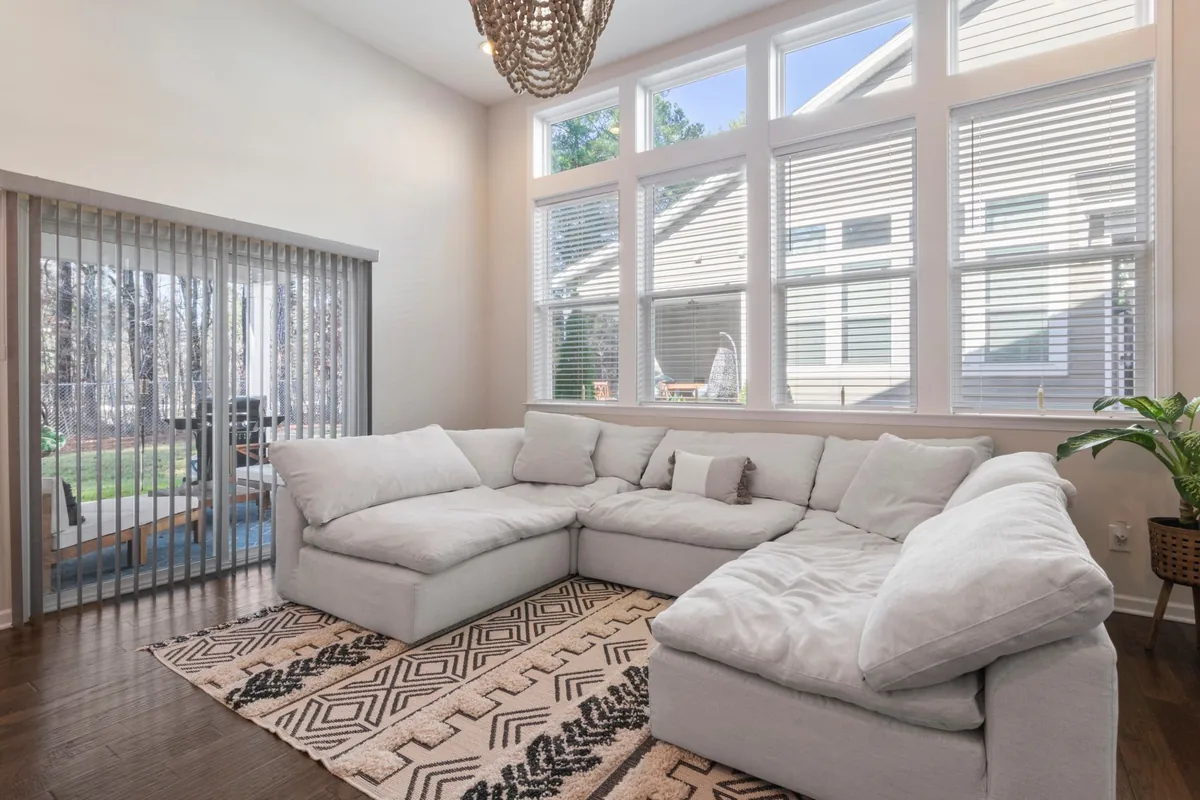
Fitting a sectional. Measure the space for each part of the L or U, plus room for a chaise or recliner extension, on the Raymour & Flanigan size guide. On one retailer’s sectional guide, leave 18 to 24 inches between the sectional and side tables or a media unit; generally, leave at least 30 inches for main walkways and at least 18 inches to a coffee table. Keep the chaise out of walkways and doorways; putting it along the wall keeps the middle of the room open. To tell a left-facing from a right-facing sectional, stand in front of it, facing it: if the extended section is on your left, it is left-facing. Outline it on the floor with painter’s tape before you choose, as that sectional guide suggests.
The Sundays Soft Spot 3-Piece Modular Sectional Right shows how far a real listing can sit from the chart. It prints 126.75 inches wide, 59.5 deep and 33.5 high, with an 18.5 inch seat depth. Its long side, 126.75 inches, is inside the 95 to 130 inch range per side; its 59.5 inch depth is just under the 60 to 72 inches Coleman gives a chaise and well under Raymour & Flanigan’s 90 to 110 at the chaise (our comparison). The listing doesn’t say which piece sets that depth. Measure your room against the listing, not the chart (our suggestion). It is $4,190 at 11 October 2026 prices (price for reference only).
Will it get through the door?
Check the way in before you order. Diagonal depth is one number to check: on one retailer’s measuring guide, the sofa’s diagonal depth must be less than the door’s width and its length less than the door’s height (or the entry’s clearance depth), and the guide adds that its rules do not guarantee a fit. For a sectional or modular couch, compare each piece, not the assembled shape. The furniture buying guide linked above walks through the doors, stairs, hallways and elevators on the route, and how to check a couch that arrives boxed.
More guides to choosing furniture are on the category page.
Where these numbers come from
Size ranges come from two furniture retailers’ size guides, and seat, arm and back figures from sofa makers’ and retailers’ comfort and measuring guides, each linked at its figure. Product dimensions and prices are from the Sundays product pages, read on 11 October 2026; figures marked “our arithmetic” or “our comparison” are ours.
Frequently asked questions
What is the standard size of a couch?
A standard three-seat couch is typically 72 to 96 inches long and 30 to 36 inches high on two furniture retailers' size guides; one puts the depth at 30 to 38 inches, the other at 30 to 40. Within that, one of them calls 84 inches the most common length. On the first retailer's guide, most seats are 17 to 19 inches off the floor, and seat depth is generally 20 to 24 inches.
How do I measure a couch?
Measure the length on the outside, from arm to arm; the depth from the front of the seat to the back, cushions and frame included; and the height from the floor to the highest point of the back. Then measure the seat height to the top of the seat cushion, the seat depth from the seat edge to the back cushion, and the diagonal depth if the couch has to go through a door.
What size is a sectional couch?
On one retailer's size guide, an L-shaped sectional is 90 to 120+ inches long and 90 to 110 inches deep at the chaise, and a U-shape 120 to 160+ inches long. Another retailer's guide puts each side of an L at 95 to 130 inches and the pieces of a modular sectional at 30 to 40 inches wide each. Plan on about 18 inches of seat cushion per person, on the first retailer's sectional guide.
How big is a sleeper sofa when it is open?
Closed, a sleeper is about the size of a standard couch: 72 to 96 inches long and 36 to 40 inches deep on one retailer's guide, and open it can measure 75 to 90 inches front to back. On another retailer's sleeper guide, most pull-outs extend at least 60 inches forward, with mattresses from twin (38 x 75 in) to king (76 x 80 in).
What seat depth is best for tall people?
On one sofa maker's comfort guide, 23 to 25 inches for a taller person, 21 to 22 inches for someone between 5'4 and 5'10, and about 20 inches for a smaller person, if you sit upright; add a few inches if you lounge. For seat height, one retailer's sectional guide says taller people might prefer 18 to 20 inches and shorter people 16 to 18.
- #couch dimensions
- #how to measure a couch
- #sectional couch
- #sleeper sofa