Wall Art Prints: Sizes, Paper, Framing and Where They Go
Pick a size for your wall, then the print type and paper, the pixels a file needs, a frame and mat that fit, and a spot that slows fading and warping.
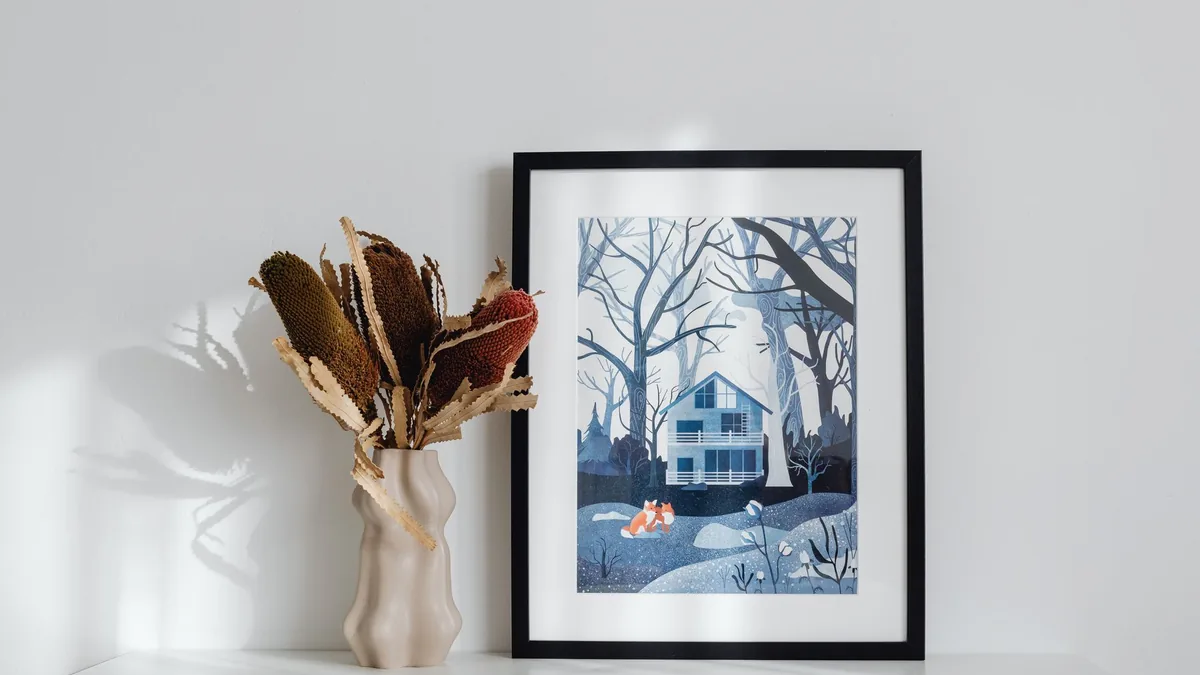
The print looked right on screen, then on the wall it is small and lost, or it got cropped, or the glass shows your window instead of the picture. The usual wrong fix is choosing by the image alone, when standard sizes come in different shapes (a 2:3 photo ordered at a 4:5 size gets cropped) and a 16x20 frame can hold an 11x14 print. So this page goes in the order you do it:
- Measure the furniture or wall and pick a size.
- Choose the kind of print and the paper surface.
- If you are printing a digital download, check its pixels against that size.
- Match the frame, mat and glazing to the print.
- Hang it away from direct sun and swings in humidity.
- If you are hanging more than one, keep one gap.
How big should the print be for the wall?
Measure the sofa, bed or console the print will hang over. One retailer’s size guide says to aim for a piece, or an arrangement, about two-thirds the width of that furniture. Heights and the gap above a sofa are in our living room decor ideas, and for over a bed see our bedroom decor ideas.
Then check the size against the standard ones. These are the sizes and shapes the two sources list:
| Print size (in) | Shape (ratio) | Listed by |
|---|---|---|
| 8x10, 16x20, 24x30 | 4:5 | WHCC (print lab) |
| 12x18, 16x24, 20x30, 24x36 | 2:3 | WHCC |
| 11x14 | close to 4:5 but not equal (our arithmetic: 0.786 against 0.8) | Americanflat (frame retailer) |
| 18x24 | 3:4 (our arithmetic) | Americanflat, as a poster size |
| A4 (8.3x11.7), A3 (11.7x16.5), A2 (16.5x23.4) | about 1:1.41 (our arithmetic) | Americanflat |
| 8.5x11 | US Letter, not the same as 8x10 | Americanflat |
A print is a fixed shape, so the shape of your image matters. WHCC’s crop-ratio page says cameras most commonly default to a 2:3 ratio, that a 2:3 file ordered at a 4:5 size gets some cropping, and that a border or fitting the file to the print ratio are two other ways to handle a mismatch. A 2:3 photo at 16x20 loses about one-sixth of its long side, 4 of 24 inches (our arithmetic). If the crop would cut something off, pick a size with the same ratio as the image (a 2:3 photo suits 12x18 or 24x36).
A single print can fall short of that on its own. A print lab’s guide says an 84-inch couch calls for art 47 to 63 inches wide; two-thirds of 84 is 56 inches, and a 24x36 hung upright is 24 inches wide (our arithmetic). Two upright 24x36 prints with a 2.5 inch gap come to 50.5 inches before the frames (our arithmetic), so a pair, or one large piece, is what fills that range.
What kind of print: giclée, poster, canvas or photo paper?
The name tells you the ink and paper, so ask for both.
- Giclée (archival pigment print): Printful’s guide describes it as inkjet printing with pigment-based inks on acid-free archival paper or canvas, and says buyers expect it to be better than a regular poster. At one photo lab, the fine art prints are inkjet printed with archival pigment inks on papers including 100% cotton ones.
- Poster: the Printful page gives no paper or ink spec for posters, so ask the seller for the paper and the ink before you pay for a large one (our suggestion).
- Canvas: the same guide calls canvas the best option for painting reproductions, because the rough canvas texture imitates brushstrokes.
- Photo paper: the same photo lab prints photographs on Fujicolor Crystal Archive paper, and its lustre is a semi-gloss surface it suggests for framed wall portraits of any size.
Next the surface, which decides glare and feel. These are descriptions from the labs, each for its own papers:
| Surface | What the lab says | Where it suits (our reading) |
|---|---|---|
| Smooth matte cotton | WHCC: Smooth Matte is 100% cotton with a smooth surface, its most popular fine art paper | Detailed art and portraits; a clean, soft look |
| Textured cotton rag | WHCC: Aquarelle Rag is 100% cotton with a textured, watercolor-like surface, ideal where you want a traditional, painterly look | Paintings and illustrations |
| Lustre or satin | WHCC: lustre is a semi-gloss surface with bold colors | Photographs where you want color without a mirror finish |
| Glossy or pearl | FinerWorks: glossy is shiny and reflective and enhances color vibrancy; WHCC: Pearl is very reflective, a high-gloss finish | Vivid, high-contrast images, hung away from windows |
On glare, FinerWorks says matte papers have a non-reflective surface and work well for prints displayed under direct lighting, to minimize glare. For a typographic print, theprintspace’s guide recommends a smooth, bright white matte paper, since texture shows in flat areas and gloss can cause glare on text. If you want the archival part in writing, FinerWorks says to look for papers that are acid-free and lignin-free.
Printing a digital download yourself: how many pixels?
Check the file’s pixel size before you order. This photo lab’s pixel chart lists pixels for each size at three resolutions:
| Print size (in) | 125 PPI | 180 PPI | 300 PPI |
|---|---|---|---|
| 8x10 | 1000x1250 | 1440x1800 | 2400x3000 |
| 11x14 | 1375x1750 | 1980x2520 | 3300x4200 |
| 16x20 | 2000x2500 | 2880x3600 | 4800x6000 |
| 18x24 | 2250x3000 | 3240x4320 | 5400x7200 |
| 24x36 | 3000x4500 | 4320x6480 | 7200x10800 |
That lab says it prints files at 125 PPI or higher well, adds that other factors can affect the result, and says pixels cannot be added by enlarging an image, only removed. A print-on-demand company’s giclée guide sets 300 DPI as the minimum for a print to count as giclée. The two figures come from different kinds of source, so use the minimum the printer you order from states. If your file is short of the 125 PPI column for your size, pick the next size down (our suggestion).
How do you frame it: frame size, mat and glass
Start from the print, not the frame. At Americanflat, an unmatted print goes in a frame of its exact size, and a matted print goes in a frame whose mat opening is the print size: a 16x20 frame with a 12x16 mat hangs as a 16x20 and displays a 12x16 print. The mat overlaps the print by about a quarter inch on each side, and the guide says to order the opening that matches your print size and not to size down for the overlap. Its standard pairings:
| Print size (in) | Frame size with mat | Other openings that frame lists |
|---|---|---|
| 5x7 | 8x10 | none listed |
| 8x10 | 11x14 | 8x11 opening |
| 12x16 | 16x20 | 11x14, 8x10, 6x8 |
| 14x20 | 18x24 | 9x12, 8x10 |
| 20x26 | 24x30 | 13x19, 14x17, 9x12 |
| 24x36 | 28x40 | none listed |
A few things go wrong here:
- The frame is bigger than its name. The same guide says the outer edge measures slightly larger because the moulding sits outside the size in the name; a print lab’s guide says framed prints add inches to the overall size. Check the outer size on the product page against the wall space.
- A small print in a big frame is fine. The guide says a wider mat in a larger frame gives a small print presence without enlarging the art, which is the fix for a small image you love.
- Poster edges. If a poster has text or a signature near the edge, check the moulding width, since a wide moulding can overlap the outer part of the print.
- 8.5x11 is not 8x10. A certificate or letter-size print needs an 8.5x11 opening.
Glass or acrylic
The glazing is the front of the frame. At one framer, glass is fragile but generally scratches less, and can be significantly heavier than acrylic; over 16x20 the weight gap can be significant, while acrylic is lighter and more likely to scratch. Clear glazing is reflective and could cause glare near a window, and non-glare softens the colors, so that framer suggests it for pieces without bright colors or in black and white. Standard acrylic or glass blocks UV rays only of a certain length, so ask your framer about UV-protective options. The same maker lists a Conservation Clear acrylic with 99% UV protection, which is that maker’s own product and not a standard.
If the print will face a window, ask for UV-filtering glazing and, if the room is bright, non-glare (our suggestion). If it hangs in a dim hallway, clear is enough (our suggestion).
A ready-made frame with a mat
If you want one purchase for an 11x14 print, here is a ready-made frame at a stated size.
Americanflat Veranda Picture Frame, 16x20 with 11x14 mat
The page lists three frame sizes, 8x10, 11x14 and 16x20. The 16x20 gives an 11x14 print a mat about 2¾ inches wide at the sides and 3¼ inches top and bottom, measured from the 10.5 x 13.5 inch opening and less what the frame lip covers (our arithmetic). It weighs 2.62 lb and has sawtooth hangers.
Drawbacks: The glazing is 1.0 mm plastic and not glass, so it scratches more easily (the framer's guide above), and the page prints no UV rating for it. The mat opening is 10.5 x 13.5, a quarter inch under the print on each side, so it is for an 11x14 print and not a 12x16.
Where should it hang to slow fading and warping?
A conservation center’s leaflet is written for libraries and archives, not homes, so what follows applies its wording to a wall (our reading).
- Direct sun: visible light will fade colors, ultraviolet light speeds the embrittlement of paper, and light damage is cumulative and irreversible. Framed color photographs or watercolors belong away from any direct light (sunlight and spotlights), glazed with UV-blocking glass or Plexiglas, and exhibits are kept away from windows and doors.
- Humidity: paper absorbs moisture and expands when humidity is high and shrinks when it is low, and rapid movement can lead to distortion. Mold is more likely at higher relative humidity. The range for paper in combined-use areas is 30% to 60% relative humidity at 68°F plus or minus 4°F. A cheap hygrometer on the wall tells you where a room sits (our suggestion).
- Outside walls: materials stored close to exterior walls are affected by the outside temperature. A print on an outside wall may run colder than the rest of the room (our reading).
- Bathrooms and kitchens: the leaflet has no advice on them. A room that steams and then dries swings between humid and dry (our reading), so the safer place for a paper print is a living area.
- Heat: one framer’s gallery wall guide says to keep the bottom of an arrangement at least 12 inches above a radiator to avoid heat damage.
The wall colour behind the print is a separate decision; our best colors for living room page covers it.
Hanging more than one: a pair, a grid or a gallery wall
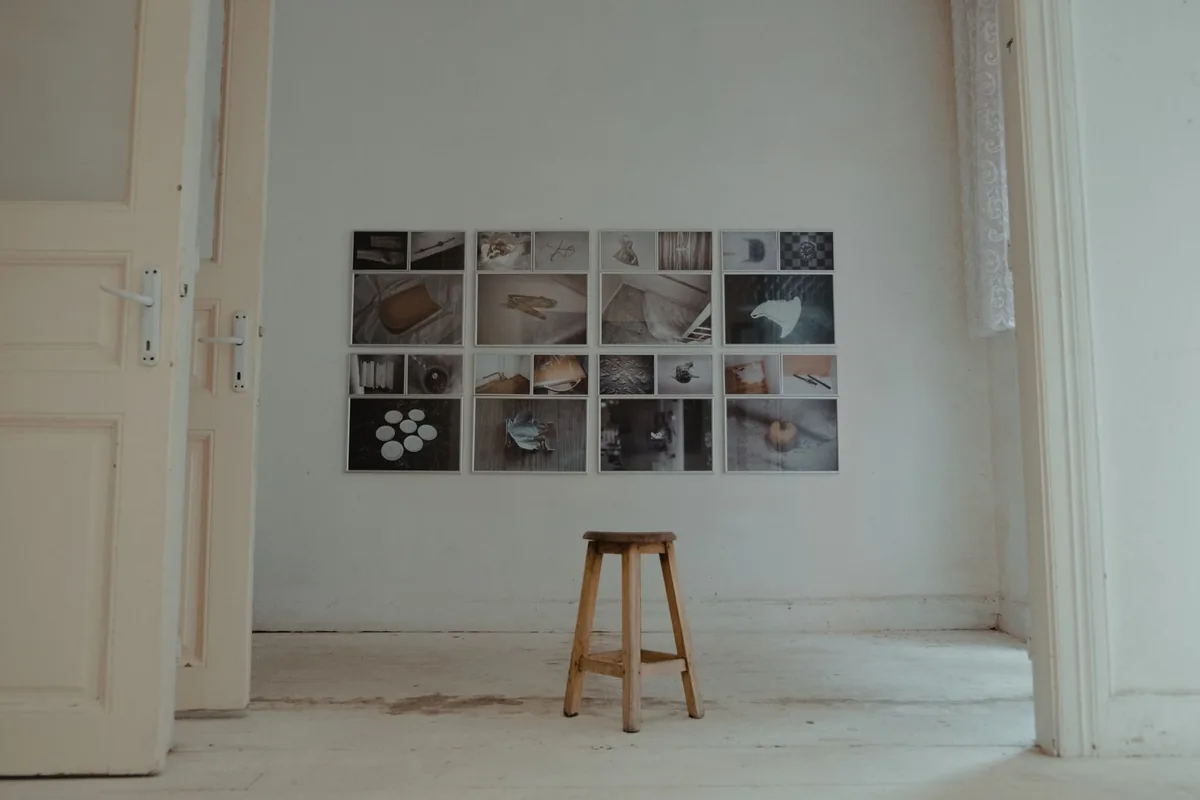
Treat the group as one shape, with one gap. One framer says to keep 2 to 3 inches between frames and to hang the center of the grouping 57 to 60 inches from the floor, and that a gap that drifts from 2 to 4 inches across one wall reads as carelessness. Another framer gives 1.5 to 2 inches as tight spacing for grids and 2.5 to 4 as standard, so the two guides span 1.5 to 4 inches, and both want the gap the same throughout.
- A pair: two frames of the same size with one 2 to 3 inch gap, centered together as one group (our suggestion).
- A grid: the tight end of the range. The second framer puts the geometric center of the whole grid at 57 inches.
- Mixed sizes: Americanflat says to keep one thing constant, either one color across mixed sizes or one size across mixed colors. The second framer says the mat color is the strongest visual unifier, even with mismatched frames.
- Above furniture: the bottom of the group sits 5 to 8 inches above it at the first framer and 6 to 12 inches at the second; the gap above a sofa is settled in our living room article.
Lay it out first. The second framer’s method is to cut paper to each frame’s size, tape the templates to the wall with painter’s tape, step back, and only then mark the hooks.
Where these numbers come from
Print sizes, mat pairings, spacing, pixel charts, paper descriptions, glazing and conservation guidance come from the Americanflat, WHCC, Nations Photo Lab, Printful, FinerWorks, theprintspace, Frame It Easy, Frameology, CustomPictureFrames and NEDCC pages linked above, read on 11 November 2026; the frame price is from Americanflat’s product page, read the same day. The crop fraction, the 50.5 and 56 inch widths, the ratios and the mat borders are our arithmetic from those figures.
Frequently asked questions
What size wall art print should I get for a living room?
One retailer's size guide says to aim for a piece or arrangement about two-thirds the width of the sofa beneath it; a print lab's guide gives 47 to 63 inches for an 84-inch couch. Over an 84-inch sofa two-thirds is 56 inches (our arithmetic), wider than any single print up to 24x36, so a large piece or a pair of prints fills that range (our arithmetic). Our living room decor ideas page has the heights.
Do I need a mat for a print?
No. At one frame retailer, an unmatted print goes in a frame of exactly its own size, and a matted one goes in a frame whose mat opening is the print size. The same guide says a wider mat in a larger frame is how a small print gets more presence without enlarging the art.
Should I choose glass or acrylic for the frame?
One framer's guide says glass is generally less susceptible to scratching but can be significantly heavier, with a weight gap that can be significant on frames over 16x20, and that acrylic scratches more easily. It also says standard glass or acrylic blocks only part of the UV range and suggests asking the framer about UV-protective options. A conservation center's leaflet advises glazing with UV-blocking glass or Plexiglas for framed color photographs and watercolors.
How many pixels does a file need to print at 16x20?
One photo lab's chart gives 2000x2500 pixels at 125 PPI, 2880x3600 at 180 PPI and 4800x6000 at 300 PPI for 16x20, and says it prints files at 125 PPI or higher well. A print-on-demand guide says giclée files need at least 300 DPI, so check the minimum at the shop you order from.
Can I hang a print in the bathroom or kitchen?
The conservation leaflet read here gives no bathroom or kitchen advice. It does say paper absorbs moisture and expands when humidity is high, that mold is more likely at higher humidity, and that its combined-use range for paper is 30% to 60% relative humidity. A steamy room is more likely to leave that range (our reading), so a room with steady humidity is the safer wall.
- #wall art prints for living room
- #framed art prints
- #giclee print
- #print and mat sizes