Bedroom Decor Ideas: Where the Bed, Lamps, Art and Rug Go
How to put a bedroom together in order: where the bed goes, how high the nightstands, lamps and art hang, what rug and curtains do, and how to dress the bed.
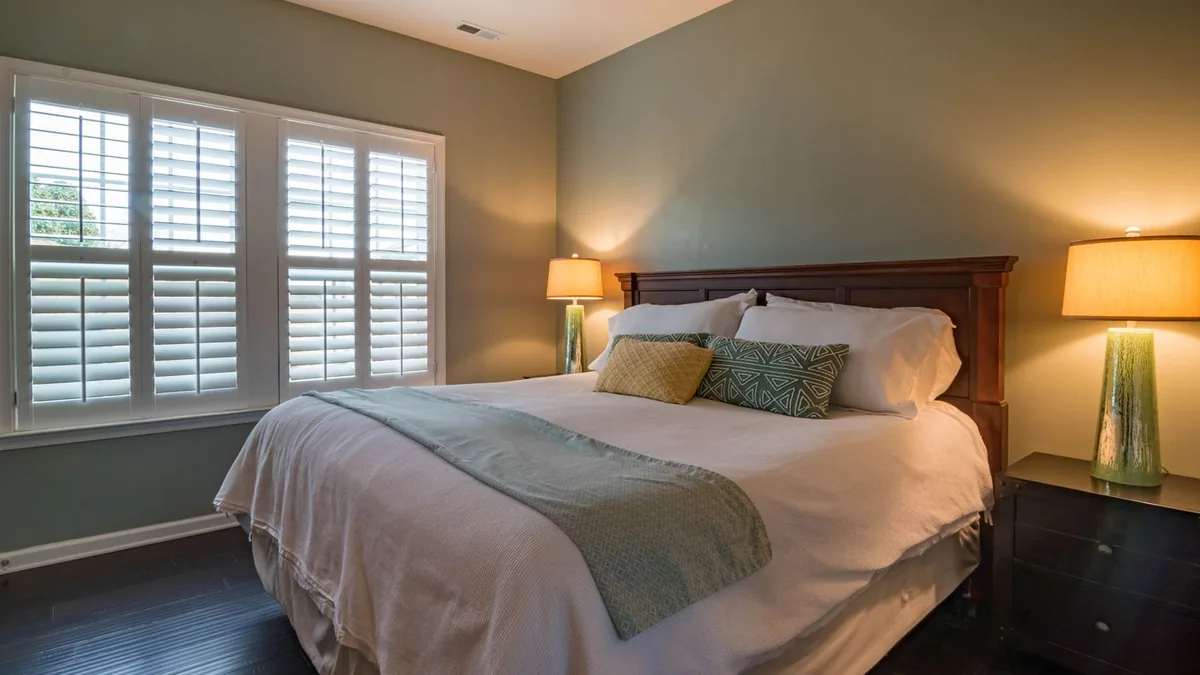
The bed is in, the lamps are on, and the room still reads as a bed with things around it. One common cause (our reading) is buying the pieces that finish a room (art, pillows, a rug) before the ones that set its measurements, so the nightstands end up wherever they fit and the art floats above them. Below are the steps in the order each one depends on the last, from where the bed goes to how to dress it, with the clearances, heights and sizes that makers’ and retailers’ guides give.
The short answer
- Place the bed first, headboard on the longest unbroken wall, not directly in line with the door: 24 to 36 inches clear on each side, 30 or more at the foot if you walk past it (one mattress retailer).
- Hang art over the headboard about two-thirds as wide as the bed, its bottom edge 8 to 12 inches above the headboard (one art retailer); measure up from the headboard.
- Set the bedside: nightstand top level with the mattress top or an inch or two above it; lamp shade bottom roughly at seated eye level; or a sconce 30 to 36 inches above the mattress top (one lighting retailer). Warm 2700K to 3000K bulbs, dimmable.
- Rug: a 9’ x 12’ under a queen leaves 42 inches each side of the bed in one rug maker’s guide; an 8’ x 10’ keeps the area around the bedside tables clear.
- Windows: blackout panels about 20 to 30% wider than the frame, with the rod 3 to 5 inches past each side (one curtain maker).
- Dress the bed: sleeping pillows and euro shams at the headboard, accent pillows in front (one mattress maker), and a throw at the foot (our suggestion).
Where should the bed go?
Place the bed before anything else, then fit the rest around it. In one mattress retailer’s layout guide, the headboard goes on the longest unbroken wall, ideally the one you see when you walk in but not directly in line with the door, and a bed centered on a solid wall reads as intentional even in a small room. It suggests keeping the headboard away from a window if you can: you lose the ability to open it and the curtains fall on your pillows. If both long walls have windows or closets, it puts the headboard on the wall with the least traffic.
Then check the gaps. The same guide gives:
- Each side of the bed: 24 to 36 inches. Thirty is comfortable, 24 is the minimum for a side you use every night, and under 18 is a squeeze.
- The foot of the bed: at least 30 inches if there is a walkway there, 36 if it leads to a closet or bathroom.
- In front of a dresser: 36 inches, so a drawer can open fully with room to stand back.
- Doors: the full swing of bedroom and closet doors kept clear; measure the arc, not the door width.
In a room under about 10 by 10 feet, the guide suggests considering pushing the bed to one wall: one accessible side and a full walkway often beats two cramped sides. It says this suits a single sleeper and works badly for a couple, and for two sleepers it keeps 24 inches minimum on each side.
What goes on the wall above the bed?
A single piece, or a symmetrical pair, about two-thirds as wide as the bed. One art retailer’s guide gives 40 to 48 inches over a queen and 50 to 60 over a king, never less than half the bed’s width, and centers the art on the bed rather than on the wall, since bedroom walls are often off-center because of a closet or window. An Australian art retailer also says about two-thirds. For a pair or a triptych, the first guide applies the two-thirds rule to the outer edges of the whole group, with 2 to 3 inches between the pieces of a pair and equal gaps in a triptych; the second also applies it to a group.
Height. Measure up from the top of the headboard, not from the floor; the 57-inch center used above a sofa would put the bottom of the frame inside a headboard that is 40 to 56 inches tall. The two guides’ gaps differ:
| Situation | Bottom of the frame | Whose figure |
|---|---|---|
| With a headboard | 8 to 12 in above the headboard (10 in as the default) | One art retailer |
| With a headboard | 15 to 25 cm above it, about 6 to 10 in | Another art retailer |
| No headboard | 28 to 32 in above the mattress top | The first retailer |
| No headboard | 20 to 30 cm above the mattress top, about 8 to 12 in | The second retailer |
With a headboard, the two overlap at about 8 to 10 inches above it (our reading), which is a safe place to start. Without one, the two do not overlap: the first guide’s 28 to 32 inches above the mattress puts the center around 62 to 68 inches, while the second also measures from the mattress top (its “virtual headboard”, about 15 cm above the pillows, is a visual check) and sits about 20 inches lower (our arithmetic). The first guide also says that with no headboard the wall reads emptier, so size the art to about three-quarters of the bed’s width. If you want the art to stand where it would over a headboard, use the first guide’s 28 to 32 inches (our reading). The first guide adds that the center usually lands 62 to 70 inches from the floor, and that a headboard 56 inches or taller leaves a band rather than a field, so a long, low piece 16 to 20 inches tall suits it.
Fixings. The first guide calls this the wall where a falling picture lands on a sleeper. The second says to use mechanical fixings, not just adhesive, above where you sleep; the first suggests two fixings about a third of the way in from each edge, into studs where possible, D-rings rather than wire, and a lighter format such as stretched canvas over a large piece under glass.
How should the bedside be set up?
Nightstand height. One mattress retailer’s nightstand page puts the top level with the top of the mattress, or an inch or two above it, and says slightly above beats slightly below. Its layout guide says within 2 to 4 inches of the mattress top. Measure from the floor to the top of the mattress with the sheets on and any topper in place, since that number, not the frame height, is the target. On that page mass-market nightstands cluster between 24 and 28 inches. Nightstands needn’t match: keep their heights within a few inches of each other. Matching ones on both sides are, in the layout guide, the easiest way to make a bedroom look finished, and where only one side has room it suggests one nightstand balanced by a wall sconce or a small shelf on the other side.
Table lamps. On the same nightstand page, the nightstand and lamp together should put the bottom of the lampshade roughly at eye level when you sit up in bed reading, usually around 40 to 48 inches from the floor, and the bulb should stay out of your sightline. Its example is a 24 to 28 inch lamp on a 26-inch nightstand. A taller nightstand wants a shorter lamp. To check before you buy, sit up against the pillows, have someone measure from the floor to your eyes, and compare it with the nightstand’s height plus the lamp’s height from its base to the bottom of the shade (our suggestion).
Wall sconces instead. One lighting retailer gives 55 to 65 inches from the floor or 30 to 36 inches above the mattress top, measured to the middle of the fixture. For reading, it suggests aiming the light source 6 to 12 inches above a seated person’s shoulder, and mounting exposed-bulb designs a little higher. With a nightstand, center the fixture over it; without one, about 12 inches in from the mattress edge. Fixed sconces need the height decided before the wall is finished, while swing-arm ones can be adjusted after.
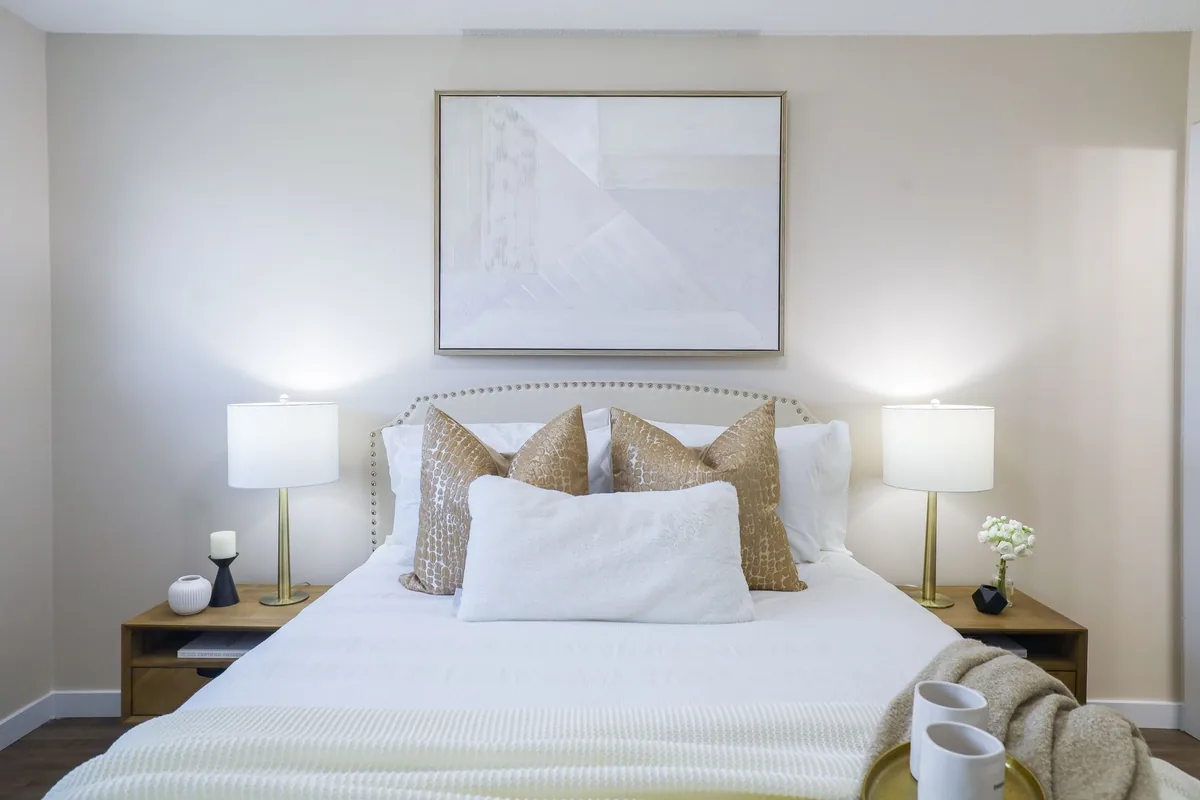
Bulbs. Warm white at 2700K to 3000K is often preferred in bedrooms for its calming effect, in one lighting supplier’s sconce guide, and dimmable LEDs let you turn the same light down from reading to winding down.
What rug goes under the bed?
Short answer for a queen: a 9’ x 12’ leaves 42 inches each side of the bed and room at the foot for a bench in one rug maker’s bedroom guide; its designer-recommended 8’ x 10’ keeps the area around the bedside tables clear, and a 6’ x 9’ is its minimum for 2 feet showing on either side. For a king it says 9’ x 12’ or wider, and calls an 8’ x 10’ not ideal for a king but workable with nightstands of 18 inches or less. How much rug shows once a real frame is on it, and whether the nightstands go on or off the rug, are worked out in our rug size for a queen bed guide. Choose the rug size once the bed and nightstands are marked out (tape their footprint), and lay it before the bed goes back in (our suggestion).
What should the windows do for sleep?
If streetlight or early sun wakes you, the fix is coverage rather than fabric, on one curtain maker’s blackout guide: it says most blackout failures are edge and seam leaks, not fabric: gaps at the sides, above the curtain line and where two panels meet. Its numbers are blackout panels 20 to 30% wider than the window frame, the rod reaching 3 to 5 inches past each side of the frame, and 2 to 4 inches of overlap at the center. It also suggests covering small standby lights and keeping mirrors and glossy frames out of the window line, since they bounce light back into the room. For how long the panels should fall, and what to add for light blocking at the hem, see curtain length.
Which colors suit a bedroom?
Choose the wall color after the bed and window wall are fixed, since which way the room faces and when you are in it decide how a shade reads. That is the job of our best bedroom colors guide; paint before the curtain rod and art go up (our suggestion).
How do you dress the bed?
Work from the headboard forward. In one mattress maker’s pillow guide, the sleeping pillows are the base: for a queen, two standard or queen-size pillows side by side, or two king-size for a more luxurious feel; for a king, two king-size, or a third added. Euro pillows, the large squares, stand upright against the headboard or the sleeping pillows, two or three for a queen or king.
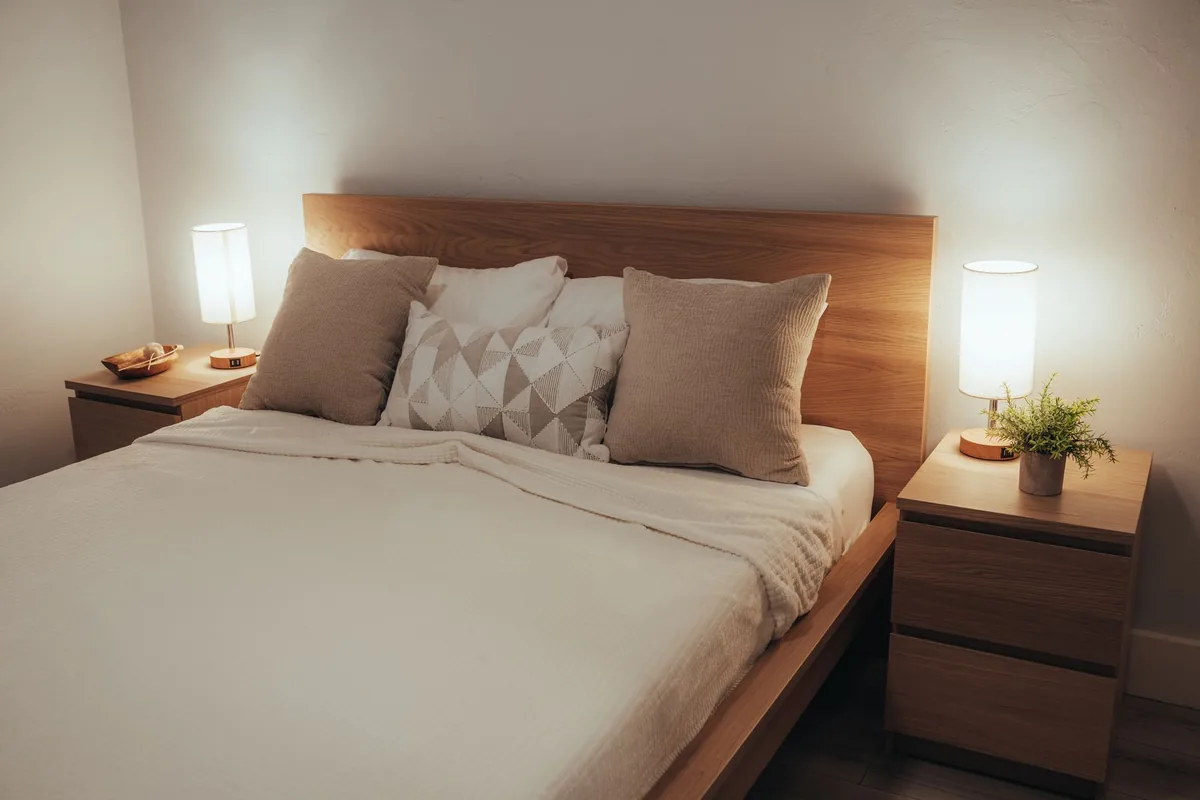
The guide’s classic symmetrical formula for a queen has three rows:
- Back: two 26-inch euro shams against the headboard.
- Middle: two standard or queen shams (20 inches) in front of them; these are the sleeping pillows in their covers (our reading).
- Front: two accent pillows in front of those.
It suggests even numbers for a balanced, symmetrical look, and odd numbers placed off-center for a more relaxed one, and warns that overstuffing leaves no room for you on the bed. For the throw, it suggests draping one over the bed; across the foot is the usual place, and it can carry the accent color (our suggestion). What goes underneath, from fitted sheet to duvet or comforter, is in our bedding guide.
What else goes in the room?
The layout guide’s remaining rules are about keeping the way through. The dresser goes opposite the bed or on the wall perpendicular to the headboard, whichever leaves the 36-inch drawer clearance, and not where it blocks the path from the door to the bed; in a narrow room it prefers a taller, shallower chest to a wide, low dresser. A bench at the foot is worth having only if you have the 30-inch walkway to spare, and a reading chair belongs in a corner with a light, not in a traffic path. In a small bedroom it says to cut seating before cutting walking space, and to keep sightlines clear from the door, since seeing across the room when you walk in makes it feel bigger.
In what order should you do it?
The order is our suggestion, built from the steps above.
- Measure the room and mark doors, windows, closets, outlets and the swing of every door.
- Place the bed on the longest unbroken wall, off the window, centered, with 24 to 36 inches each side.
- Place the dresser and any bench or chair with their clearances, before anything small.
- Set the nightstands to the mattress-top height, with a lamp shade at seated eye level or a sconce 30 to 36 inches above the mattress.
- Choose the rug size once the bed and nightstands are marked out, and lay it before the bed goes back in.
- Choose the wall color and paint.
- Hang the curtains, wide enough for blackout coverage.
- Hang the art over the headboard, measured up from it.
- Dress the bed from the headboard forward: euro shams, then the sleeping pillows, then accent pillows and the throw.
Where these numbers come from
Clearances, nightstand and lamp heights come from one mattress retailer’s layout and nightstand pages; art size and height from two art retailers; sconce height from a lighting retailer; bulb color from a lighting supplier; rug sizes from a rug maker; blackout widths from a curtain maker; pillow layouts from a mattress maker. All were read on 20 October 2026. The centimeter-to-inch conversion and the overlap in the art heights are our arithmetic and reading.
Frequently asked questions
How far should a bed be from the wall and the dresser?
One mattress retailer's layout guide gives 24 to 36 inches on each side of the bed (24 is its minimum for a side you use every night), at least 30 inches at the foot if there is a walkway there, and 36 inches in front of a dresser so the drawers open fully.
How high should art hang above a bed?
Put the bottom of the frame 8 to 12 inches above the top of the headboard in one art retailer's guide, and 15 to 25 cm (about 6 to 10 inches, our arithmetic) in another's. The two overlap at about 8 to 10 inches (our reading). Measure up from the headboard, not from the floor.
How tall should a nightstand be?
Level with the top of the mattress or an inch or two above it on one mattress retailer's nightstand page; the same retailer's layout guide says within 2 to 4 inches of the mattress top. Measure from the floor to the top of the mattress with the sheets on and any topper in place.
How high should a bedside lamp or wall sconce be?
For a table lamp, one mattress retailer wants the bottom of the shade roughly at eye level when you sit up in bed, around 40 to 48 inches from the floor. For a wall sconce, one lighting retailer gives 30 to 36 inches above the mattress top, or 55 to 65 inches from the floor, measured to the middle of the fixture.
What color light bulbs are best for a bedroom?
Warm white: one lighting supplier says 2700K to 3000K is often preferred in bedrooms for its calming effect, and that dimmable LEDs let you set the brightness for reading or winding down.
- #bedroom layout
- #nightstands
- #bedside lamps
- #wall art
- #pillows