Wallpaper for a Bedroom Wall: Which Wall, Paper and Pattern
Wallpaper for one bedroom wall in the order you decide it: which wall, peel-and-stick or paste, pattern size, how many rolls and taking it down later.
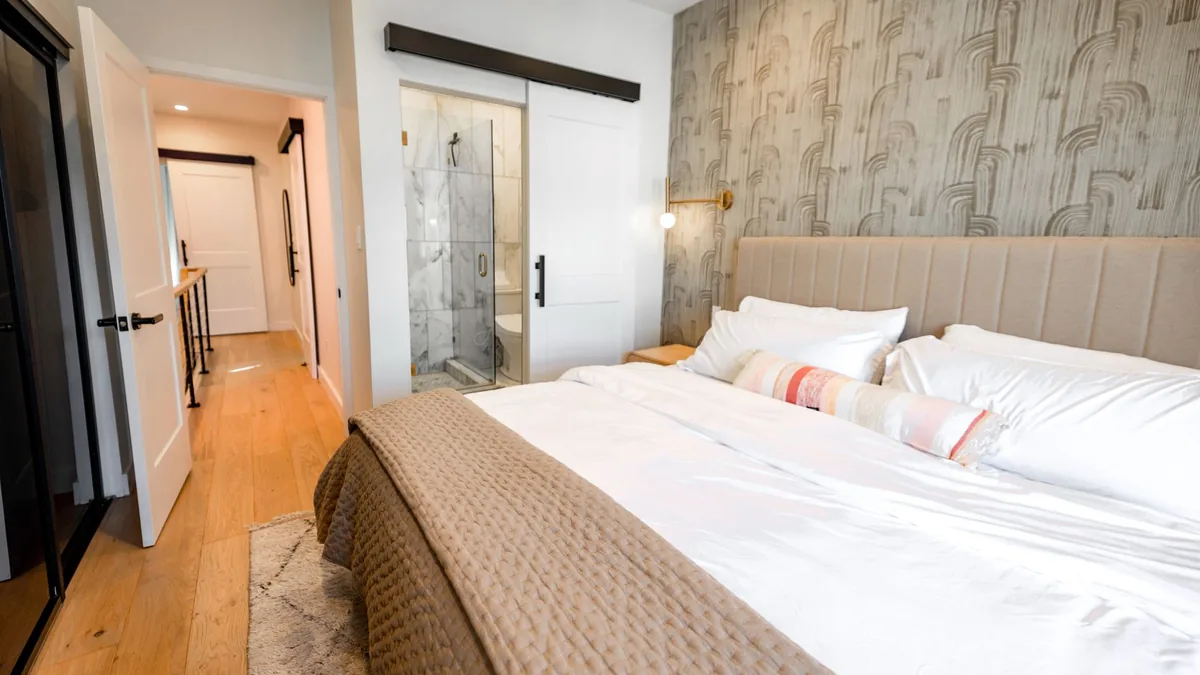
You have a bare wall behind the bed, a few samples on the nightstand, and five choices that depend on each other: which wall, which kind of paper, how big a pattern, how many rolls, and what happens when you want it gone. The order below follows those choices, so the buying is settled before the first strip goes up. Where makers give different numbers, each one is named, so you can follow the maker whose paper you buy.
The short answer
| Decision | Short answer | Numbers and sources |
|---|---|---|
| Which wall | Behind the bed; with no window or door, strips run full height | Headboard-alternative placement (Tempaper); full-height first strip on a wall with no door or window (Graham & Brown) |
| Wall check | Smooth, clean, dry; test a sample | Fresh paint: at least 30 days (Tempaper peel-and-stick), 30 to 60 days (Tempaper unpasted) |
| Paper | Peel-and-stick, prepasted or paste-the-wall | Paste-the-wall: paste on the wall, paper hung dry (Graham & Brown) |
| Pattern | Large print behind the bed with simple furnishings, or a delicate pattern for a quieter wall; random match wastes less | Tempaper small-room guide; Graham & Brown for match types |
| Rolls | Strips across, strips per roll, plus the maker’s extra | 10% extra (Tempaper); 10 by 8 ft wall = 2 paste-the-wall rolls, 3 with a spare (our arithmetic and suggestion) |
| Hanging | Plumb line first; center a large motif on the bed (our suggestion) | Strip = wall height + 4 in (Graham & Brown; other makers differ) |
| Taking it down | Peel from a corner, or strip in sheets | Paint can lift on flat or matte (Tempaper) |
Which bedroom wall should you wallpaper?
Behind the bed is the placement one peel-and-stick maker suggests for a bedroom: the paper acts as a headboard alternative.
In our reading, a wall’s openings matter more than its position. Graham & Brown says to start on a wall with no doors or windows so you can hang a full length from ceiling to baseboard, and to avoid having to hang narrow strips against a window or door. A wall with openings still has to be measured at its full width and height, since Walls Need Love’s measuring guide treats doors and windows as if they were not there and cuts them away during installation, so you pay for paper that gets trimmed off (our reading).
- Bed wall with no window or door: the simplest case (our reading).
- Bed wall with a window or door: possible, but plan the layout so you do not end with a narrow strip beside an opening, and expect more cuts (our reading).
- Bed wall hidden by a wardrobe or sloping ceiling: the wall you see first from the doorway is our suggestion instead.
- Walls that are far from straight: Graham & Brown says a plain paper or a small, frequently repeating pattern may be better than stripes here, and that a single feature wall is an alternative to papering the room.
Is the wall ready for wallpaper?
Tempaper, Graham & Brown and Chasing Paper each ask for a smooth wall, and they differ on what else it needs. The detail for peel-and-stick (paint sheen, the wait after painting, texture, test patch) is in our guide to install peel and stick wallpaper; the short version is below.
- Peel-and-stick: a smooth wall primed and painted in eggshell, satin or semi-gloss; at least 30 days after fresh paint at one maker, 4 to 6 weeks at another.
- Paste-the-wall: Graham & Brown wants smooth, clean, dry walls with holes filled and rough patches sanded, and says a coat of primer or sealer helps the paper grip and makes later removal easier. Tempaper’s unpasted line asks for a smooth, primed and painted wall and 30 to 60 days after fresh paint.
- Light texture: one paste-the-wall maker says its paper hides minor texture and small cracks; Walls Need Love says paste-the-wall may suit lightly textured walls better and does not guarantee its peel-and-stick on textured ones; Chasing Paper recommends traditional paper over peel-and-stick for a slight texture.
Whatever the paper, put a sample on the wall first (Tempaper) and look at it in your bedroom’s own light, since screens and lighting change how a color looks.
Peel-and-stick, prepasted or paste-the-wall?
The three differ in where the adhesive comes from and in how the paper comes off.
| Type | What you do | Taking it down |
|---|---|---|
| Peel-and-stick | Peel the backing and press the paper on; no paste or glue (Tempaper) | Start at any corner and peel slowly, parallel to the wall (Tempaper) |
| Prepasted | Activate the paste with water; Walls Need Love says its prepasted needs nothing else, and Graham & Brown adds that prepasted paper has to rest (“book”) after soaking | Removable, and water can assist (Walls Need Love) |
| Paste-the-wall (non-woven) | Roll paste onto the wall and hang the dry paper; no soaking, no pasting table (Graham & Brown) | Strippable on a properly primed wall with strippable paste (Walls Need Love) |
On renting the makers disagree. Tempaper says unpasted wallpaper is not recommended for rentals and that its unpasted line is designed to be a more permanent fixture; Graham & Brown says its paste-the-wall paper is easy to remove without damaging walls, perfect for renters. If you rent, ask your landlord and peel-test a sample first (our suggestion).
Our suggestion for one wall: peel-and-stick if you want the shortest job and a stay of a few years on a smooth painted wall; paste-the-wall if the wall has a light texture or you want the paper to stay put for good. The bathroom moisture limits and heat-source distances in the install guide are less likely to matter in a bedroom (our reading).
Big pattern or small pattern on one wall?
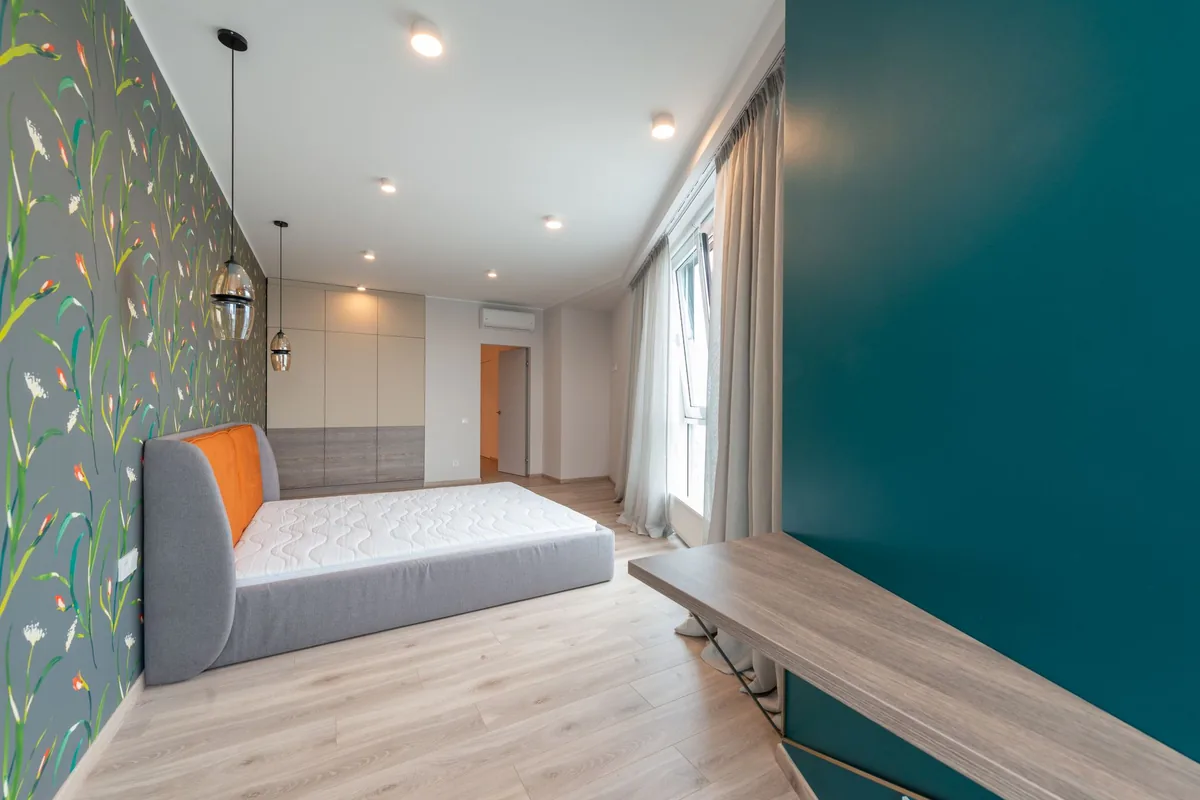
Tempaper’s small-room guide says a large print can work in a small bedroom as a statement wall behind the bed if the furnishings around it stay simple, that delicate patterns and fine geometrics add interest without overwhelming a room, and that vertical stripes or upward-moving motifs emphasize ceiling height. Its article on covering a whole room in one pattern, which is the opposite of one wall, ties scale to mood: small-scale prints feel cozy and inviting, medium-scale ones balanced and versatile, large-scale ones dramatic, especially in bigger rooms. Read that as a rough guide to the feel of each scale (our reading).
Match type changes how much you buy:
- Straight match: strips line up the same at the ceiling line.
- Drop match: every other strip lines up; a half drop runs the print diagonally and takes three strips to repeat (Tempaper’s match guide).
- Random (free) match: no alignment at the seams, as with vertical stripes or textures; Graham & Brown says it reduces wasted paper, and that offset (drop) matches need more paper and create more waste.
Large motifs may come as A/B rolls, where the pattern spans two rolls hung in alternating strips; the maker says to order equal numbers of each (A/B wallpaper guide).
For the rest of the room, the small-room guide suggests coordinating the paper with the surrounding paint, textiles and furnishings. Pull one of the paper’s colors into the bedding or the other walls (our suggestion; paint ideas are in our guide to the best bedroom colors). If the paper is bold, keep the larger furniture simple; if it is quiet, add interest through lighting and layered textiles. The rest of the room is covered in our bedroom decor ideas.
How many rolls does one wall take?
Order by strips, not by square footage alone, because the repeat decides how much of a roll you can use (our reading).
- Measure the widest width and highest height of the wall, leaving out baseboards and crown molding (Walls Need Love).
- Strips across: wall width divided by roll width, rounded up.
- Strip length: wall height plus 4 inches, which leaves 2 inches at the top and bottom for trimming (that is Graham & Brown’s figure for paste-the-wall; peel-and-stick makers give their own, as in our install guide; Graham & Brown). On a straight match each strip is cut from the same point in the pattern; on a drop match you lay the strips side by side to match before cutting, so allow up to half a repeat more (our reading).
- Strips per roll: roll length divided by strip length, rounded down.
- Rolls: strips across divided by strips per roll, rounded up, plus your maker’s extra.
The extras differ: Tempaper recommends 10% more than you calculated for its peel-and-stick, to allow for matching and trimming; Chasing Paper, which sells panels, 15%; Graham & Brown’s roll calculator on each product page already includes the repeat, and its guide says A/B designs need an even total. Walls Need Love prints to order from your wall size and adds its extra itself.
A worked example (our arithmetic). A 10 foot (120 inch) wide, 8 foot (96 inch) high bed wall with a Graham & Brown paste-the-wall roll, 20.87 inches wide and 32.81 feet (about 394 inches) long, with a 25.2 inch offset repeat. Strips across: 120 / 20.87 = 5.75, so 6. Strip length: 96 + 4 = 100 inches, plus up to half a repeat (12.6 inches), so 112.6 inches. Strips per roll: 394 / 112.6 = 3.5, so 3. Rolls: 6 / 3 = 2, which leaves no spare strip, so we would order a third roll (our suggestion); Graham & Brown’s own calculator includes the repeat, so check the number there. The same wall in a straight-match peel-and-stick paper on a 20.5 inch by 18 foot roll comes to 3 rolls, or 4 with Tempaper’s 10% extra, as worked in our install guide.
Two papers to run this on:
- Peel-and-stick: Tempaper’s Farmhouse Botanical, which the page lists for bedrooms among other rooms, is 20.5 inches by 18 feet, a straight match with a 20.5 inch repeat, $60.00 a single roll (price for reference only); its sample is $8.00 (price for reference only).
- Paste-the-wall: Graham & Brown’s Boreas Midnight, listed under its bedroom wallpapers, is $180 a double roll (price for reference only), covering up to 56 square feet; two of them are $360 for the wall above, and a third as a spare is $540 (our arithmetic; price for reference only), with the paste bought separately.
Whichever you buy, keep every roll from one batch or lot. Graham & Brown says paper from a different batch may not match and could be a slightly different color, and that it ensures batch numbers are all the same on online orders; for print-to-order paper, which carries no lot numbers at Tempaper and can vary between runs at Chasing Paper, see the install guide.
How do you hang one wall?
Move the bed away from the wall first (our suggestion), and turn the power off before touching outlets or wall lights.
Where to start. Graham & Brown says to start at the corner on a wall with no doors or windows, but not to trust walls and corners as straight: draw a plumb line with a level. For a large pattern its advice is to hang the first length over a focal point and work away in both directions, so the design ends up central and symmetrical; A/B papers start from a plumb line rather than a corner. On a bed wall, our suggestion is to treat the bed’s center line as that focal point: mark it, decide whether a motif or a seam falls on it, and work outward from there. With a small repeat, starting at the corner is fine (our suggestion).
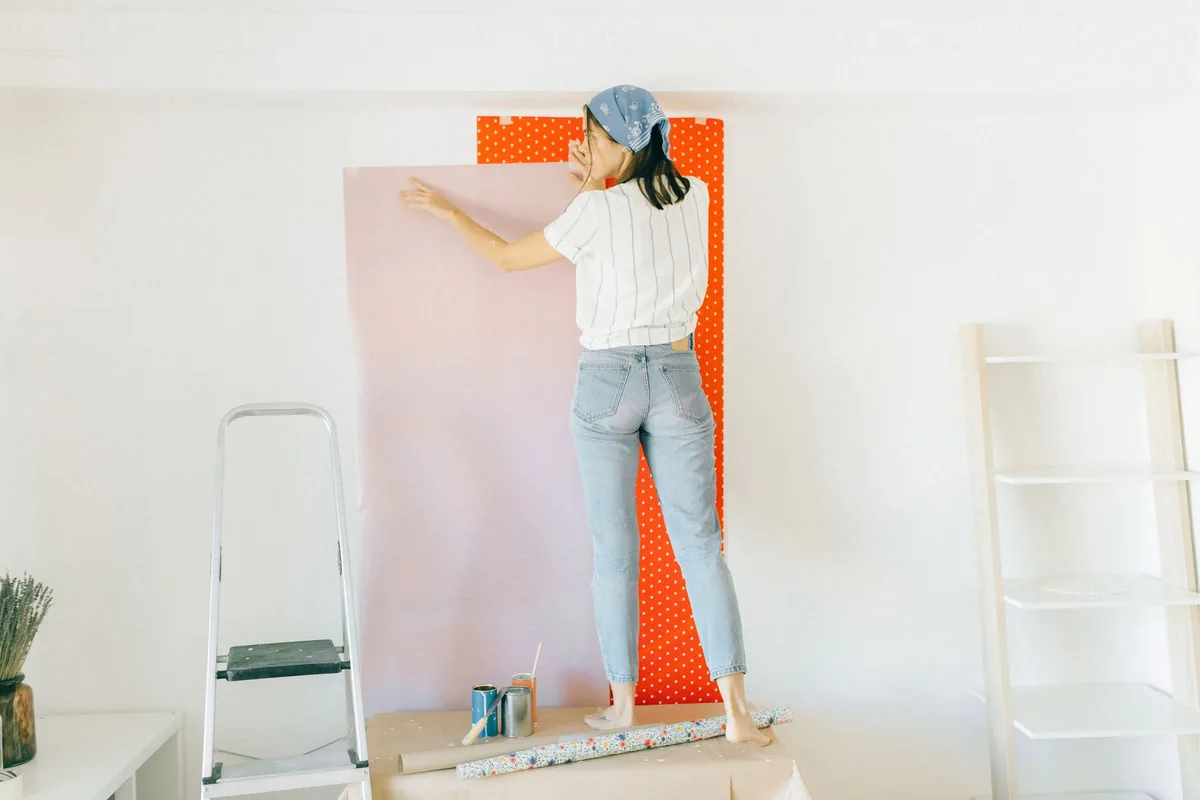
Peel-and-stick. The plumb line, the backing, the seams and the bubbles are all in the install guide linked above.
Paste-the-wall, the key steps.
- Draw a plumb line, and a fresh one each time you reach a corner or start a new wall (Tempaper’s unpasted steps).
- Cut the first strip to wall height plus 4 inches.
- Roll paste onto the wall, covering only a little more than the strip’s width (Tempaper). Graham & Brown recommends Solvite All Purpose Wallpaper Adhesive, which it says is formulated for its papers (one pack covers up to 4.5 rolls), and says pre-mixed pastes are not compatible with its papers.
- Slide the dry strip into place against the line and smooth it with a squeegee (Tempaper), center first and then outward (Graham & Brown).
- Butt the next strip against the last, not overlapping, matching the pattern at eye level, and run a seam roller lightly along the join (Graham & Brown).
- Trim the top and bottom with a straight edge and a precision knife (Tempaper). Paste on the ceiling or baseboard comes off with a wet sponge and clean water (Graham & Brown), and residue on the paper with a damp sponge (Tempaper).
Outlets and bedside lights. Graham & Brown’s method for a socket or switch: power off, let the paper hang over it, cut an X leaving a gap of about a centimeter before each corner, trim the flaps, loosen the faceplate, tuck the small flaps under it and screw it back. For wall fixings, the same maker says to unscrew them, leave the wall plugs in, mark each plug with a matchstick (head broken off), press the paper onto it to pierce it, and refit once the paper is quite dry. For hard-wired lights, switch the circuit off at the breaker first (our suggestion).
Can you take it down later?
- Peel-and-stick: peel from any corner, slowly, parallel to the wall. Whether paint comes with it depends on the sheen, the paint wait and what is underneath; the install guide’s section on taking it down lists each maker’s warnings.
- Prepasted: removable, and water can help it release (Walls Need Love).
- Paste-the-wall: one maker says non-woven paste-the-wall paper is designed to strip off in full sheets, and that most modern non-woven papers peel off in large sheets without steaming or scraping, especially on a primed wall. Another says its paper is strippable on a properly primed wall with strippable paste. Tempaper says its unpasted paper, hung with the recommended paste, can come off in full sheets, though the line is meant to be more permanent.
- Older pasted paper: Tempaper’s removal guide scores the paper, wets it with warm water, waits 10 to 15 minutes and lifts it with a plastic putty knife at a low angle, testing a small area first.
After the paper is off, residue comes away with dish soap and warm water, minor paint chips are likelier on bare drywall, and Tempaper says to prime before repainting.
Where these numbers come from
Measurements, rules and prices come from Tempaper, Graham & Brown, Walls Need Love and Chasing Paper pages linked above, read on 9 November 2026; prices are from the product pages with no code applied. The 10 by 8 foot wall and its roll counts are our arithmetic, and steps marked (our suggestion) are ours.
Frequently asked questions
Which bedroom wall should you wallpaper?
The wall behind the bed is the placement one peel-and-stick maker suggests for a bedroom, as a headboard alternative. If that wall has no window or door, one maker's guide says the first strip can run full height from ceiling to baseboard, and it advises avoiding narrow strips beside a window or door. If the bed wall is hidden by a wardrobe or a sloping ceiling, the wall you see first from the doorway is our suggestion.
Is peel-and-stick or paste-the-wall better for one bedroom wall?
Peel-and-stick needs no paste and peels off from a corner, but its makers want a smooth, painted wall and a wait after fresh paint. Paste-the-wall (non-woven) goes on with paste rolled onto the wall; one maker says it hides minor texture and strips off in sheets on a primed wall. On renting the makers disagree, so ask your landlord and test a sample first.
How many rolls of wallpaper does one bedroom wall need?
Count strips across (wall width divided by roll width, rounded up), then strips per roll (roll length divided by strip length, rounded down), then add your maker's extra. Our arithmetic for a 10 by 8 foot wall: with Graham & Brown's 20.87 inch by 32.81 foot paste-the-wall roll that is 6 strips and 2 rolls with no spare strip, so we would order 3 (our suggestion); with Tempaper's Farmhouse Botanical (20.5 inches by 18 feet) it is 3 rolls, or 4 with Tempaper's 10% extra. Your maker's own calculator has the last word.
Should the pattern on one bedroom wall be big or small?
One peel-and-stick maker says a large print can work as a statement wall behind a bed if the furnishings around it stay simple, and that delicate patterns and fine geometrics add interest without overwhelming a room. A paste-the-wall maker advises a plain paper or a small, frequently repeating pattern on uneven walls, and says to avoid striped papers there.
Can you take bedroom wallpaper down later?
It depends on the type. Tempaper's peel-and-stick peels from any corner, slowly and parallel to the wall, and flat, matte or low-sheen paint could come off with it. One paste-the-wall maker says most modern non-woven papers peel off in large sheets without steaming or scraping, especially on a primed wall; another says its paste-the-wall paper is strippable on a properly primed wall with strippable paste.
- #wallpaper for bedroom wall
- #accent wall
- #peel and stick wallpaper
- #paste the wall wallpaper