How to Install Peel and Stick Wallpaper Without Bubbles
How to install peel and stick wallpaper in order: wall and paint checks, how many rolls, the plumb line, seams, bubbles, outlets, bathrooms and taking it down.
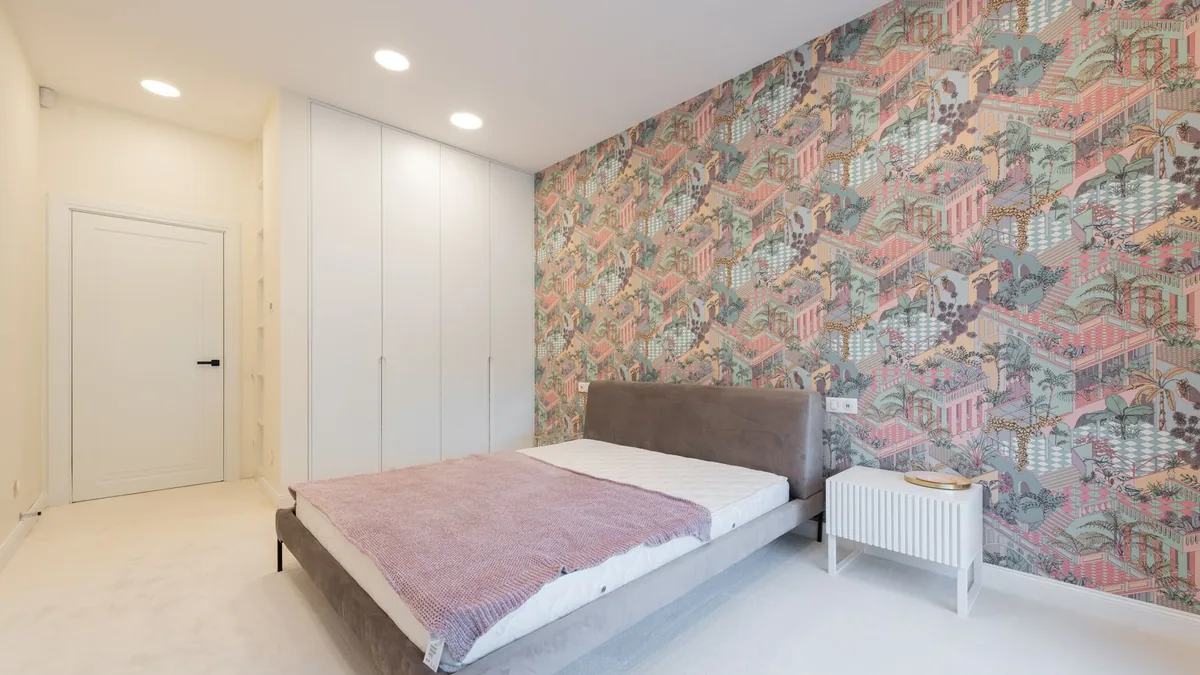
By the third panel the pattern has drifted off level, a bubble keeps sliding ahead of the squeegee, and a sliver of bare wall shows at a seam. Much of that is settled before the first panel goes up: one maker’s FAQ warns that paper hung before the paint has fully cured may bubble or peel, and the four makers below ask fresh paint to wait anywhere from 2–4 weeks to 30–60 days. Here are the steps in order, with each maker’s own number wherever they disagree, so you can follow the one whose paper you bought.
The short answer
| Step | What to do | Numbers to know |
|---|---|---|
| Check the wall | Smooth and painted (primer alone only for Chasing Paper, or Walls Need Love’s wallpaper primer); test a sample | Fresh paint: 2–4 weeks to 30–60 days by maker, or the paint can’s cure time if longer |
| Order | Count panels with the pattern repeat | 10% extra (Tempaper); 15% on Chasing Paper’s panels |
| Prep | Power off, covers off, wall cleaned | 1:1 isopropyl alcohol and water (Tempaper) |
| Mark | A plumb line from the corner | Roll width minus ½ in (Tempaper) |
| Hang | Top first on the line, smooth from the center out | Backing peeled 6 in to 4 ft at a time, by maker |
| Seams | Butt or overlap, as your maker says | About 1/32 in overlap (WallPops); seam to seam (Chasing Paper) |
| Trim | Straight edge, sharp blade, an X cut at outlets | Covers back, then power, once every panel is up |
| Remove | Power off and covers off, then peel from a corner, parallel to the wall | Flat, matte or low-sheen paint could come off (Tempaper; matte, Chasing Paper) |
Can your wall take peel-and-stick wallpaper?
All four makers want a smooth, sealed wall (painted, or at least primed) and differ on the details.
| Maker | Surface it wants | Not recommended, or warned about | Wait after painting |
|---|---|---|---|
| Tempaper | Smooth, primed and painted in eggshell, satin or semi-gloss | Flat, matte and low-sheen paint (paint could come off with the paper); textured walls (the FAQ allows nothing more than an orange peel); exterior surfaces; sheetrock | At least 30 days (FAQ); at least 4 weeks (product page) |
| WallPops | Clean, dry, smooth and flat | Textured walls; existing wallpaper; brick or cinderblock; unpainted drywall or plaster; outdoors; non-stick paint | At least 4 weeks (install guide); 30 to 60 days (FAQ) |
| Chasing Paper | Primer at least, primer and paint ideal; premium eggshell, satin or semi-gloss | Wallpaper straight onto drywall; orange peel, knockdown or bumpy walls; matte paint is a bit trickier, as the adhesive can bond and pull it | 4 to 6 weeks |
| Walls Need Love | A wallpaper primer gives the best adhesion | Textured walls carry no adhesion guarantee | At least 2 to 4 weeks for painted walls |
Use your own paper’s wait. Where your maker prints two figures, go by the longer (our suggestion): for WallPops that is 30 to 60 days, set so the paper will not damage the paint when it comes off. (Chasing Paper’s how-to page also says paint can take up to 4 weeks to cure; its prep step and FAQ say 4 to 6.) If your paint can gives a longer cure time, use that: Tempaper’s install guide says to follow the paint can, since paint types cure differently.
Check the sheen. Tempaper’s paper can go on flat or matte paint, but paint could come off when the paper does. Repainting in eggshell, satin or semi-gloss puts the wall on Tempaper’s recommended list and restarts the wait (our reading). The painting steps are in our weekend home improvement projects, and bedroom sheen and color in our guide to the best bedroom colors.
Check the texture. Tempaper’s install guide and textured-wall guide advise against textured walls in general. To try anyway, leave a sample over the roughest spot for a few days before you order: air behind the adhesive is one of the biggest reasons paper fails there, and texture may show through. Walls Need Love suggests skim-coating or sanding smooth, then a wallpaper primer, cured as the primer’s directions say. On any wall, test a small area for adhesion first (Tempaper).
Mind heat and water. WallPops says to keep its paper at least 15 inches from a stove, fireplace or other heat source. For a bathroom, read the moisture limits further down before you order.
How much peel-and-stick wallpaper should you order?
Measure each wall’s widest width and highest height; one maker’s measuring guide ignores doors and windows, since they are cut away. Then count panels, because the pattern decides how much of each roll you can use (our reading).
- Panels across. Wall width divided by paper width, rounded up: a 10 foot (120 inch) wall with 20.5 inch paper takes 5.85, so 6 panels (our arithmetic).
- Panel length. Wall height plus 2 to 3 inches at the bottom (Tempaper) or an inch or two at top and bottom (WallPops). For an 8 foot wall, 96 + 3 = 99 inches.
- The pattern repeat. On a straight match every panel lines up the same at the ceiling; on a drop match every other panel does; a random match, such as stripes, needs no alignment, per Tempaper’s match-type guide. On a straight match each length must start at the same point in the pattern, so with a 20.5 inch repeat a 99 inch panel uses 102.5 inches of roll (our arithmetic).
- Panels per roll. Roll length divided by that, rounded down. An 18 foot (216 inch) roll gives two, so six panels take three rolls. A 16.5 foot (198 inch) roll, the length Tempaper’s FAQ gives for some single rolls, gives only one full-height panel, so six rolls (our arithmetic). Check roll length before comparing prices.
- Extra. Tempaper’s removable wallpaper guide recommends 10% more than you calculated, which here means a fourth roll, since three give exactly six panels (our arithmetic); its match guide says to round up on straight and drop matches. Chasing Paper, which sells panels rather than rolls, recommends padding its orders by 15%.
- One lot, or one order. For paper sold by the roll, check that every roll carries the same lot number. Tempaper’s digital prints have no lot numbers, and Chasing Paper can’t guarantee an exact color match unless everything is printed together, so order print-to-order paper in one go.
The roll in that arithmetic is Tempaper’s Farmhouse Botanical: 20.5 inches by 18 feet, a straight match with a 20.5 inch repeat, $60.00 a single roll at 11 October 2026 prices (price for reference only). Its sample, for the wall test, is $8.00 at the same date (price for reference only).
Which tools do you need?
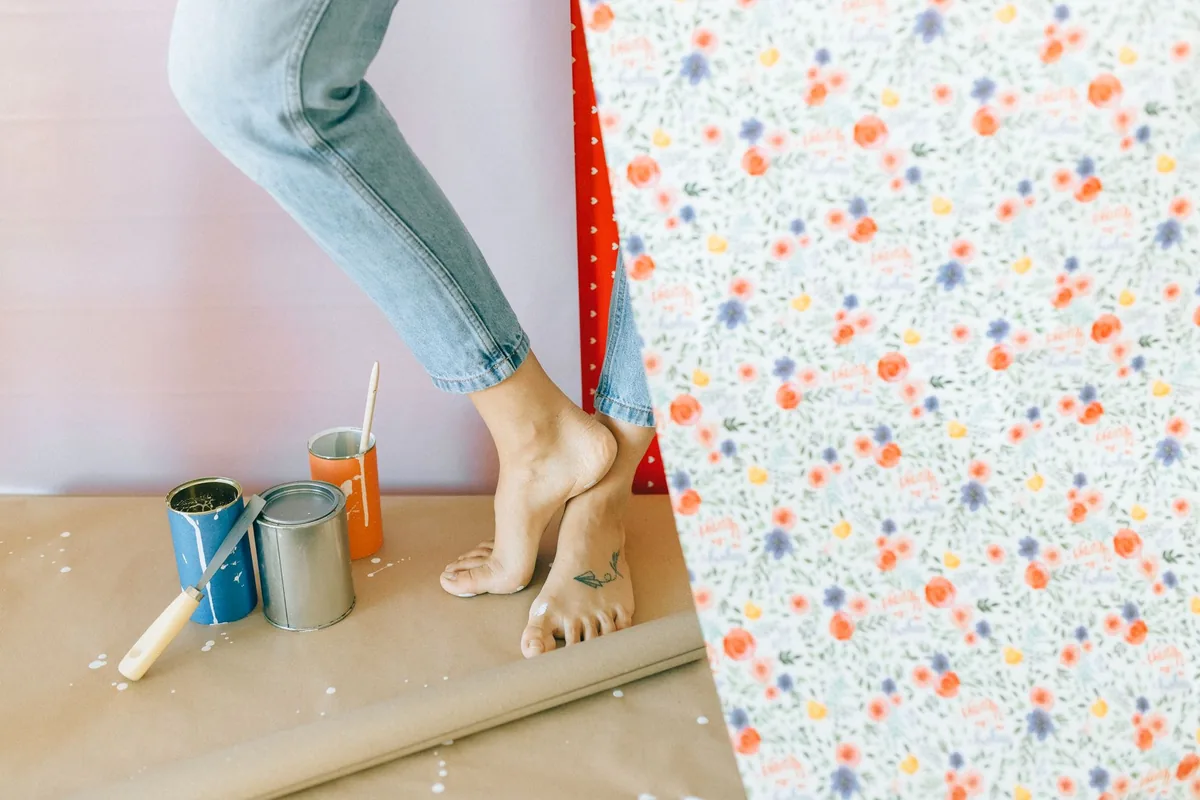
Tempaper’s list: a craft knife, a cutting surface, a level, a pencil, a ruler or straight edge, a step stool, a squeegee and a tape measure. WallPops’ list is shorter (tape measure, level, steel ruler or straight edge, razor knife or scissors, pencil, plastic smoother) and says to change the blade often. Add a screwdriver for the switch plates and outlet covers (our suggestion), a safety pin and isopropyl (rubbing) alcohol.
If you lack only the smoother, Tempaper’s felt-edge squeegee is $5.99 for the 4 inch size at 11 October 2026 prices (price for reference only): a hard plastic edge for guiding paper into corners and along molding, and a felt side for smoothing.
How do you prep the wall and mark the first line?
- Power off, covers off. Turn the electricity off at the source before removing switch plates and outlet covers, and restore it only once the covers are back on, per Tempaper’s install guide. WallPops adds: clean the dust out around sockets and switches, since it hurts adhesion. With the power off the room’s lights may be off too, so work by daylight or a battery work light (our suggestion).
- Clean the wall. Tempaper’s prep is a 1:1 isopropyl alcohol and water wipe, left to dry (household cleaners can leave a residue); Chasing Paper’s is a damp cloth, dried fully. On washable or zero-VOC paint, Walls Need Love suggests an isopropyl alcohol wipe for good adhesion.
- Mark a plumb line. Tempaper: from the corner, measure the roll width minus half an inch (20 inches for a 20.5 inch roll) and draw a vertical line with the level; the panel’s far edge goes on it, so the spare half inch tucks into the corner (our reading). WallPops: measure the full paper width from the left-hand corner and set the strip’s right edge on the line.
- A new line at each corner. Tempaper recommends a fresh plumb line every time you reach a corner or start a new wall.
How do you hang the first panel?
- Cut and match. Pre-cut each panel to height plus trimming room, aligning the pattern with the previous panel before each cut and numbering the backs. Laying them out on the floor first shows how the design matches.
- Peel only part of the backing, by your maker’s figure: 3 to 4 feet (Tempaper), 12 to 24 inches (WallPops), 6 to 8 inches at a time (Chasing Paper).
- Start at the top, on the line. WallPops lets a little run onto the ceiling for trimming and presses the edge lightly along the mark first.
- Smooth from the center out, then keep peeling and smoothing in your maker’s amount from step 2 (3 to 4 feet at a time for Tempaper) to the bottom.
- Don’t pull on the paper. It may stretch and then won’t align.
- Reposition as needed to fix the pattern or a bubble; Tempaper’s and WallPops’ papers both allow it.
Should the seams overlap or butt together?
Three of the makers here give three different rules:
- Seam to seam. Chasing Paper butts its panels together, no overlap.
- About 1/32 inch overlap. WallPops overlaps edges by approximately 1/32 inch (0.5 mm), pattern aligned, so the material has some tolerance if it shrinks.
- Overlap where temperatures swing. Tempaper asks for a slight overlap in rooms subject to temperature swings, to avoid split seams; its guide gives no seam rule for other rooms (our reading).
If your paper’s instructions don’t cover your room, as with Tempaper in a room at an even temperature, ask the maker before you start (our suggestion).
How do you get rid of bubbles?
Hang steps 2, 4 and 6 are the prevention. For a bubble left at the end, a tiny safety-pin hole in its center lets the air out; then smooth it flat (our suggestion).
Bubbles that show up later can come from large temperature swings, high humidity or certain paint types and sheens, per Walls Need Love’s FAQ; its fix is to peel the section back, apply a thin layer of strippable wallpaper paste to the wall and smooth the paper back. Uncured paint is another cause, per Chasing Paper.
How do you trim at the ceiling, baseboard, windows and outlets?
Ceiling and baseboard. Press the paper into the joint with the squeegee’s hard edge (our suggestion), then trim with a straight edge and a sharp razor knife, changing the blade often (WallPops).
Doors and windows. The written install pages read for this article don’t cover them; Tempaper’s video tutorials include one on cutting around doors and windows. Our suggestion: hang the panel over the frame, smooth it down to the casing, make a diagonal relief cut in the waste toward each corner of the casing, then press the paper into the casing edge and trim along it.
The last panel into a corner. Let it run into the corner, press it in with the hard edge and trim along the corner (our suggestion); start the next wall with a fresh plumb line.
Outlets and switches. With the power and covers still off, smooth the paper over the opening, cut a small X over it and trim the excess, per the WallPops FAQ.
Covers back, then power. When every panel is up and trimmed, screw the switch plates and outlet covers back on, and only then turn the power on (Tempaper).
Can you put peel-and-stick wallpaper in a bathroom?
Each maker sets its own line:
- Tempaper: bathrooms and areas with steam and indirect moisture; its bathroom page calls the paper water-resistant, not waterproof.
- WallPops: fine as long as it is not hit directly with water; with a shower, a working ventilation system; and in any bathroom, extra care smoothing bubbles.
- Chasing Paper: some ventilation, a window cracked or the fan on.
- Walls Need Love: made to withstand humidity, in a ventilated space; if humidity worries you, its prepasted or paste-the-wall papers, or a large sample left up in the bathroom first.
Two of the four put the limit at direct water (Tempaper’s “indirect moisture”, WallPops’ “not being directly hit with water”), so keep the paper off the walls the shower sprays (our reading).
How do you take it down without damaging the wall?
- Power off, covers off. Turn the electricity off at the source and unscrew the switch plates and outlet covers; Tempaper’s product page says removing covers and hardware first helps, and its install guide keeps the power off whenever covers are off.
- Peel from any corner, slowly, up or down, parallel to the wall, per Tempaper’s install guide.
- Covers back, then power.
Whether paint comes off depends on the sheen (on flat, matte and low-sheen paint, removal could occur, per Tempaper; on matte, the adhesive can bond and pull the paint, per Chasing Paper), on the paint wait above, and on what is underneath: over non-textured existing wallpaper, Tempaper cannot guarantee a clean removal. Tempaper and WallPops sell their paper as removable without damage to walls, a claim each makes for its own paper on the surfaces it recommends (our reading). If you rent, ask your landlord first, and peel the test sample after a few days to see what comes off (our suggestion). More projects are in our home improvement section.
Where these numbers come from
Waits, measurements and rules come from the four makers’ install guides, FAQs and product pages linked above, read on 11 October 2026; steps marked (our suggestion) are ours. Prices are from Tempaper’s product pages on that date, with no code applied. The 10 by 8 foot wall is our example, and the panel and roll counts are our arithmetic.
Frequently asked questions
How long after painting can you put up peel and stick wallpaper?
It depends on whose paper it is. Of the four makers here, Walls Need Love asks for at least 2 to 4 weeks, Tempaper at least 30 days (FAQ) or 4 weeks (product page), Chasing Paper 4 to 6 weeks, and WallPops at least 4 weeks (install guide) or 30 to 60 days (FAQ). Where your maker gives two figures, go by the longer one, which for WallPops means 30 to 60 days; and if your paint can gives a longer cure time, wait for that.
Do you overlap peel and stick wallpaper seams?
It depends on the paper. Chasing Paper places its panels seam to seam with no overlap; WallPops overlaps edges by about 1/32 inch (0.5 mm), pattern aligned, to allow for shrinking; Tempaper asks for a slight overlap in rooms subject to temperature swings, and its guide gives no seam rule for other rooms. If your paper's instructions don't cover your room, ask its maker.
How do you get bubbles out of peel and stick wallpaper?
While you hang it, peel back only part of the backing, smooth from the center out, and lift and re-lay any section that bubbles; Tempaper's paper can be repositioned to get rid of bubbling. For a bubble left at the end, a tiny safety-pin hole in its center lets the air out. Bubbles that appear later can come from big temperature swings, high humidity or the paint underneath, per one maker's FAQ.
Can you put peel and stick wallpaper in a bathroom?
Yes, on all four makers' terms. Two of them draw the line at direct water: Tempaper allows its paper in bathrooms with steam and indirect moisture and calls it water-resistant, not waterproof, and WallPops says it should not be hit directly with water. So keep it off the walls the shower sprays. WallPops, Chasing Paper and Walls Need Love also ask for ventilation.
Does peel and stick wallpaper damage walls when you remove it?
It can take paint with it. Tempaper warns that flat, matte and low-sheen paint could come off when its paper is removed, Chasing Paper that its adhesive can bond to matte paint and pull it, and WallPops sets its 30 to 60 day paint wait so the paper will not damage the paint when it comes off. To remove it, turn the power off, take the switch plates and outlet covers off, and peel slowly from a corner, parallel to the wall.
- #peel and stick wallpaper
- #wallpaper for walls
- #removable wallpaper
- #accent walls