Wood Dining Room Tables: Solid Wood, Veneer and 6 Picks
Wood dining room tables compared: six picks from 71.25 to 104 inches long and $479 to $2,744, sorted by solid wood or veneer top, wood, finish and base.
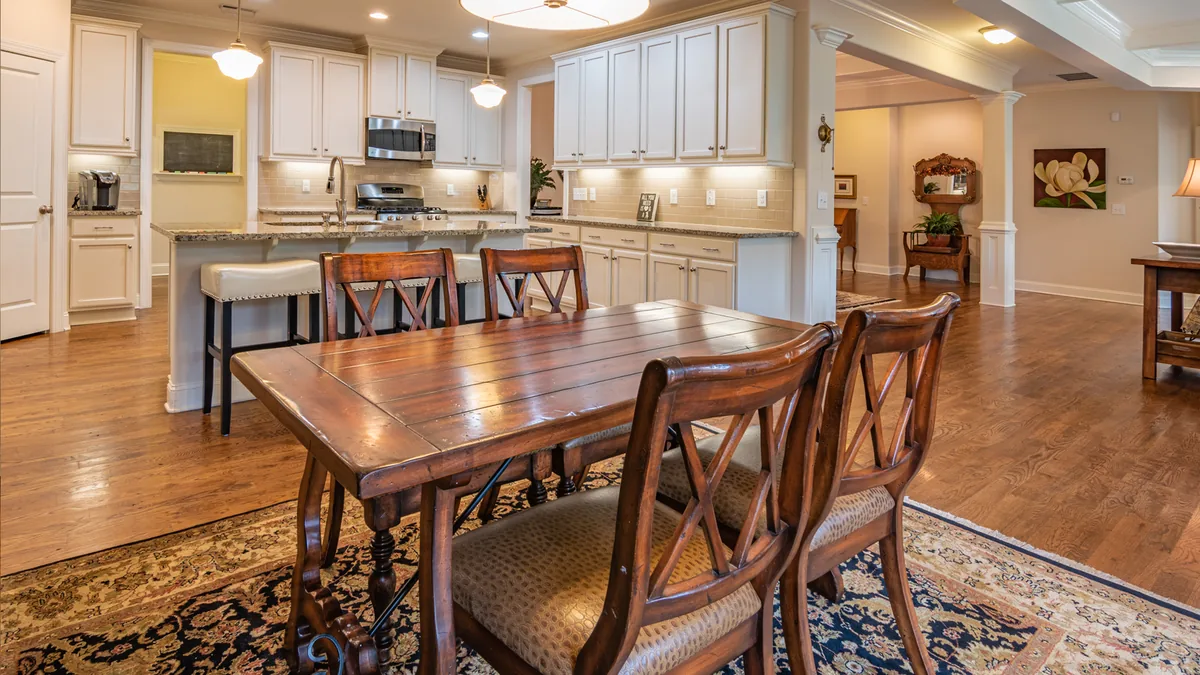
A glass leaves a ring on the table in the listing photo, a corner of the top lifts, or the “wood” turns out to be MDF under a thin skin. The usual wrong fix is buying by the word “wood” in the product name, but the six tables below describe themselves six different ways: solid pine, a solid reclaimed fir slab, a solid oak base under an oak veneer top, oak veneer on MDF, a birch plywood core with a veneer top, and a line that says only “Teak, Metal”. So we compare six wood dining room tables, 71.25 to 104 inches long and $479 to $2,744, on what the top is made of, the wood, the finish and the base, with who each one suits and what it gives up.
The short answer
| Pick | Best for | Top and wood as printed | Length (in) | Price (reference) |
|---|---|---|---|---|
| Plank+Beam Camden Dining Table 72 in | The lowest price, with a solid pine table | Solid pine | 71.25 | $479 |
| Scandinavian Designs Unni Dining Table | 86.6 inches under $1,000, solid oak base | Solid oak base, oak veneer top | 86.6 | $949 |
| Scandinavian Designs Faroe Dining Table | A smoked oak look with the construction spelled out | Oak veneer, MDF board, solid rubberwood | 86.6 | $1,399 |
| Scandinavian Designs Andor 98 in Dining Table | The longest of the six that stays under $1,500 | Teak, metal (solid or veneer not stated) | 98.4 | $1,449 |
| Thuma Pillar Rectangular Dining Table | Seating up to 10 in the 104 inch size | Birch plywood core, wood veneer top | 80 or 104 | $1,695 (80 in), $1,995 (104 in) |
| Urban Wood Goods Urban Intersections Pedestal Dining Table | A solid slab top, in sizes up to 120 inches | Solid reclaimed Douglas fir slab top | 84 | $2,744 |
Solid wood, veneer or engineered wood: what the listing words mean
One maker’s guide to real wood furniture sorts the words this way: solid wood is natural lumber, veneer is a thin layer of real wood applied over a stable core, and engineered wood means MDF, plywood and composites. It gives a table with solid wood legs and frame pieces and a wood veneer top as an example of a well-built combination, and it says plywood or MDF is often used for wide panels and surfaces, where solid wood may expand, contract or shift with temperature and humidity. A maker of reclaimed slab tables says the same of solid wood: its wood care notes say solid wood expands and contracts with the seasons and tell owners to maintain 40–60% humidity to minimize movement and prevent warping. The first guide adds that a solid wood label does not tell you how well the piece is joined and braced, which matters as much.
The six pages sort into four kinds. Camden and the Urban Wood Goods table say solid and name the wood: solid pine, and a solid wood slab top of reclaimed Douglas fir. Unni’s material line reads “Solid Oak, Oak Veneer”, and its text puts the solid oak in the base and the oak veneer on the tabletop. Faroe’s reads “Oak Veneer, MDF Board, Solid Rubber Wood” and its text gives a smoked oak veneer finish over a solid rubberwood base, so the top is veneer over MDF (our reading). Thuma’s text says a birch plywood core with a wood veneer top, on solid rubberwood legs and frame. Andor’s line is “Teak, Metal” and its text describes a reclaimed teak top; it does not say whether that top is solid or veneer.
Do not stop at the description. On two Scandinavian Designs pages that are not among the six, the Aden description says “Crafted from solid oak” and the Leevi description says “Crafted from solid acacia wood”, while their material lines read “Solid Oak, Oak Veneer” and “Solid Acacia, Acacia Veneer”. Read the material line first, then the description for which part is which, and if neither says whether the top is solid, ask the maker before you order (our suggestion).
On repair, the care note printed on the Unni and Andor pages says water will stain wood or veneered surfaces left for a period, leaving a mark that can be much harder to fix, so on that note a veneer top is in the same position as a solid one for water marks (our reading). The same note says oil finishes may be renewed with a light application of penetrating oil and very fine steel wool. None of the pages read for this article says whether a veneer top can be sanded back and refinished, so ask before you count on it (our suggestion).
Which wood, and which finish
The species on these pages are pine (Camden), reclaimed Douglas fir (Urban Wood Goods), oak (the Unni base and top, the Faroe veneer), rubberwood (the Faroe base, the Thuma legs and frame), teak (Andor) and an unnamed veneer (Thuma). None of the six pages, and none of the care pages, prints a hardness rating, so we do not rank the woods by hardness. What three of the pages do say is to expect marks of the wood itself: the Camden page says every knot, grain line and texture is on display, the Andor page lists knots, natural splits and color variations, and the Urban Wood Goods page says its reclaimed planks may shift, dip, cup, bow or crack over time, and that cracks do not reduce the wood’s strength or longevity.
The finishes differ more than the woods. Camden has a low-VOC finish in the Rustic style, which its maker’s finish guide describes as showing subtle grain highlights with a textured feel. Thuma’s page says an oil-based colored stain that develops a patina, and also a protective finish resistant to stains and moisture, the only one of the six pages that makes a stain-resistance claim; the same page says to avoid moisture and direct sunlight to keep the color, and to use a coaster and a soft cloth. Urban Wood Goods sells the 84 inch table raw (natural, unprotected) at $2,645 (price for reference only), or stained, clear or oiled at $2,744 (our arithmetic: $99 more), and its care page gives a wood conditioner for unfinished surfaces only, applied annually or as needed. The Unni and Faroe pages name a finish color but not a finish type.
The care pages agree on the basics. All four sellers read here ask for coasters or trivets: Scandinavian Designs adds felt pads and placemats and warns that intense heat can change the surface, and Plank+Beam’s care guide says hot items can leave permanent heat marks. They differ on cleaners: Scandinavian Designs says to avoid wax-based furniture polish and to wipe with a damp, not wet, cloth; Urban Wood Goods says no polish or products with petroleum, alcohol, ammonia or silicone; Plank+Beam says no ammonia, abrasives, silicones or acetone. If you will not wipe spills at once and use coasters, skip the unprotected option (our suggestion).
Length and base for a large or long table
Lengths run from 71.25 inches (Camden) through 80 (Thuma’s smaller size), 84 (Urban Wood Goods), 86.6 (Unni and Faroe) and 98.4 (Andor) to 104 (Thuma’s larger size), so five of the six are offered at 84 inches or more. Urban Wood Goods also lists 96, 108 and 120 inch sizes, at higher prices.
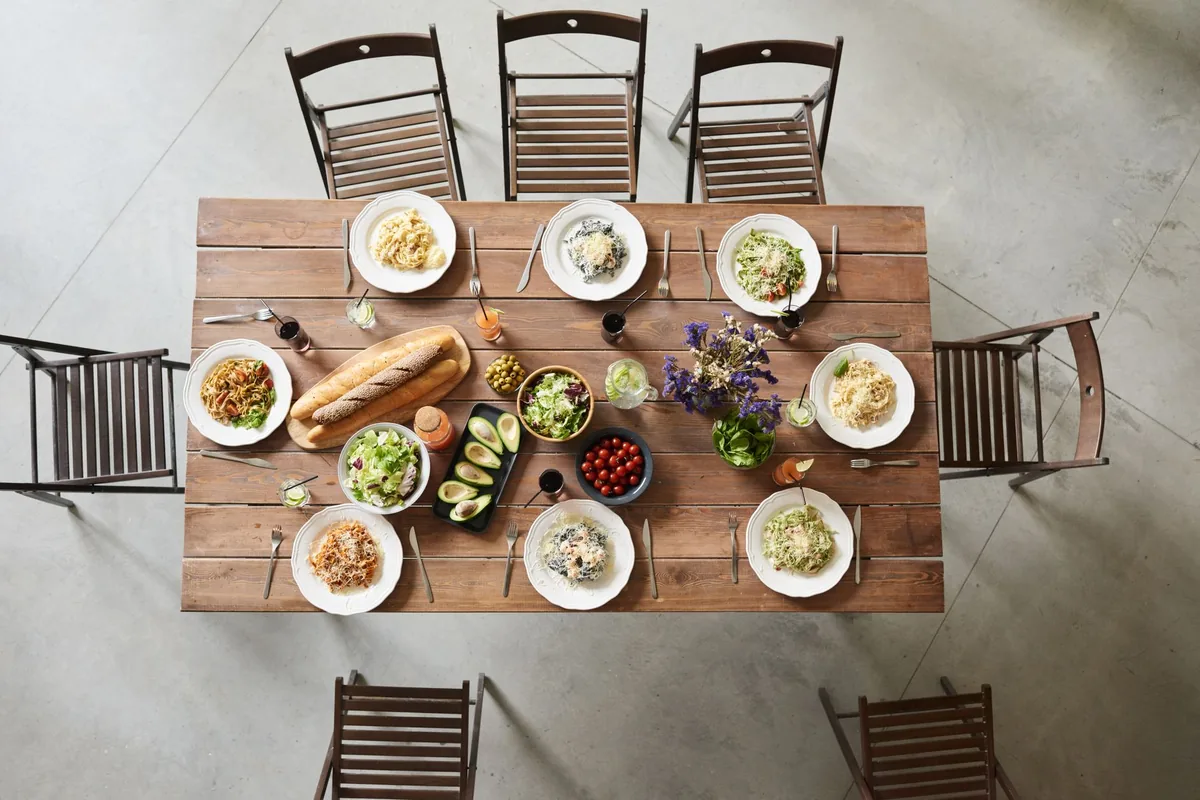
The printed seat counts do not follow length. The 71.25 inch Camden says it seats 6 to 8, the 86.6 inch Unni and Faroe say 6, and Thuma says up to 8 at 80 inches and up to 10 at 104; the Andor and Urban Wood Goods pages print no seat count in their text. So count seats from the length yourself: for inches of table edge per person, sizes by headcount and the room to leave around the table, see our dining table size guide. If one side will be a bench or a sofa, see our dining table with sofa seating guide first.
The bases differ too. Unni has a solid oak base, Faroe has angled legs over a solid rubberwood base, Andor has a black metal base, and the Urban Wood Goods table has a recycled steel pedestal base. Thuma’s page prints the room under the table: 48 inches between the legs on the 80 inch size and 72 on the 104, so the extra 24 inches of length is 24 more inches between the legs (our arithmetic), and 25 inches of clearance under the apron on the 80. The Camden page prints no base description.
Six wood dining room tables compared
| Pick | Material as printed | Finish | L x W x H (in) | Seats (as printed) | Base |
|---|---|---|---|---|---|
| Camden | Solid pine (page text) | Low-VOC, Rustic finish in Honey, Char or Barnwood | 71.25 x 36 x 29.75 | 6 to 8 | Not printed |
| Unni | Solid Oak, Oak Veneer | Natural Oak or Dark Oak Veneer | 86.6 x 39.4 x 29.5 | 6 | Solid oak |
| Faroe | Oak Veneer, MDF Board, Solid Rubber Wood | Smoked Oak | 86.6 x 39.4 x 29.9 | 6 | Solid rubberwood, angled legs |
| Andor | Teak, Metal | Natural Teak | 98.4 x 39 x 29.5 | Not printed | Black metal |
| Thuma | Birch plywood core, wood veneer top; solid rubberwood legs and frame (page text) | Oil-based colored stain in Walnut, Oak or Espresso | 80 x 40 x 30 or 104 x 40 x 30 | Up to 8 (80 in), up to 10 (104 in) | Pillar legs |
| Urban Wood Goods | Solid wood slab top of reclaimed Douglas fir (page text) | Natural raw, stains, clear or oil | 84 x 36 x 30 | Not printed | Recycled steel pedestal |
The picks
From the lowest price to the highest. Prices are for the size and finish named, with no code.
Plank+Beam Camden Dining Table 72 in
For the lowest price of the six on a table the page calls solid pine, finished with a low-VOC finish in a rustic style. It suits a family that wants a solid wood table for 6 to 8 on the page’s count and likes a worn, knotty look.
Drawbacks: At 71.25 inches it is the shortest of the six, and the only one under 80. The page says knots, grain lines and texture are all on display, so it is not the table for a clean, uniform look. It prints no base description and no care instructions.
Scandinavian Designs Unni Dining Table
For 86.6 inches under $1,000 with the solid wood where the load is: the page puts solid oak in the base and veneer on the top, the split the real-wood guide above describes (our reading). It suits a six-person table where you accept a veneer top.
Drawbacks: The top is oak veneer, not solid oak, and the page says nothing on whether it can be refinished. It prints seats 6 at 86.6 inches, and names a finish color (Natural Oak or Dark Oak Veneer) but no finish type.
Scandinavian Designs Faroe Dining Table
For the smoked oak look with a plainly listed construction: oak veneer finish, a solid rubberwood base and angled legs. The page says it seats up to six comfortably, which suits a family that wants that look and does not need a solid top.
Drawbacks: It costs $450 more than the Unni at the same 86.6 inches (our arithmetic) and its material line includes MDF board, so the top is veneer over MDF (our reading). The page prints no care note and no finish type.
Scandinavian Designs Andor 98 in Dining Table
For length: 98.4 inches for $1,449, the longest of the six that stays under $1,500. The page describes a reclaimed teak top with rustic wear marks on a black metal base. It suits a large dining room where the rustic look is the point; ask the maker what the top is made of first (our suggestion).
Drawbacks: The page does not say whether the reclaimed teak top is solid or veneer, and it prints no seat count. It says to expect knots, highlighted grain, natural splits and color variations, and a matte finish with wear marks.
Thuma Pillar Rectangular Dining Table
For a ten-person table: it is the only pick that prints 10 seats, up to 10 at 104 inches and up to 8 at 80. The legs and frame are solid rubberwood with mortise and tenon joinery and a veneer top, finished in an oil-based stain in Walnut, Oak or Espresso.
Drawbacks: The top is wood veneer over a plywood core, and the 104 inch size costs $300 more (our arithmetic). The page calls the finish resistant to stains and moisture but also says to avoid moisture and direct sunlight to keep the color, so its care steps are stricter than that line sounds (our reading). On the 80 inch size the page prints 25 inches under the apron. One table maker’s chair guide asks for about 10 to 12 inches from the top of the seat to the bottom of the table or apron, so a 17 to 19 inch seat leaves 6 to 8 inches, under that range (our arithmetic); measure your chairs before you order (our suggestion).
Urban Wood Goods Urban Intersections Pedestal Dining Table
For a top that is solid wood across, with the longer sizes (96, 108 and 120 inches) available if you outgrow the 84. The page describes a solid wood slab plank top of reclaimed Douglas fir on a recycled steel base, in raw, stained, clear or oil finishes. It suits a buyer who wants the character of reclaimed wood and will keep to the care steps.
Drawbacks: It costs the most of the six. The page says reclaimed planks may be uneven and may shift, dip, cup, bow or crack over time, asks for 40–60% humidity, calls the tables indoor use only, and prints no seat count in its text. The page says most furniture over 60 inches long ships by freight, unassembled and flat-packed.
Which table for your room
Decide the top construction first, then the length, then the finish (our suggestion).
- Solid top or veneer top. Camden and Urban Wood Goods describe a solid wood table or top. Unni, Faroe and Thuma put veneer in the top. Andor does not say, so ask first (our suggestion).
- Room length. Using the rule in our dining table size guide (room length less 72 inches), the 71.25 inch Camden needs a room at least 143.25 inches long, Thuma’s 80 inch 152, the 84 inch Urban Wood Goods 156, Unni and Faroe 158.6, Andor 170.4 and Thuma’s 104 inch 176 (our arithmetic). Do the same on the width.
- Ten at the table. Only the 104 inch Thuma prints up to 10 seats.
- Spills and children. Thuma is the only one of the six pages that prints a stain and moisture resistance line, Urban Wood Goods sells a raw, unprotected option, and the care pages of all four sellers ask for coasters or trivets. Pick the finish you will look after (our suggestion).
- Budget. $479 buys a solid pine table at 71.25 inches. Under $1,500 you can reach 98.4 inches with Andor, with a top that is not stated as solid.
- Getting it in. Camden ships in one box, Thuma ships by scheduled white glove delivery that includes assembly, and on the Urban Wood Goods page most furniture over 60 inches long ships by freight, unassembled and flat-packed. Measure the route before you order; our furniture buying guide covers it.
Where these numbers come from
Materials, dimensions, finishes, seat counts and prices (shown without a code) come from each maker’s or retailer’s product page for the six tables, read on 8 November 2026, and the care and construction points come from the care guides and notes of Plank+Beam, Scandinavian Designs, Thuma and Urban Wood Goods. The price differences and the room lengths are our arithmetic, and the points marked (our reading) are our inference from those figures. Where a page does not say which part of a table is solid or veneer, we say so.
Frequently asked questions
Is a solid wood or a veneer dining table better?
On one maker's real-wood guide, solid wood suits high-use pieces such as dining tables, while veneer and engineered wood make sense where a consistent surface or stability matters, and a table with a solid wood base and a veneer top is given as an example of a well-built combination. The same guide says how the table is joined and braced matters as much as the label. Of the six here, two describe the table or its top as solid wood (Camden, Urban Wood Goods), three put veneer in the top (Unni, Faroe, Thuma) and one does not say (Andor).
How can I tell whether a wood dining table is solid wood?
Read the material line, then the description, and compare them. On two Scandinavian Designs pages that are not among the six, the description says “Crafted from solid oak” (Aden) and “Crafted from solid acacia wood” (Leevi), while the material line also lists veneer (“Solid Oak, Oak Veneer” and “Solid Acacia, Acacia Veneer”). If neither says which part is solid, ask the maker before you order (our suggestion).
How long is a large wooden dining table?
Of the six here, lengths run from 71.25 to 104 inches and five are offered at 84 inches or more: Urban Wood Goods at 84 (its page also lists 96, 108 and 120), Unni and Faroe at 86.6, Andor at 98.4 and Thuma at 104. Printed seat counts do not follow length: the 104 inch Thuma says up to 10, the 71.25 inch Camden says 6 to 8 and the 86.6 inch Unni and Faroe say 6.
How do I protect a wood dining table from water rings and heat marks?
The care pages from Plank+Beam, Scandinavian Designs, Thuma and Urban Wood Goods all ask for coasters or trivets; Plank+Beam and Urban Wood Goods also say to wipe spills up straight away. One retailer's care note says water will stain wood or veneered surfaces left for a period, and one maker's care guide says hot items can leave permanent heat marks. Those notes cover each seller's own tables, so check the page of the one you buy.
- #large wooden dining table
- #long wood dining table
- #solid wood dining table
- #wood veneer dining table