Dining Table With Sofa Seating: Seat Height, Depth and Fit
Can a sofa sit at your dining table? The seat height, seat depth and table gap to check, how much table should overlap the seat, and how many people fit.
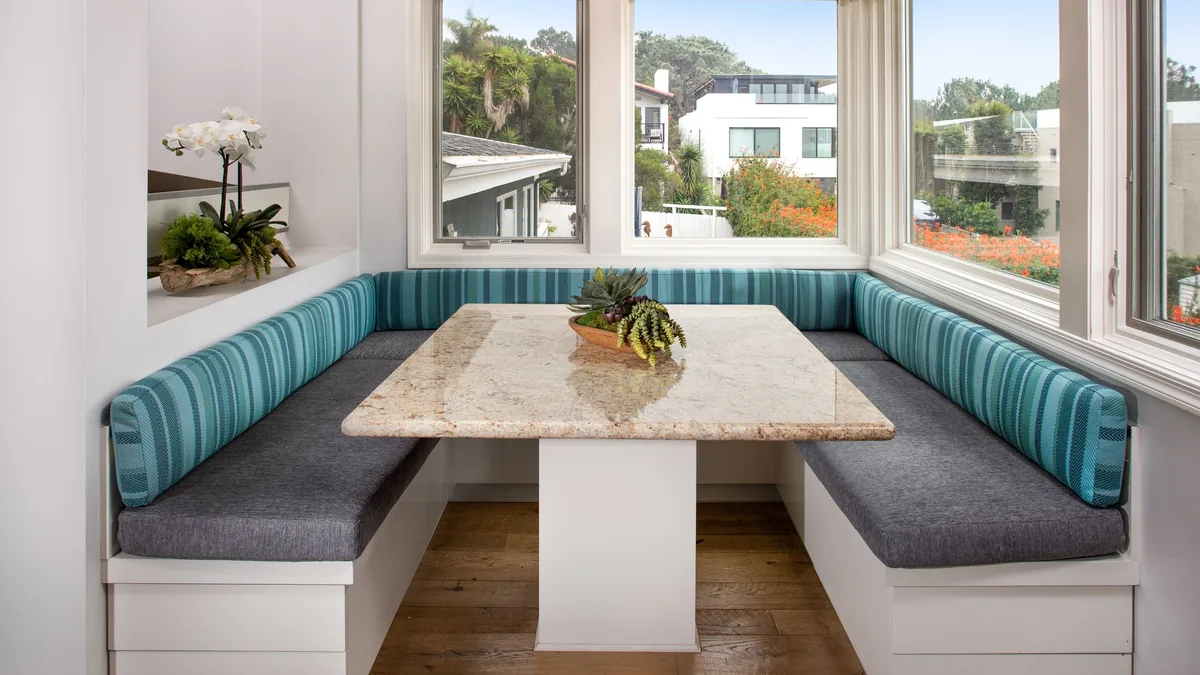
You sink into a lounge sofa with your plate at chin height, or you perch on the front edge to reach the table. The usual fix is to push the living-room sofa up to the table as it is, but one sofa maker’s comfort guide lists seat depths of 21 to 24 inches across its twelve collections, where one banquette maker’s dining seats typically run 18 to 20. Below are the three measurements to check, the seat height, the seat depth and the gap up to the table, and then how to set the seat out along one side.
The short answer
| Step | Measure | Work to |
|---|---|---|
| 1. Table | Floor to the lowest point under the table edge (the apron, if there is one) | Seat height = that figure minus 10–12 in on one table maker’s guides; minus at least 12 on one countertop maker’s |
| 2. Seat height | Floor to the top of the cushion | 17–19 in for a 28–30 in table (table maker); around 19 in for dining (banquette maker); sofas on one maker’s guide run 17–20 in |
| 3. Seat depth | Front edge of the seat to the back cushion | 18–20 in typical for a dining banquette (banquette maker); 21–24 in on one sofa maker’s twelve collections |
| 4. Seat width | The seat between the arms | 24 in per person on one banquette maker’s rule; 24–26 on one countertop maker’s guide |
| 5. Overlap | How far the table edge sits over the seat front (with sofa arms, the table must fit between them or clear their tops) | At least about 2 in on one retailer’s guide; a second retailer’s example assumes about 4.5 in |
| 6. Open side | Table edge to the wall or furniture on the side without the sofa | 32 in, 36 in if people pass behind a diner, ideally 44 (countertop maker) |
Measure the table first
The seat has to fit the table, not the other way round, so start under the table. A standard dining table is 28 to 30 inches high on one table maker’s guide, and the same page aims for about 10 to 12 inches between the seat and the bottom of the tabletop; its chair guide measures that 10 to 12 to the bottom of the table or the apron. One countertop maker’s seating guide asks for a minimum of 12 inches between the top of the seat and the bottom of the tabletop, or the skirt if it has one. Our dining table size guide has the table heights and sizes by headcount.
- Measure from the floor to the lowest point under the table edge, which is the apron or skirt if there is one, not the top’s surface (our suggestion).
- Subtract 10 to 12 inches. What is left is the seat height you are aiming for (our arithmetic). A table whose lowest point is 28 inches off the floor wants a 16 to 18 inch seat; on the countertop maker’s 12-inch minimum, 16 or lower.
- Measure the sofa’s seat the same way: floor to the top of the cushion, taken while someone sits on it if you can. One banquette maker measures seat height to the top of the cushion’s “crown”, and the table maker’s chair guide warns that thick padding compresses once you sit, so a seat that measures right empty can sit low.
Seat height: will your sofa work?
For a table 28 to 30 inches high, one table maker’s guides give a seat 17 to 19 inches high, and its chair guide gives 17 to 20 as typical for dining chairs. One banquette maker’s seating guide recommends around 19 inches for dining, and says the number matters most in relation to the table, so it suggests test fits at different seat heights. One furniture retailer’s banquette guide says many dining benches fall around 17 to 19 inches. One retailer’s banquette ideas give 45 to 50 cm, which is 17.7 to 19.7 inches (our conversion).
Sofas are close to that. On one sofa maker’s comfort guide, the twelve collections it lists have seat heights from 17 to 20 inches: six at 19 or 20, five at 18 and one at 17, so eleven of the twelve are inside the 17 to 19 band (our count). On height they pass; the trouble is what happens under you. The banquette maker says a sofa has a lower seat height and a deeper seat depth than a dining seat, which has you sinking in and sitting back. The sofa maker’s own rule is that the deeper the seat, the lower the seat height should be, so a deep lounge sofa is the one to check for a low seat (our reading).
A banquette can also sit high. On the five Sixpenny banquette product pages read for this guide, seat height is 21 inches on three and 22.5 on two, and the same maker’s two dining tables read are 30 and 31 inches high. That leaves 9 to 10 inches from a 21-inch seat to the top surface, and 7.5 to 8.5 from a 22.5-inch one (our arithmetic), before taking off the top’s thickness for the gap to its underside. The five pages, which sell these as dining seating, name no table height, so check the pairing before you order.
If the seat is too low or too high, no page we read gives a fix. A firm pad on a low seat adds height (our suggestion), but it also changes the depth, so recheck both. If the gap to the underside comes out under 10 inches, the seat or the table has to change, since the table maker’s guides ask for 10 to 12 inches and the countertop maker for at least 12.
Seat depth and back: can you reach the plate?
Depth decides whether you sit up to the table or back against the cushion. The banquette maker recommends a seat depth of at least 18 inches for dining, strongly discourages anything shallower than 16, and says its dining banquettes typically fall between 18 and 20. It says a shallower seat with a straighter back lends to sitting up straighter, which works best for dining or sitting down to work at a computer.
Sofas are deeper. The sofa maker’s guide puts seat depth in three bands: 19 to 20 inches for sitting upright with your feet on the floor, 21 to 23 for most sitting and light lounging, and 24 and up for curling up. Across the twelve collections it lists, depth runs from 21 to 24 inches (one of them also comes extra deep at 28): eight in the 21 to 23 band and four at 24 (our count). None is in the 19 to 20 upright band. Our two seat sofa guide has loveseats with seat depths printed down to 19 inches.
Banquettes and benches sold for dining print shallower seats. The Plank+Beam Risa corner banquette’s Q&A gives a 17.25 inch seat. On the five Sixpenny banquette pages, seat depth with the back cushion is 16 inches on one, 18 on three and 20 on one, and 25 to 28 without it. On those banquette pages, taking the back cushion off makes the seat 7 to 10 inches deeper, so a listed seat depth may not be where your back ends up (our reading).
What that means at the table: sitting back against a 24 inch seat puts your plate 4 to 6 inches further away than a 20 or 18 inch seat would, if the front edges line up (our arithmetic). The sofa maker does not say how it measures seat depth, so treat the comparison as approximate (our reading). To bring a deep seat in, put firm pillows behind your lower back (our suggestion). The banquette maker’s minimum for a comfortable seat cushion is 3 inches thick, and it recommends a high-resiliency foam with a firm rating; for the back cushion it says a minimum of 2 inches is good, in a high-density, soft foam.
Which kind of seat: a sofa, a settee or a banquette
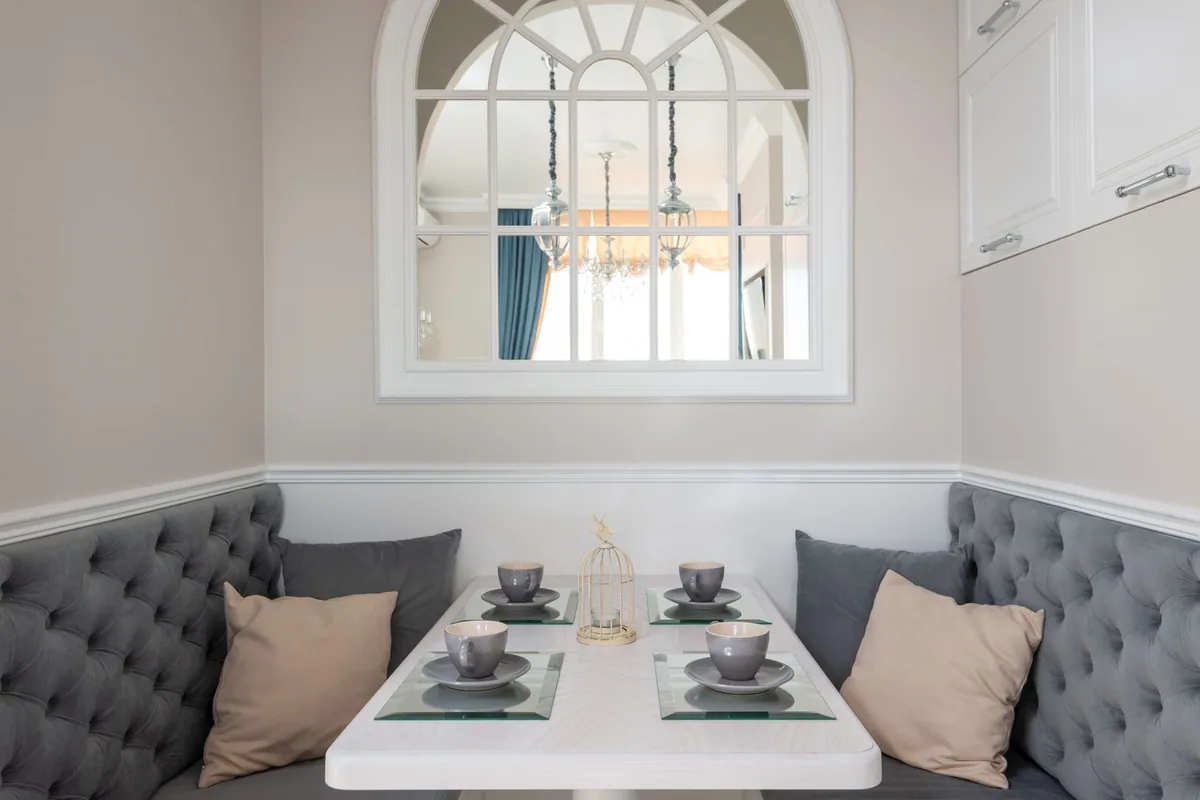
We found no maker’s page that defines a dining settee, so here is how we use the words (our reading): we treat a settee as a small sofa, so it falls under the first of these. A sofa is a lounge seat: what you already own, or a two-seater sized from our standard couch size guide. A banquette is fixed or fitted seating along a wall or corner; one countertop maker’s guide says banquettes save square footage by using wall space. A dining bench, with or without a back, is the smaller version of the same idea (our reading).
| What | Seat height (in) | Seat depth (in) |
|---|---|---|
| Twelve sofa collections on one maker’s guide | 17–20 | 21–24 (one also 28) |
| Dining banquette, what one maker typically builds | Around 19 | 18–20 |
| Plank+Beam Risa corner banquette | 17.75 | 17.25 (Q&A) |
| Five Sixpenny banquettes | 21–22.5 | 16–20 with back cushion; 25–28 without |
Buying only comes into it if nothing you own fits the table. Two ends of the range, each printing a seat height:
- Plank+Beam Risa Banquette, $419 to $449 by finish, $599 with a seat cushion Price for reference only. A wood corner banquette, armless, 63 by 63 inches, 24.75 high, with a 17.75 inch seat height. The page prints no back height; overall height less seat height is 7 inches (our arithmetic), so expect a low back at most (our reading). The page’s Q&A gives a 17.25 inch seat, and says the optional seat pads have a cover that is not removable and are spot clean.
- Sixpenny Gabriel Banquette, $4,199 to $4,399 by fabric Price for reference only. An upholstered, slipcovered L-shape, 138 by 84 inches overall and 34 high, with a 21 inch seat height and a 20 inch seat depth (28 without the back cushion). At 21 inches it sits above the 17 to 19 band; check it against your table’s underside first.
Lay it out
Seat side to the wall. The sofa goes along a wall or the room’s edge, so that side needs no room for chairs to slide back (our reading), and one retailer’s guide says clearance figures apply to the open seating side, not the fixed bench against the wall. For the other sides, the countertop maker’s figures are 32 inches behind a diner where nobody passes, 36 where people pass and ideally 44.
Slide the table over the seat. The table edge should reach over the seat front. On a sofa with arms, the table has to fit between the arms or its lowest point has to clear the arm tops; measure both before you count on any overlap (our suggestion). One retailer’s banquette ideas say at least 5 cm, about 2 inches (our conversion); another retailer’s worked example assumes about 4.5 inches and calls its figures planning examples, not universal requirements. The two pages give different kinds of figure, a minimum on one and a worked assumption on the other, and no other page we read gives one, so tape the table edge on the floor and sit at it before you buy (our suggestion).
Work out the room depth. That second retailer’s formula for a straight wall-side seat is the seat’s overall depth, wall to front edge (for a sofa, its overall depth, not its seat depth), plus table width, minus the overlap, plus the open-side clearance. With a banquette 30 inches deep overall (the long side of the Gabriel), a 36 inch wide table, a 2 inch overlap and 36 inches on the open side, that is 30 + 36 − 2 + 36 = 100 inches, about 8 ft 4 in (our arithmetic). With 44 on the open side it is 108.
Count the seats. The banquette maker’s rule is 24 inches per person, so a 48 inch banquette seats two and 96 seats four. One table maker’s chair guide allows 21 to 22 inches a chair, and the countertop maker’s guide gives 24 to 26 a diner. On a sofa, count the seat between the arms: a sofa 84 inches long with 7 inch arms has 70 between them, which is two at 24 each, and three need 72 (our arithmetic). The banquette maker adds that an L-shaped banquette wastes some seat in the corner, and says its outer lengths typically need to be at least 48 inches.
Check the table base. Corner legs can block the path along the seat, and a central pedestal often helps, on the same retailer’s guide, which also says a wide pedestal or low crossbar can catch knees and feet. Look at the underside as well: a thick apron or an extension mechanism can cut thigh room even when the top is the right height. Our guide to wood dining room tables covers choosing the table itself.
What to check on the cover
The countertop maker says banquette cushions should have zippers so the covers come off for cleaning, and that indoor/outdoor fabrics, which it says resist stains and moisture, are a great choice for dining chairs of all types. For Sixpenny’s slipcovered pieces, the maker strongly recommends dry cleaning for natural and recycled fabrics and says machine washing is possible with a bit of mindful care. Ask for the care line before you pick a fabric for a seat people eat on (our suggestion).
Where these numbers come from
Seat heights, depths, gaps, overlaps, widths and clearances come from the maker and retailer guides linked above, and the product sizes and prices, shown without a code, from each product page, all read on 8 November 2026. Counts, conversions and room sums are our arithmetic from those figures. We found no first-party page that gives an ideal seat depth for a sofa at a dining table beyond the banquette maker’s own range.
Frequently asked questions
Can you use a regular sofa at a dining table?
Seat height can work and seat depth is the sticking point. One sofa maker's comfort guide lists seat heights of 17 to 20 inches across its twelve collections, and eleven of them fall within the 17 to 19 one table maker gives for a 28 to 30 inch table (our count), but seat depths of 21 to 24 inches, where one banquette maker's dining seats typically run 18 to 20. That maker says a sofa's lower, deeper seat has you sinking in and sitting back, and that lounging while eating might not be the best position.
What seat height should a sofa have at a dining table?
On one table maker's guides, 17 to 19 inches for a 28 to 30 inch table, with about 10 to 12 inches from the seat to the bottom of the table or apron; one banquette maker recommends around 19 for dining, and one countertop maker asks for at least 12 inches of gap. Measure floor to the lowest point under the table edge and subtract the gap (our arithmetic).
How far should the table overlap the sofa seat?
One furniture retailer's banquette guide says at least 5 cm, which is about 2 inches (our conversion). Another retailer's worked example assumes about 4.5 inches and says its figures are planning examples, not requirements. The two pages give different kinds of figure, a minimum on one and a worked assumption on the other, and no other page we read gives one, so tape it out before you buy (our suggestion).
How many people fit on a dining sofa?
One banquette maker works at 24 inches per person, so 48 inches seats two and 96 inches seats four. On a sofa, count the seat between the arms, not the overall length: 72 inches between the arms seats three at 24 each (our arithmetic).
- #sofa dining table
- #dining room couch
- #dining banquette
- #dining settee