Best Bathroom Colors: Paint That Works With Tile and Steam
Choosing a bathroom paint color around the tile, tub and vanity you are keeping: undertones, little or no daylight, light or dark, finish and how to test.
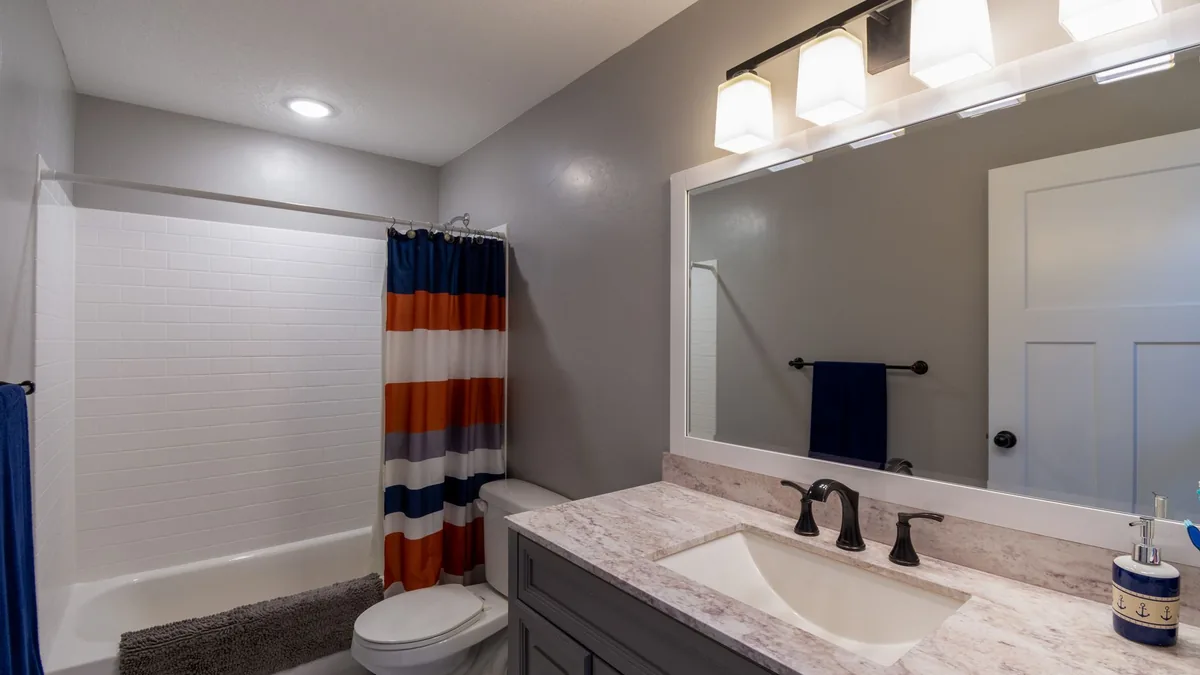
You are repainting, but the tile, tub and vanity are staying, and a color that looked right on a chip in the store can fall flat against them. Picking from a photo of someone else’s bathroom skips the two things that decide it: what the color has to sit beside, and the light at your mirror, which in a small bathroom can come from bulbs alone. Below is the order to choose in: read what is not changing, work out the light, decide between light and dark, shortlist from the examples, choose a paint and finish that can take steam, then test.
The short answer
| Your bathroom | Where to start | Example colors (LRV) |
|---|---|---|
| White or cool gray tile and tub | Lighter, cooler colors with subtle gray undertones (one maker’s note on subway tile) | Gray Cloud (69.7), Metropolitan (49.96), Palladian Blue (60.4) |
| Beige, cream or warm wood | A warm white or warm neutral (our reading) | Swiss Coffee (81.91), Ballet White (71.97), Natural Cream (64.78) |
| No window or very little daylight | Lighter colors, which reflect more of the light you have; one maker’s advice for rooms without windows adds: especially yellow-tinted ones, and of the examples only Swiss Coffee leans warm (our reading) | Swiss Coffee (81.91), Gardenia (85.03) |
| You want it dark | Only with good lighting; one maker also asks for lots of natural light | Kendall Charcoal (14.61), Charcoal Slate (14.51) |
| Paint and finish | Satin or semi-gloss on walls (three makers’ guides); matte only in a paint made for bathrooms | Aura Bath & Spa, matte: $109 a gallon (Price for reference only) |
All example colors are Benjamin Moore colors, with LRV from each color’s own page. They are starting points to test, not our picks.
What in your bathroom is not changing, and what undertone does it have?
Stand in the doorway and list what stays: tile, tub, vanity, countertop, floor, fixtures. One maker’s guide to choosing colors says to decide which finishes are permanent, such as cabinets and tile, and include them in your color selection; its example is cabinet wood with a red undertone, where the paint has to work with that hue. Undertone is the color under the color you see first. Holding chips next to each other helps you spot it, and our guide to best bedroom colors explains how to read it, so we won’t repeat that here.
What the makers say about bathrooms:
- Tile. One maker’s bathroom page says subway tile tends to balance better with lighter, cooler colors, especially ones with subtle gray undertones. On the same page, the fixtures cue is style: a cozy white for a rustic look, cool neutrals like grays for a contemporary one, a dramatic color if the fixtures are decorative.
- Marble tile. Another maker’s marble-bathroom page says even the palest marble is not a true white and has blue and brown casts. White walls contrast with it, but the tile might look a little more dingy by comparison; a pale or medium gray won’t make marble tile look less white.
- Warm beige or cream. We found no maker page that gives a rule for warm tile; our reading is to start from the warm column in the shortlist below.
Then do the step that costs nothing: hold each chip against the tile, the tub and the vanity top, not on the opposite wall (our suggestion). Write down a word or two for each fixed element, for example “white, cool” or “beige, warm”, and keep the colors whose undertone agrees with the fixtures that cover the biggest area (our suggestion).

How much light does the room get, and what are the bulbs?
Window direction matters if you have a window; the four directions are covered in our bedroom colors guide. In a bathroom the bigger question is what lights the mirror. One maker’s bathroom page says it is common to have several sources, from windows to a vanity to ceiling lights, and each can change how a color looks. On the same page: if your bathroom doesn’t have much natural light, it’s a good idea to lean into interior lighting, and warm light temperatures can help vivid and bold colors feel more livable.
Bulbs change the wall too. On Farrow & Ball’s light guide, halogen and incandescent bulbs give a yellow light that makes wall colors look warmer, cool white bulbs tend to give a bluer light and a cooler cast on paint, and a neutral white bulb most accurately replicates daylight. So check what is in your vanity fixture now, and put the bulbs you plan to keep in before you judge any sample (our suggestion).
Should a small bathroom with little light go light or dark?
Makers split on this, so here are both sides.
Lighter. One maker’s advice for a room with no windows is lighter colors, especially yellow-tinted paints, to reflect the light you’ll need, with white trim and mirrors to throw it around. On Benjamin Moore’s small-rooms page, off-white and white colors help open up smaller spaces by reflecting natural light, and it lists Gardenia among its white paint colors for small spaces.
Darker. Benjamin Moore’s bathroom page says deeper, richer colors combined with the right lighting give a small space ambience, and that luxuriously deep hues look especially sumptuous in a higher sheen. The marble-bathroom page above says a bathroom has much less wall space than most rooms, so a daring dark color can still look bright, but the pitfall is that the bathroom has to get lots of natural light and have great artificial lighting.
Where they differ is the window. Valspar’s bathroom page puts the weight on interior lighting; the marble-bathroom page asks for natural light too. For a windowless room lit by a single ceiling fixture, our reading is to stay in the light group and save dark for a bathroom whose bulbs you have already tested. LRV, the share of light a color reflects, is what the numbers in the shortlist show; our bedroom colors guide explains it.
Which shades should you start from?
Each table lists the LRV from the color’s page and the page’s own words; “Listed as” is where the color appears on Benjamin Moore’s bathroom and small-rooms pages. Pick one or two from the row that fits step 1 and the light from steps 2 and 3, and take them to the testing step.
White or cool gray tile
| Color | LRV | Color page says | Listed as |
|---|---|---|---|
| Gray Cloud 2126-60 | 69.7 | “A light, floaty gray brightened with a hint of blue.” | Popular bathroom colors list; spa-like list |
| Metropolitan AF-690 | 49.96 | “A stylish gray with cool undertones…” | Spa-like list |
| Palladian Blue HC-144 | 60.4 | “All is calm with this soft, airy blue-green that conjures clear skies.” | Spa-like list |
Beige, cream or warm wood
| Color | LRV | Color page says | Listed as |
|---|---|---|---|
| Swiss Coffee OC-45 | 81.91 | “An essential white paint color with just the right amount of warmth.” | Popular bathroom colors list |
| Ballet White OC-9 | 71.97 | “A crowd-pleasing off white that offers just the right amount of color.” | Soothing off-whites |
| Natural Cream OC-14 | 64.78 | “A light greige that flatters both warm and cool color schemes.” | Popular bathroom colors list |
No window or very little daylight
| Color | LRV | Color page says | Listed as |
|---|---|---|---|
| Swiss Coffee OC-45 | 81.91 | “An essential white paint color with just the right amount of warmth.” | Popular bathroom colors list; our suggestion for this row: the only example whose color page mentions warmth (our reading: nearest the yellow-tinted advice) |
| Gardenia AF-10 | 85.03 | “A bright white scented with soft pink undertones.” | White colors for small spaces |
The advice for a windowless room above names yellow-tinted paints. Gardenia’s page says soft pink undertones, and Swiss Coffee’s says warmth, so Swiss Coffee is the closer of the two (our reading); sample it first and put Gardenia beside it (our suggestion).
If you want it dark
| Color | LRV | Color page says | Listed as |
|---|---|---|---|
| Kendall Charcoal HC-166 | 14.61 | “A classic charcoal gray with timeless dependability and enduring appeal.” | Rich, bold bathrooms |
| Charcoal Slate HC-178 | 14.51 | “A handsome dark gray with moody indigo undertones.” | Color scheme with navy trim |
Both sit at about 14.5, against 50 to 85 for the seven colors above (our arithmetic), so they give back far less of the light a small bathroom has.

Which paint and finish stand up to steam?
Makers mostly point the same way for walls, with one matte exception:
- Satin or semi-gloss. Sherwin-Williams’ sheen guide says a satin or semi-gloss sheen is ideal for bathrooms as it can withstand moisture, and that flat or eggshell hides imperfections better. On Valspar’s bathroom page, bathrooms come down to washability and moisture resistance, and satin and semi-gloss are your best bet. Glidden’s bathroom-finishes page says Glidden officially recommends semi-gloss as the most durable and scrubbable of the wall finishes it compares, and that flat or matte are not recommended for high-moisture areas.
- Vanity and trim. The same Glidden page says semi-gloss or high-gloss for trim, doors and a vanity.
- Matte. Benjamin Moore’s bathroom page says homeowners typically use gloss and semi-gloss because they are easier to clean, and offers a matte alternative made for bathrooms.
That alternative is Aura Bath & Spa in matte, $109 a gallon Price for reference only. Its product page lists “Provides a mildew resistant coating” and “Vibrant color that resists humidity”, and lists coverage of 350 to 400 square feet a gallon. That is the maker’s claim for this one product, not a promise that any paint outlasts steam. If you want matte walls, it is the choice the maker offers; if you would rather follow the satin and semi-gloss guides above, pick a satin or semi-gloss in the color you shortlisted.
How do you test samples in a bathroom?
The full routine is in our bedroom colors guide. For a bathroom, in order:
- Chips against the tile first. Hold each chip against the tile, tub and vanity top before you buy anything (our suggestion).
- Buy a sample jar for each of two to four colors. Benjamin Moore’s 8 oz sample covers about 2 by 2 feet at two coats: $5.99 Price for reference only. It comes in eggshell, so a satin or semi-gloss wall will look a little shinier than the patch (our reading).
- Paint a white foam board, not the wall. Benjamin Moore suggests painting samples on white foam board and watching them in the bathroom, so you can move the board.
- Test where you really stand. Valspar’s bathroom page says to use samples on multiple walls and in different lighting, and to look at the times you are typically in the room, like the morning or getting ready for bed.
- Test with the door closed and the vanity lights on, using the bulbs you will keep (our suggestion), then again after a hot shower, when the mirror has fogged and the light has changed, to see whether the color still looks right (our suggestion). This step checks color, not moisture resistance; a sample jar tells you nothing about how the paint handles steam.
- Decide only after they are dry. Our bedroom guide covers drying and how long to wait.
If you are weighing a bigger change than paint, our remodeling a bathroom cost guide covers what that costs, and more projects like this are in home improvement.
Where these numbers come from
LRVs and color descriptions are from each color’s page on Benjamin Moore’s site, and the advice is from the paint makers’ pages linked above. The comparison of 14.5 with 50 to 85 is our arithmetic. We read all of them on 27 October 2026, including the two prices from Benjamin Moore’s product pages.
Frequently asked questions
What is the best paint color for a small bathroom with no window?
On one maker's small-rooms page, off-white and white colors help open up smaller spaces by reflecting natural light, and Gardenia (LRV 85.03) is among its white picks. For a room without windows, a second maker advises lighter colors, especially yellow-tinted ones; of our examples Swiss Coffee (81.91) is the only one whose color page mentions warmth (our reading: nearest the yellow-tinted advice). Darker colors are possible, but the makers’ conditions differ: one maker’s marble-bathroom page says black walls need lots of natural light and great artificial lighting, while Benjamin Moore’s bathroom page says deeper colors can work with the right lighting. Sample two to four colors under your own vanity bulbs before buying gallons.
What sheen should bathroom walls be?
Three makers’ guides name satin or semi-gloss for bathroom walls: one says the sheen can withstand moisture, one says bathrooms come down to washability and moisture resistance, and one says it recommends semi-gloss as the most durable and scrubbable of the wall finishes it compares. For a matte look, Benjamin Moore’s answer is a bathroom-specific matte paint, Aura Bath & Spa, which its page says provides a mildew resistant coating. Glidden’s page suggests semi-gloss or high-gloss for a vanity and trim.
Does bathroom paint have to match the tile?
It does not have to be the same color, only agree with it in undertone (our reading). One maker’s color guide says to treat permanent finishes such as cabinets and tile as part of the selection and, in its example of cabinet wood with a red undertone, to make sure the paint works with that hue; another maker’s bathroom page says subway tile tends to balance better with lighter, cooler colors with subtle gray undertones. For warm beige tile, start from a warm white or warm neutral (our reading) and test it against the tile.
How do I test paint colors in a bathroom?
Paint a sample on a white foam board and move it around the room, then look at it with the bulbs you will keep, at the times you use the room, such as in the morning or when getting ready for bed. Hold chips next to the tile first (our suggestion). The full sampling routine is in our guide to bedroom colors.
- #bathroom paint colors
- #paint colors
- #paint sheen
- #bathroom paint