Fire Pit Ideas: Wood, Propane and Smokeless Compared
Fire pit ideas for your yard: the distance rules to check first, how wood, smokeless and propane pits compare on smoke and fuel, and how to set one up safely.
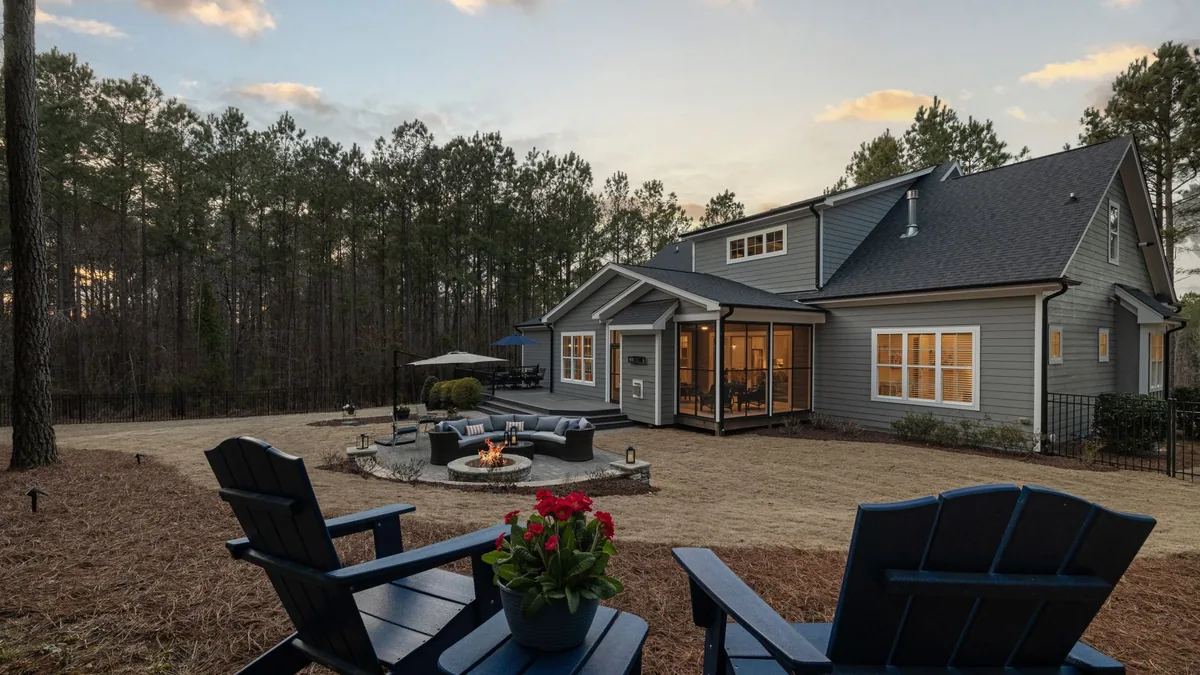
The smoke follows you around the circle whichever chair you take, or the fire pit is unboxed before anyone checks whether the yard is even big enough for it. The second one catches people out because the numbers depend on who writes them: they run from 3 feet from the house in national safety guidance (the US Fire Administration’s flyer) to 25 feet for a recreational fire under the fire code one Colorado city applies. Below: where a fire pit may go, how the three types compare, then setup, lighting and putting it out.
The short answer
| Type | Smoke | Fuel | Setup | Rules to check |
|---|---|---|---|---|
| Wood-burning | Yes; damp or unseasoned wood smokes more | Seasoned firewood; below 20% moisture burns best (EPA stove guidance) | Level ground; a manufactured pit or one lined with brick, rock, concrete or heavy-gauge metal; a metal spark screen | Your local rule (guidance and code on the sheets here: 3 to 25 ft); burn bans; smoke complaints |
| Smokeless wood (Breeo X Series) | Significantly less than a conventional pit when built right, never guaranteed smoke-free | Dry, split wood cut to the pit’s length | Outdoors only; level, fireproof surface such as rock, stone or dirt; never a wood or composite deck, stamped concrete or any heat-sensitive surface | The same as any wood fire (our reading) |
| Propane (Outland Cypress) | No wood burned, so no wood smoke (our reading) | A 20 lb cylinder: 7 to 11 hours at up to 58,000 Btu/h | Outdoors only: it can give off carbon monoxide; non-combustible surface; 36 in to the sides and 80 in overhead clear; tank 36 in away; leak test (check your own model’s manual) | Ask whether the local distance rule covers gas; may be allowed in some burn bans |
Where are you allowed to put a fire pit?
Start here, because the rule can cross a type off your list. Three official sheets put the distance from the house anywhere from 3 to 25 feet, and only one of them is code:
- 3 feet (safety guidance): the US Fire Administration’s backyard flyer, national advice rather than a local law, says to make sure a fire pit, permanent or portable, is at least three feet from your house and anything that can burn.
- 10 feet (safety guidance): Albany, New York’s fire department tips (compiled from This Old House, HGTV, NFPA and Ready WV) tell residents to build the fire pit at least 10 feet from the home, fences, trees and the like.
- 15 or 25 feet (code): Aurora Fire Rescue’s sheet in Colorado quotes the edition of the International Fire Code the city has adopted. It classes self-contained fire pits, chimineas and outdoor fireplaces as portable outdoor fireplaces: used according to the manufacturer’s instructions and at least 15 feet from a structure or combustible material. Recreational fires, which the same sheet labels “(fire pits)”, may not be within 25 feet and are limited to 3 feet across and 2 feet high. Which number covers your pit is the fire department’s call (our reading: 15 for a manufactured pit, 25 for an open fire).
Your own fire department’s rule is the one that counts: check it before you buy, and ask your landlord or homeowners’ association too (our suggestion). The three sheets here don’t treat gas fire pits separately, so ask about propane by name.
Two more things decide whether you can light it on a given night:
- Smoke and weather. Under the fire code text in Aurora’s sheet, open burning that is offensive or objectionable because of smoke, or hazardous because of weather or local conditions, is prohibited, including Red Flag days and Air Quality Index days of red or higher. Albany’s tips advise against windy days and say to check the wind direction before you light. In both cities fire officials can order a hazardous fire put out.
- Burn bans. Bans are set by each jurisdiction and differ each time; in one propane-pit maker’s description, a partial ban allows open fires only at certain hours and a full ban not at all. Check the rules in force each time, not the last ban’s.
What this rules out. If your rule is 25 feet and your yard can’t give that, an open wood fire is out (our reading); a manufactured pit at 15 feet, if your fire department agrees it counts as a portable outdoor fireplace, or a propane pit it allows, may still fit. Measure to the house, fences, sheds and trees first (our suggestion).
Wood, smokeless or propane: which suits your yard?
| Wood-burning | Smokeless wood (Breeo X Series) | Propane (Outland Cypress) | |
|---|---|---|---|
| Heat | As big as the fire you build, within any local size limit (our reading) | Built to burn hot; a hot fire is what cuts the smoke | Adjustable dial; 58,000 Btu/h maximum |
| Fuel | Seasoned wood, below 20% moisture | Dry split wood: 14–16 in logs for the X19, 16–18 in for the X24 | 20 lb cylinder, 7–11 hours |
| Upkeep | Cool the ashes, then clear them | Empty the ash after every 3–4 fires | Check hose, burner and spider webs before each use; leak test once a year and whenever the cylinder or any gas part is taken apart, serviced or replaced; inspection at least yearly by a qualified service person |
A wood-burning fire pit
- Wood. In the EPA’s archived Burn Wise guidance for wood stoves and fireplaces, wood burns best at under 20 percent moisture: season it for at least six months, stored outdoors off the ground with only the top covered, and check it with a moisture meter. Among the things the same stove guidance lists not to burn: household trash (including cardboard, plastics and foam), coated, painted or pressure-treated wood, plywood, particle board or any wood with glue on or in it, ocean driftwood, wet or moldy wood, and plastic, rubber and asbestos. Soft woods such as pine or cedar can pop and throw sparks, so Albany’s tips advise avoiding them.
- Sparks. Use a metal screen over a wood fire (US Fire Administration).
- A built-in pit. In Albany’s definition, a permanently built fire pit must be made or completely lined with a non-combustible material such as brick, rock, concrete or heavy-gauge metal, and river stones should be avoided: smooth stones from river beds may have absorbed moisture and can heat rapidly and explode. Use dry, rough stones instead. A portable pit should be commercially made and assembled and used according to its instructions; for a masonry kit, follow its instructions (our suggestion).
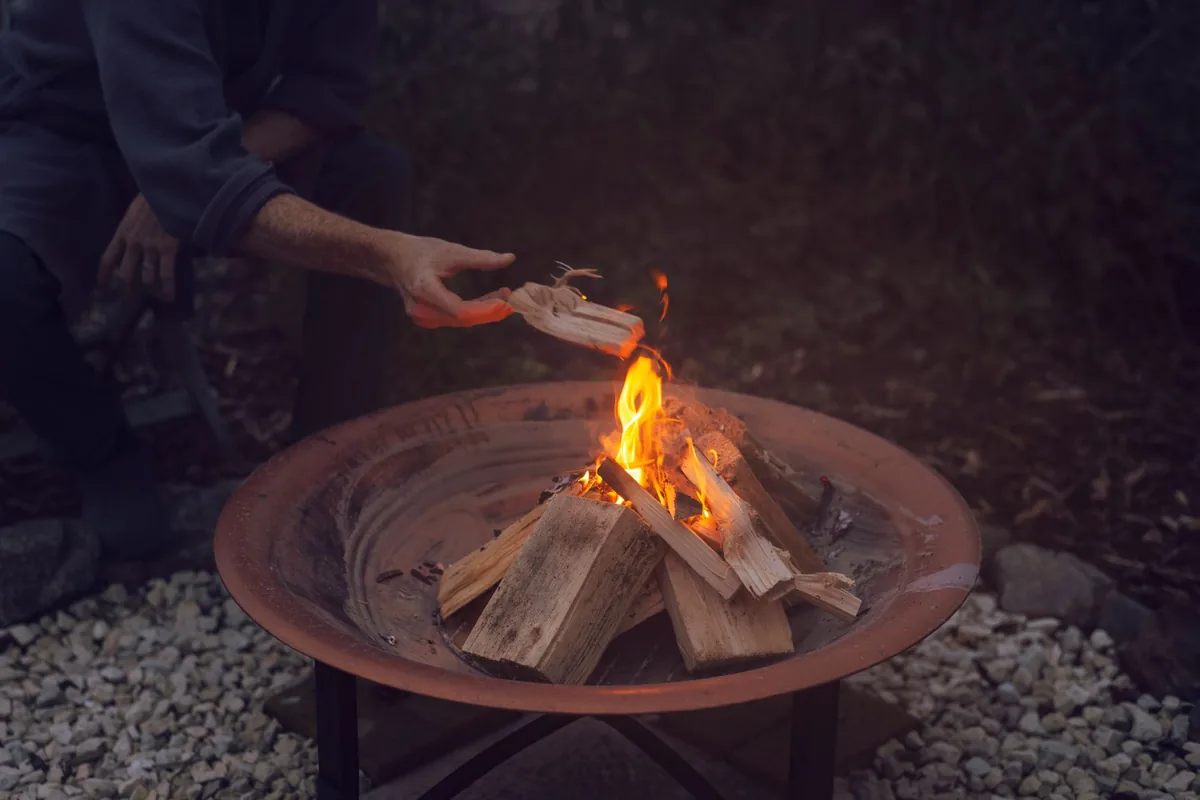
A smokeless fire pit
Smokeless pits such as Breeo’s, the one design read here, are double-walled steel and still burn wood. Air heated between the walls leaves through holes around the rim and mixes with the smoke to reburn it. Breeo can’t guarantee its pits will never produce any smoke, only that built properly they produce significantly less than a conventional fire pit.
So the fire you build matters. Breeo’s tips: start with a fire starter or dry shreds of paper or cardboard, add kindling, then split logs 3 to 4 inches thick one at a time, stacked log-cabin style; begin small, because big logs make the fire burn cooler; keep the fire hot and spread evenly; and burn only wood that has been dried. The EPA’s stove guidance lists cardboard among things not to burn, so plain paper avoids the question (our suggestion). Empty the ash after every 3 or 4 fires, because a buildup can block the airflow at the bottom and make the fire smokier.
If you choose this type: the Breeo X Series Smokeless Fire Pit comes in four sizes; Breeo pitches the X19 at small patios and the X24 at most backyards. The X19 is 22 inches across the outside, weighs 47 lb and takes logs 14 to 16 inches long; the X24 is 27.5 inches across, weighs 62 lb and takes 16 to 18 inch logs. In Corten steel the X19 is $399 and the X24 $599 at 11 October 2026 prices (price for reference only); stainless steel costs more. Its drawback is the surface rule in the setup section: it is not for a deck, stamped concrete or any heat-sensitive surface.
A propane fire pit
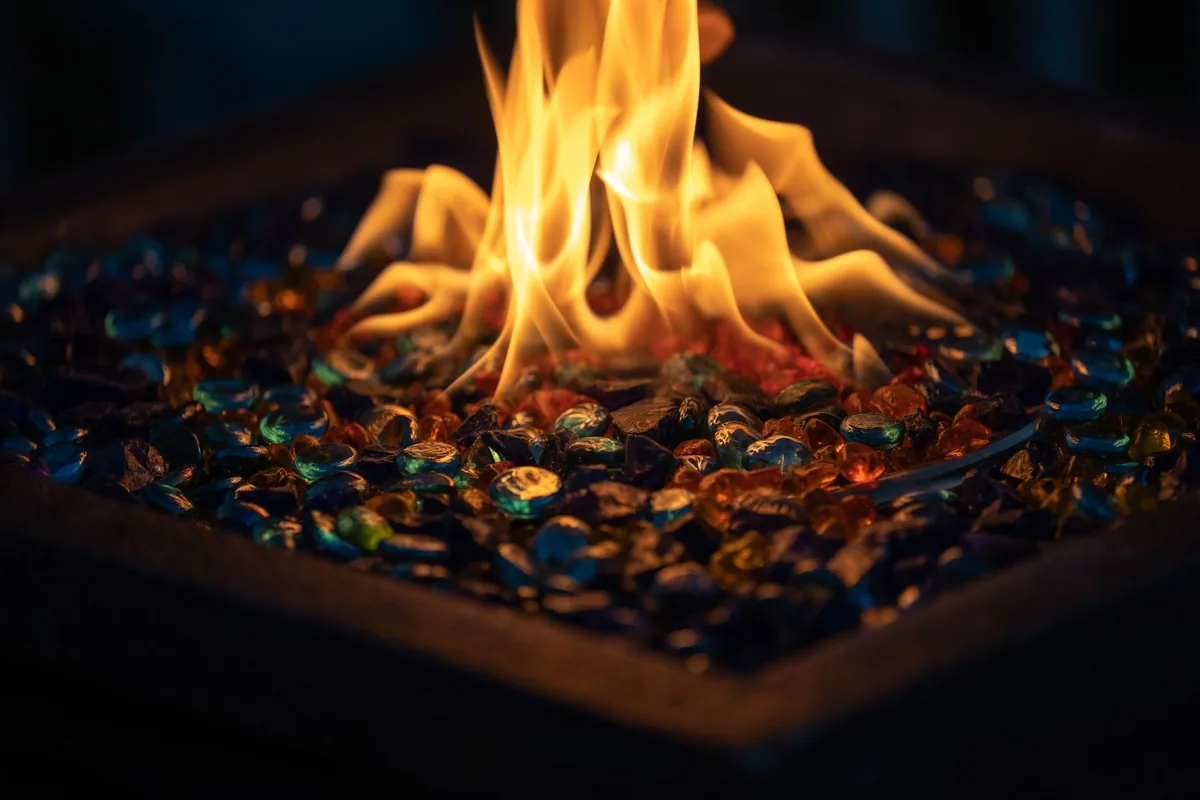
No wood or ash, and a flame on a dial (our reading); the trade-offs are the clearances, a tank to place and refill, never filled beyond 80 percent full per the Cypress manual, and a leak test.
If you choose this type: the Outland Living Cypress Fire Pit is a 21-inch propane bowl, 9 inches high and 26 lb with its lava rocks, rated at 58,000 Btu/h. It runs on a 20 lb cylinder on a 10-foot hose and is lit by hand. A full cylinder lasts 7 to 11 hours, depending on the flame height. It costs $200 at 11 October 2026 prices (price for reference only). Drawbacks: it isn’t to be left out in the rain, and the tank and hose on the ground are a trip hazard to plan around.
Natural gas instead of a tank. As shipped, the Cypress must not be connected to a remote gas supply. Outland sells a natural gas conversion kit for it (Model 781), whose own instructions aren’t covered here; converting it and running a gas line are jobs for a qualified installer, service agency or the gas supplier, the people the manual names for installation and service.
How do I set up a fire pit safely?
- Pick an outdoor spot. Both pits here are outdoor-only: never use either in a building, garage or any enclosed area. The Cypress can give off carbon monoxide, which has no odour; in its manual’s words, “Using it in an enclosed space can kill you.” Then meet your local distance rule and your pit’s own clearances. Nothing combustible overhead: the Cypress is not to be used under overhead combustible surfaces and needs 80 inches clear above and 36 inches to the sides. Keep clear of fences and trees.
- Get the surface right. The X Series goes on a level, fireproof surface such as rock, stone or dirt, and never on wooden or composite decks, stamped concrete or any heat-sensitive surface. Breeo also sells a Base, and a Deck Bundle that includes it, marketed for wood and composite decks; the user guide still says never on a deck, with no exception for the Base, and its warranty excludes damage to a patio or deck surface. Treat a deck as off-limits for this pit unless Breeo confirms otherwise in writing (our suggestion). The Cypress needs a non-combustible surface and must never be used in tall grass. A level surface also reduces the risk of a fire escaping the pit, per Albany’s tips.
- Leave room around it. Keep children and pets at least 3 feet from the fire, per Albany’s tips, and place chairs so people can get up without stepping near it (our suggestion). For outdoor chairs and walking room around them, see our patio furniture guide.
- Have something to put it out with. Keep at least one portable fire extinguisher rated 4-A or more ready, or other approved equipment such as dirt, sand, a water barrel or a garden hose: that is the fire code text in Aurora’s sheet, and Albany’s tips name an extinguisher, garden hose or bucket of sand. If you can’t put a fire out quickly, call 9-1-1.
- For propane: connect the tank and test for leaks. Keep gasoline and other flammable liquids away from the propane pit.
- Before connecting, arrange the supplied lava rocks in the burner as the manual shows (medium rocks first, large ones on top) and inspect the hose.
- With the cylinder valve and the fire pit’s knob both off, set the cylinder in its stabilizer ring at least 36 inches from the bowl, hose stretched out, untwisted and out of the walkway. No spare cylinder under or near the fire pit.
- Connect the regulator by turning its hand wheel clockwise until it stops: hand-tight only, no tools, held straight so it doesn’t cross-thread.
- Leak test with no flame, spark or other source of ignition nearby, smoking included: mix half liquid detergent and half water.
- Open the cylinder valve slowly, then brush the solution on the fire pit valve coupling, the hose regulator and the cylinder valve coupling.
- Bubbles or a smell of gas: immediately close the cylinder valve, wait 5 minutes, then tighten the joint or replace the part. Don’t use the fire pit until the leak is fixed. If you can’t stop it, keep the cylinder valve shut or take the cylinder off until it is fixed, and call a gas appliance repairman or your LP gas dealer.
- Repeat the test each time you connect a cylinder, once a year, and whenever any other gas part is taken apart, serviced or replaced.
How do I light it, use it and put it out?
Every fire. Never leave a fire pit unattended: under the fire code text in Aurora’s sheet, a fire must be attended until it is out. Put the fire out before you leave the backyard, watch children closely, and keep matches and lighters out of their sight and reach (US Fire Administration). Don’t wear flammable clothing such as nylon, or anything loose-fitting (Albany’s tips).
If you smell gas at a propane pit. Shut off the gas to the appliance and put out any open flame. If the smell continues, leave the area immediately, then call your gas supplier or the fire department (the DANGER notice in the Cypress manual).
Lighting wood. Start with dry kindling that stays inside the edge of the pit; never gasoline, kerosene or lighter fluid, which can push a fire out of control quickly (Albany’s tips). The EPA’s stove guidance also suggests newspaper or all-natural fire starters.
Lighting propane (the Cypress steps).
- Before every use, inspect the hose and replace it if it is worn, abraded or damaged, inspect the burner, and clear the valve and gas openings of debris, spider webs included: insects can nest in the burner tube and cause a back-flame.
- Put nothing in the bowl but the supplied rocks: no wood, nothing else. Don’t use it if any part has been under water; immediately call a qualified service technician to inspect it and replace any part of the control system and any gas control that was under water.
- Check the fire pit’s knob is off (push and turn it clockwise until it stops), then, if the cylinder valve is closed, open it slowly: opening it fast, or with the knob left open, can trip the excess-flow safety device in the regulator. Keep your body, clothing and anything combustible out from above the burner before, during and after lighting.
- Light a lighter or match, hold the flame slightly above the burner, and slowly open the fire pit’s valve counter-clockwise until it lights. Then set the flame height.
- If you see no flame, immediately turn the fire pit’s valve off and repeat the lighting steps.
Putting out wood. Douse the fire with water, then gently stir and spread the ashes so they cool. Albany’s tips say to leave only once the ashes are cool; Breeo’s guide says never touch ashes or coals to check, so keep dousing and stirring until no hiss, steam or glowing embers remain, and keep watching until they have cooled before you leave (our suggestion). On the X Series, don’t move or store the pit until all ashes and coals are out and all surfaces have cooled completely, and don’t snuff the fire with its lid, which can damage the lid. Cooled ashes go in a covered metal container stored outdoors on a non-combustible surface, the EPA’s advice for stove ash.
Turning off propane. On the Cypress, close the cylinder valve first, then turn the fire pit’s knob to off. Wait at least 5 minutes before relighting and at least 30 minutes before moving or handling the bowl, and never use the lid to put out the flame. The rocks are hot: never handle them until they have cooled, and never rearrange them while it is lit. Store a disconnected cylinder outdoors in a well-ventilated place out of children’s reach, with its valve plug tightly in; never in a building, garage or any other enclosed area, and never under or near the fire pit. More guides for the yard are in patio and garden.
Where these numbers come from
Distances and safety advice come from the US Fire Administration flyer, Albany’s fire department tips, Aurora Fire Rescue’s code sheet and the EPA’s archived Burn Wise page. Product details and steps come from the Breeo and Outland Living pages and manuals linked above, read on 11 October 2026, with prices shown without a code.
Frequently asked questions
How far should a fire pit be from the house?
Distances run from 3 feet (US Fire Administration guidance) and 10 feet (Albany, New York fire department tips) to 15 or 25 feet under the fire code Aurora, Colorado applies: 15 for a portable outdoor fireplace, 25 for a recreational fire, which Aurora's sheet also labels fire pits (our reading: a manufactured pit is the 15; confirm with Aurora Fire Rescue). Your own fire department's rule is the one that counts, plus your pit's manual clearances.
Are smokeless fire pits really smokeless?
Not completely. Breeo, whose double-walled design is the one read here, can't guarantee its pits will never produce any smoke; built properly, they produce 'significantly less smoke than a conventional fire pit'. The amount depends greatly on how well the fire is built: dry wood, small pieces first, a hot fire.
Can I put a fire pit on a wood deck?
Not these two models. Per its user guide, the Breeo X Series is never to be used on wooden or composite decks, stamped concrete or any heat-sensitive surface, and the Outland Cypress is for non-combustible floors only. Breeo's Base and Deck Bundle don't change the guide's never, so treat a deck as off-limits for the X Series unless Breeo confirms otherwise in writing (our suggestion).
Can I use a propane fire pit during a burn ban?
Sometimes. Outland lists its Cypress as CSA approved and 'safe to use during most fire bans'. But bans differ from place to place and, in British Columbia's wording quoted in Outland's burn ban guide, may cover gas appliances too in extreme fire conditions, so check the rules in force before you light it.
- #fire pit
- #backyard ideas
- #outdoor heating